

12. Assessing Ecosystem-Level Water Relations Through Stable Isotope Ratio Analyses
185
Soil, Leaf, and Stem Water Extraction
Water is extracted from the bulk sample by cryogenic extraction. The entire frozen leaf, stem, or
soil sample along with the vial is placed into the
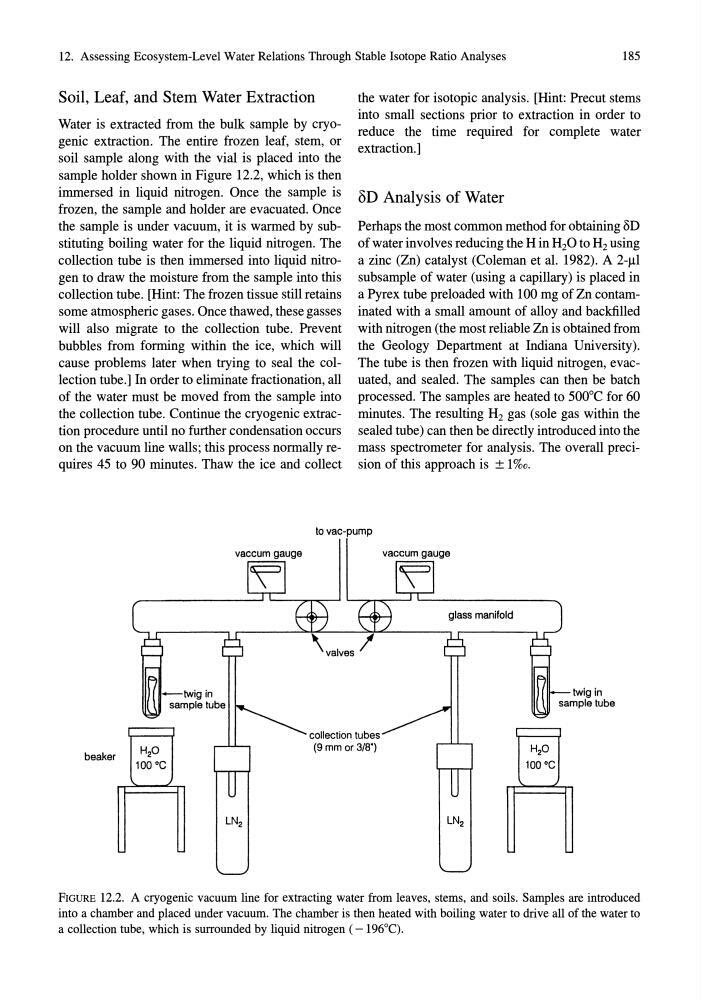
sample holder shown in Figure 12.2, which is then
immersed in liquid nitrogen. Once the sample is
frozen, the sample and holder are evacuated. Once
the sample is under vacuum, it is warmed by substituting boiling water for the liquid nitrogen. The
collection tube is then immersed into liquid nitrogen to draw the moisture from the sample into this
collection tube. [Hint: The frozen tissue still retains
some atmospheric gases. Once thawed, these gasses
will also migrate to the collection tube. Prevent
bubbles from forming within the ice, which will
cause problems later when trying to seal the collection tube.] In order to eliminate fractionation, all
of the water must be moved from the sample into
the collection tube. Continue the cryogenic extraction procedure until no further condensation occurs
on the vacuum line walls; this process normally requires 45 to 90 minutes. Thaw the ice and collect
the water for isotopic analysis. [Hint: Precut stems
into small sections prior to extraction in order to
reduce the time required for complete water
extraction.]
oD Analysis of Water
Perhaps the most common method for obtaining 8D
of water involves reducing the H in H20 to H2 using
a zinc (Zn) catalyst (Coleman et al. 1982). A 2-JlI
subsample of water (using a capillary) is placed in
a Pyrex tube preloaded with 100 mg of Zn contaminated with a small amount of alloy and backfilled
with nitrogen (the most reliable Zn is obtained from
the Geology Department at Indiana University).
The tube is then frozen with liquid nitrogen, evacuated, and sealed. The samples can then be batch
processed. The samples are heated to 500°C for 60
minutes. The resulting H2 gas (sole gas within the
sealed tube) can then be directly introduced into the
mass spectrometer for analysis. The overall precision of this approach is ± 1 %0.
to vac-pump
vaccum gauge
beaker
vaccum gauge
twig in
sample tube
FIGURE 12.2. A cryogenic vacuum line for extracting water from leaves, stems, and soils. Samples are introduced
into a chamber and placed under vacuum. The chamber is then heated with boiling water to drive all of the water to
a collection tube, which is surrounded by liquid nitrogen (- 196°C).
185
Soil, Leaf, and Stem Water Extraction
Water is extracted from the bulk sample by cryogenic extraction. The entire frozen leaf, stem, or
soil sample along with the vial is placed into the
sample holder shown in Figure 12.2, which is then
immersed in liquid nitrogen. Once the sample is
frozen, the sample and holder are evacuated. Once
the sample is under vacuum, it is warmed by substituting boiling water for the liquid nitrogen. The
collection tube is then immersed into liquid nitrogen to draw the moisture from the sample into this
collection tube. [Hint: The frozen tissue still retains
some atmospheric gases. Once thawed, these gasses
will also migrate to the collection tube. Prevent
bubbles from forming within the ice, which will
cause problems later when trying to seal the collection tube.] In order to eliminate fractionation, all
of the water must be moved from the sample into
the collection tube. Continue the cryogenic extraction procedure until no further condensation occurs
on the vacuum line walls; this process normally requires 45 to 90 minutes. Thaw the ice and collect
the water for isotopic analysis. [Hint: Precut stems
into small sections prior to extraction in order to
reduce the time required for complete water
extraction.]
oD Analysis of Water
Perhaps the most common method for obtaining 8D
of water involves reducing the H in H20 to H2 using
a zinc (Zn) catalyst (Coleman et al. 1982). A 2-JlI
subsample of water (using a capillary) is placed in
a Pyrex tube preloaded with 100 mg of Zn contaminated with a small amount of alloy and backfilled
with nitrogen (the most reliable Zn is obtained from
the Geology Department at Indiana University).
The tube is then frozen with liquid nitrogen, evacuated, and sealed. The samples can then be batch
processed. The samples are heated to 500°C for 60
minutes. The resulting H2 gas (sole gas within the
sealed tube) can then be directly introduced into the
mass spectrometer for analysis. The overall precision of this approach is ± 1 %0.
to vac-pump
vaccum gauge
beaker
vaccum gauge
twig in
sample tube
FIGURE 12.2. A cryogenic vacuum line for extracting water from leaves, stems, and soils. Samples are introduced
into a chamber and placed under vacuum. The chamber is then heated with boiling water to drive all of the water to
a collection tube, which is surrounded by liquid nitrogen (- 196°C).