

182
James R. Ehleringer, John Roden, and Todd E. Dawson
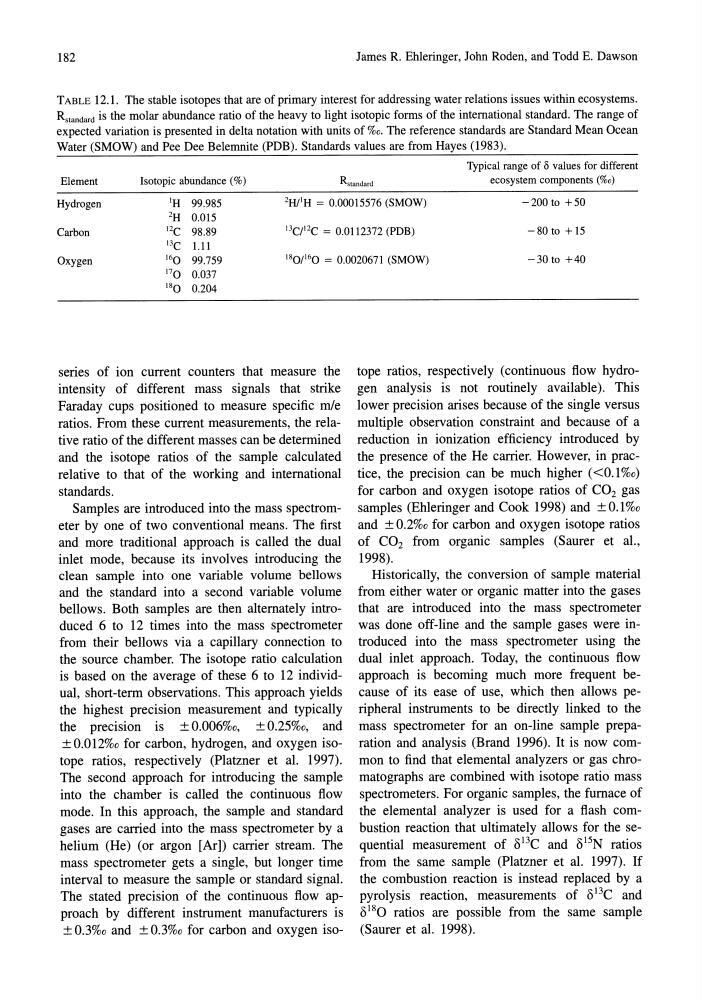
TABLE 12.1. The stable isotopes that are of primary interest for addressing water relations issues within ecosystems.
Rstandard is the molar abundance ratio of the heavy to light isotopic forms of the international standard. The range of
expected variation is presented in delta notation with units of %0. The reference standards are Standard Mean Ocean
Water (SMOW) and Pee Dee Belemnite (PDB). Standards values are from Hayes (1983).
Typical range of /) values for different
Element
Isotopic abundance (%)
Rstandard
ecosystem components (%0)
Hydrogen
IH 99.985
2H/ I H = 0.00015576 (SMOW)
-200 to +50
2H 0.015
Carbon
12C 98.89
l3C/IZC = 0.0112372 (PDB)
-80 to + 15
l3C 1.11
Oxygen
16 0 99.759
18 0/ 16 0 = 0.0020671 (SMOW)
-30 to +40
17 0 0.037
18 0 0.204
series of ion current counters that measure the
intensity of different mass signals that strike
Faraday cups positioned to measure specific mJe
ratios. From these current measurements, the relative ratio of the different masses can be determined
and the isotope ratios of the sample calculated
relative to that of the working and international
standards.
Samples are introduced into the mass spectrometer by one of two conventional means. The first
and more traditional approach is called the dual
inlet mode, because its involves introducing the
clean sample into one variable volume bellows
and the standard into a second variable volume
bellows. Both samples are then alternately introduced 6 to 12 times into the mass spectrometer
from their bellows via a capillary connection to
the source chamber. The isotope ratio calculation
is based on the average of these 6 to 12 individual, short-term observations. This approach yields
the highest precision measurement and typically
the precision is ± 0.006%0, ± 0.25%0, and
±0.012%0 for carbon, hydrogen, and oxygen isotope ratios, respectively (Platzner et al. 1997).
The second approach for introducing the sample
into the chamber is called the continuous flow
mode. In this approach, the sample and standard
gases are carried into the mass spectrometer by a
helium (He) (or argon [ArD carrier stream. The
mass spectrometer gets a single, but longer time
interval to measure the sample or standard signal.
The stated precision of the continuous flow approach by different instrument manufacturers is
± 0.3%0 and ± 0.3%0 for carbon and oxygen isotope ratios, respectively (continuous flow hydrogen analysis is not routinely available). This
lower precision arises because of the single versus
multiple observation constraint and because of a
reduction in ionization efficiency introduced by
the presence of the He carrier. However, in practice, the precision can be much higher «0.1%0)
for carbon and oxygen isotope ratios of CO 2 gas
samples (Ehleringer and Cook 1998) and ±0.1%0
and ± 0.2%0 for carbon and oxygen isotope ratios
of CO 2 from organic samples (Saurer et al.,
1998).
Historically, the conversion of sample material
from either water or organic matter into the gases
that are introduced into the mass spectrometer
was done off-line and the sample gases were introduced into the mass spectrometer using the
dual inlet approach. Today, the continuous flow
approach is becoming much more frequent because of its ease of use, which then allows peripheral instruments to be directly linked to the
mass spectrometer for an on-line sample preparation and analysis (Brand 1996). It is now common to find that elemental analyzers or gas chromatographs are combined with isotope ratio mass
spectrometers. For organic samples, the furnace of
the elemental analyzer is used for a flash combustion reaction that ultimately allows for the sequential measurement of 013C and 015N ratios
from the same sample (Platzner et al. 1997). If
the combustion reaction is instead replaced by a
pyrolysis reaction, measurements of 013C and
0 18 0 ratios are possible from the same sample
(Saurer et al. 1998).
James R. Ehleringer, John Roden, and Todd E. Dawson
TABLE 12.1. The stable isotopes that are of primary interest for addressing water relations issues within ecosystems.
Rstandard is the molar abundance ratio of the heavy to light isotopic forms of the international standard. The range of
expected variation is presented in delta notation with units of %0. The reference standards are Standard Mean Ocean
Water (SMOW) and Pee Dee Belemnite (PDB). Standards values are from Hayes (1983).
Typical range of /) values for different
Element
Isotopic abundance (%)
Rstandard
ecosystem components (%0)
Hydrogen
IH 99.985
2H/ I H = 0.00015576 (SMOW)
-200 to +50
2H 0.015
Carbon
12C 98.89
l3C/IZC = 0.0112372 (PDB)
-80 to + 15
l3C 1.11
Oxygen
16 0 99.759
18 0/ 16 0 = 0.0020671 (SMOW)
-30 to +40
17 0 0.037
18 0 0.204
series of ion current counters that measure the
intensity of different mass signals that strike
Faraday cups positioned to measure specific mJe
ratios. From these current measurements, the relative ratio of the different masses can be determined
and the isotope ratios of the sample calculated
relative to that of the working and international
standards.
Samples are introduced into the mass spectrometer by one of two conventional means. The first
and more traditional approach is called the dual
inlet mode, because its involves introducing the
clean sample into one variable volume bellows
and the standard into a second variable volume
bellows. Both samples are then alternately introduced 6 to 12 times into the mass spectrometer
from their bellows via a capillary connection to
the source chamber. The isotope ratio calculation
is based on the average of these 6 to 12 individual, short-term observations. This approach yields
the highest precision measurement and typically
the precision is ± 0.006%0, ± 0.25%0, and
±0.012%0 for carbon, hydrogen, and oxygen isotope ratios, respectively (Platzner et al. 1997).
The second approach for introducing the sample
into the chamber is called the continuous flow
mode. In this approach, the sample and standard
gases are carried into the mass spectrometer by a
helium (He) (or argon [ArD carrier stream. The
mass spectrometer gets a single, but longer time
interval to measure the sample or standard signal.
The stated precision of the continuous flow approach by different instrument manufacturers is
± 0.3%0 and ± 0.3%0 for carbon and oxygen isotope ratios, respectively (continuous flow hydrogen analysis is not routinely available). This
lower precision arises because of the single versus
multiple observation constraint and because of a
reduction in ionization efficiency introduced by
the presence of the He carrier. However, in practice, the precision can be much higher «0.1%0)
for carbon and oxygen isotope ratios of CO 2 gas
samples (Ehleringer and Cook 1998) and ±0.1%0
and ± 0.2%0 for carbon and oxygen isotope ratios
of CO 2 from organic samples (Saurer et al.,
1998).
Historically, the conversion of sample material
from either water or organic matter into the gases
that are introduced into the mass spectrometer
was done off-line and the sample gases were introduced into the mass spectrometer using the
dual inlet approach. Today, the continuous flow
approach is becoming much more frequent because of its ease of use, which then allows peripheral instruments to be directly linked to the
mass spectrometer for an on-line sample preparation and analysis (Brand 1996). It is now common to find that elemental analyzers or gas chromatographs are combined with isotope ratio mass
spectrometers. For organic samples, the furnace of
the elemental analyzer is used for a flash combustion reaction that ultimately allows for the sequential measurement of 013C and 015N ratios
from the same sample (Platzner et al. 1997). If
the combustion reaction is instead replaced by a
pyrolysis reaction, measurements of 013C and
0 18 0 ratios are possible from the same sample
(Saurer et al. 1998).