

6. Benthic Respiration in Aquatic Sediments
87
TABLE 6.1. Generalized stoichiometries of carbon mineralization pathways in sediments.
dation is an essential part of manganese, iron, and
sulfur cycles in sediments where typically 90% or
more of the reduced species produced during mineralization are recycled (J\'irgensen 1982; Canfield
et al. 1993b; Thamdrup et al. 1994a). Also, a large
part of the ammonia formed is nitrified to nitrate.
Thus, a substantial amount of electron acceptor utilization may be coupled to reoxidation. No methods
are available for the direct, separate quantification
of organotrophic, lithotrophic, and abiotic consumption of electron acceptors, and it is a major
challenge in the measurement of benthic respiration
to distinguish among these different types of
processes.
Oxygen respiration:
Denitrification:
Manganese reduction:
Iron reduction:
Sulfate reduction:
2CH20 + SO~- ---; 2HCO; + 2HS -
Methanogenesis:
Water
In this paper, we review methods for the quantification of total rates of benthic mineralization as
well as of the individual respiratory pathways. Our
emphasis is on the conditions met on the continental margins from coast to slope, but the application
of the methods to freshwater and deep-sea sediments is also discussed. We further focus on direct
experimental techniques rather than quantifications
------cr.-N0 3 -
Sediment
Burial:
__ ---o-~I ~Mnlll, IV
--""-----'-.....~ Felli
Org. matter
Fell. I -----"'!!~===:/:=:=;;:::;~
S-II . . ----~~======~I
+
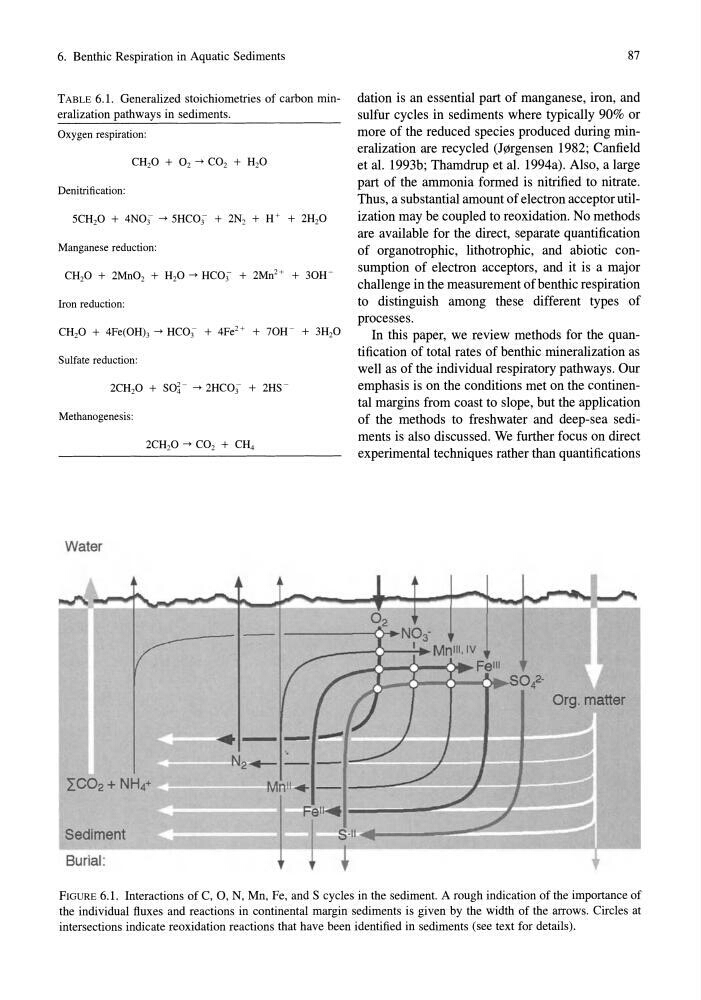
FIGURE 6.l. Interactions of C, 0, N, Mn, Fe, and S cycles in the sediment. A rough indication of the importance of
the individual fluxes and reactions in continental margin sediments is given by the width of the arrows. Circles at
intersections indicate reoxidation reactions that have been identified in sediments (see text for details).
87
TABLE 6.1. Generalized stoichiometries of carbon mineralization pathways in sediments.
dation is an essential part of manganese, iron, and
sulfur cycles in sediments where typically 90% or
more of the reduced species produced during mineralization are recycled (J\'irgensen 1982; Canfield
et al. 1993b; Thamdrup et al. 1994a). Also, a large
part of the ammonia formed is nitrified to nitrate.
Thus, a substantial amount of electron acceptor utilization may be coupled to reoxidation. No methods
are available for the direct, separate quantification
of organotrophic, lithotrophic, and abiotic consumption of electron acceptors, and it is a major
challenge in the measurement of benthic respiration
to distinguish among these different types of
processes.
Oxygen respiration:
Denitrification:
Manganese reduction:
Iron reduction:
Sulfate reduction:
2CH20 + SO~- ---; 2HCO; + 2HS -
Methanogenesis:
Water
In this paper, we review methods for the quantification of total rates of benthic mineralization as
well as of the individual respiratory pathways. Our
emphasis is on the conditions met on the continental margins from coast to slope, but the application
of the methods to freshwater and deep-sea sediments is also discussed. We further focus on direct
experimental techniques rather than quantifications
------cr.-N0 3 -
Sediment
Burial:
__ ---o-~I ~Mnlll, IV
--""-----'-.....~ Felli
Org. matter
Fell. I -----"'!!~===:/:=:=;;:::;~
S-II . . ----~~======~I
+
FIGURE 6.l. Interactions of C, 0, N, Mn, Fe, and S cycles in the sediment. A rough indication of the importance of
the individual fluxes and reactions in continental margin sediments is given by the width of the arrows. Circles at
intersections indicate reoxidation reactions that have been identified in sediments (see text for details).