

46
B. Manca et al.
12
13
14
15
16
Longitude E
17
However, a strong interaction between the shelf
and the open-sea waters may be expected, due to
the combination of topographic and baroclinic
constraints.
The main factors influencing the Adriatic
Sea's hydrography are: the fresh water buoyancy
input, coming mainly from river discharges in
the northern shelf region and leading to a southward flow of the western coastal current which
transports the diluted Adriatic surface water
(ASW); the saline water input from the Ionian
Sea, which leads to a northward flow along the
eastern coast transporting Ionian surface water
(ISW) and Levantine intermediate water (LIW);
the atmospheric forcing, which leads to a twolayer baroclinic circulation during summer and
to dense-water formation during winter. In fact,
the Adriatic Sea has been noted as an area of
convective movements and dense-water formation, namely the North Adriatic dense water
18
19
20
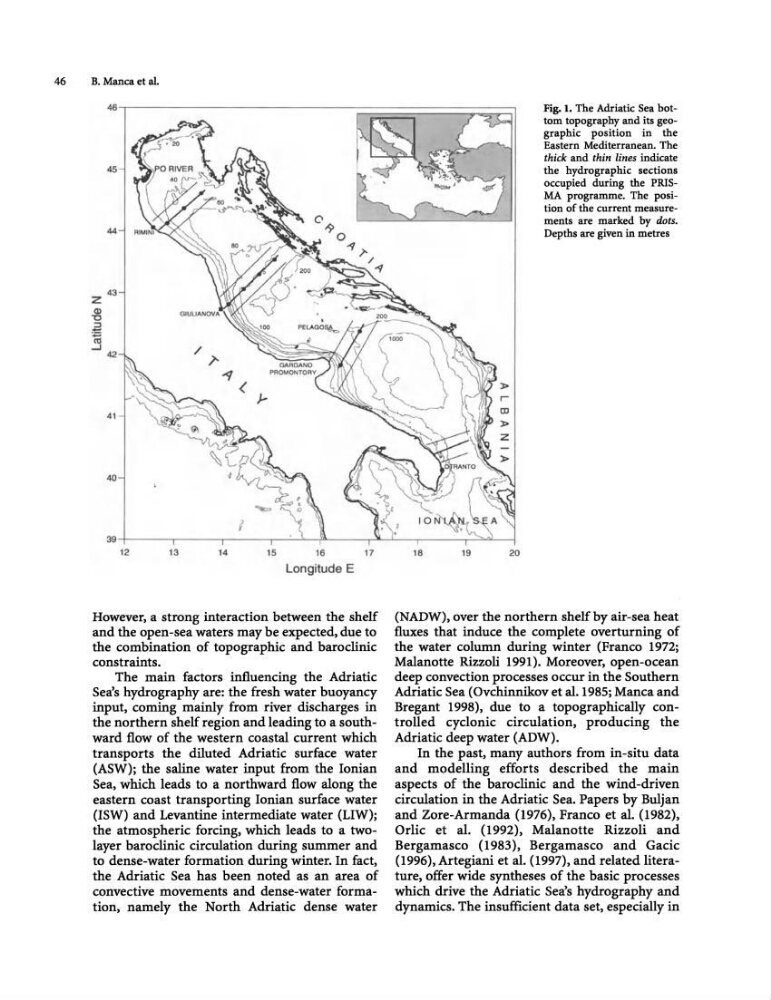
Fig. 1. The Adriatic Sea bottom topography and its geographic position in the
Eastern Mediterranean. The
thick and thin lines indicate
the hydrographic sections
occupied during the PRISMA programme. The position of the current measurements are marked by dots.
Depths are given in metres
(NADW), over the northern shelf by air-sea heat
fluxes that induce the complete overturning of
the water column during winter (Franco 1972;
Malanotte Rizzoli 1991). Moreover, open-ocean
deep convection processes occur in the Southern
Adriatic Sea (Ovchinnikov et al.1985; Manca and
Bregant 1998), due to a topographically controlled cyclonic circulation, producing the
Adriatic deep water (ADW).
In the past, many authors from in-situ data
and modelling efforts described the main
aspects of the baroclinic and the wind-driven
circulation in the Adriatic Sea. Papers by Buljan
and Zore-Armanda (1976), Franco et al. (1982).
Orlic et al. (l992), Malanotte Rizzoli and
Bergamasco (1983), Bergamasco and Gadc
(1996), Artegiani et al. (1997), and related literature, offer wide syntheses of the basic processes
which drive the Adriatic Sea's hydrography and
dynamics. The insufficient data set, especially in
B. Manca et al.
12
13
14
15
16
Longitude E
17
However, a strong interaction between the shelf
and the open-sea waters may be expected, due to
the combination of topographic and baroclinic
constraints.
The main factors influencing the Adriatic
Sea's hydrography are: the fresh water buoyancy
input, coming mainly from river discharges in
the northern shelf region and leading to a southward flow of the western coastal current which
transports the diluted Adriatic surface water
(ASW); the saline water input from the Ionian
Sea, which leads to a northward flow along the
eastern coast transporting Ionian surface water
(ISW) and Levantine intermediate water (LIW);
the atmospheric forcing, which leads to a twolayer baroclinic circulation during summer and
to dense-water formation during winter. In fact,
the Adriatic Sea has been noted as an area of
convective movements and dense-water formation, namely the North Adriatic dense water
18
19
20
Fig. 1. The Adriatic Sea bottom topography and its geographic position in the
Eastern Mediterranean. The
thick and thin lines indicate
the hydrographic sections
occupied during the PRISMA programme. The position of the current measurements are marked by dots.
Depths are given in metres
(NADW), over the northern shelf by air-sea heat
fluxes that induce the complete overturning of
the water column during winter (Franco 1972;
Malanotte Rizzoli 1991). Moreover, open-ocean
deep convection processes occur in the Southern
Adriatic Sea (Ovchinnikov et al.1985; Manca and
Bregant 1998), due to a topographically controlled cyclonic circulation, producing the
Adriatic deep water (ADW).
In the past, many authors from in-situ data
and modelling efforts described the main
aspects of the baroclinic and the wind-driven
circulation in the Adriatic Sea. Papers by Buljan
and Zore-Armanda (1976), Franco et al. (1982).
Orlic et al. (l992), Malanotte Rizzoli and
Bergamasco (1983), Bergamasco and Gadc
(1996), Artegiani et al. (1997), and related literature, offer wide syntheses of the basic processes
which drive the Adriatic Sea's hydrography and
dynamics. The insufficient data set, especially in