

486
R. La FerIa et al.
In the framework of the Prisma 2 research
programme, subproject: biogeochemical cycles,
bacterioplankton abundance, heterotrophic bacteria, aminopeptidase and respiratory activities
have been studied in the Northern Adriatic Sea.
The aim of this paper was two-fold: to describe
the changes of microbial biomass and activities
and to quantify the C fluxes through the microbial community during a two-year study period.
Previous research had shown that the hydrological features of the Northern Adriatic Sea do not
have a strong influence on the bacterial abundance but affect both the bacterial composition
and activities with consequences on the trophic
web. In fact, near the coast in low salinity and
high nutrient waters, the bacterial production
was very high. Moreover. in productive periods,
the bacterial carbon demand was supported by
phytoplankton production while, in less productive periods, it was sustained by external carbon
sources (Puddu et al.1998). In conclusion, bacteria can utilise dissolved organic carbon of
autochthonous origin, derived from primary
production, or of allochthonous origin from
river inputs (Ducklowand Carlson 1992).
.... Feb-97
30'
•
Jun-97
13·
Materials and Methods
During 1996-1998. four oceanographic cruises
were performed in June (96; 97) and February
(97; 98) on board the R/V Urania in two areas of
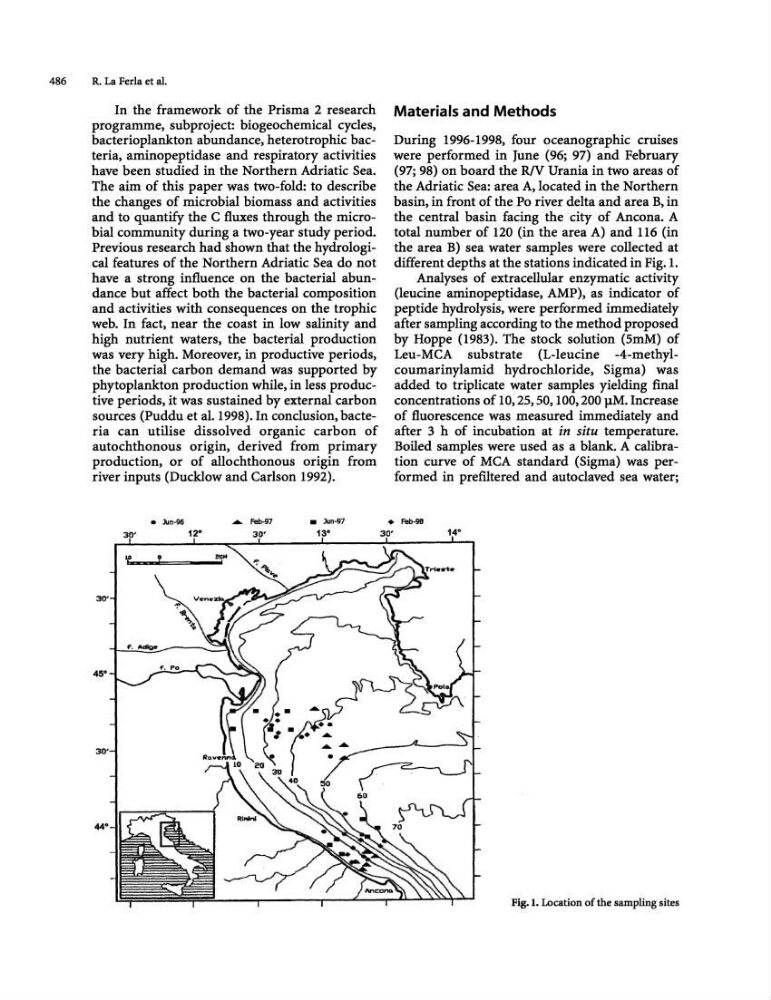
the Adriatic Sea: area A,located in the Northern
basin, in front of the Po river delta and area B, in
the central basin facing the city of Ancona. A
total number of 120 (in the area A) and 116 (in
the area B) sea water samples were collected at
different depths at the stations indicated in Fig. 1.
Analyses of extracellular enzymatic activity
(leucine aminopeptidase, AMP). as indicator of
peptide hydrolysis, were performed immediately
after sampling according to the method proposed
by Hoppe (1983). The stock solution (5mM) of
Leu-MCA substrate (L-Ieucine -4-methylcoumarinylamid hydrochloride. Sigma) was
added to triplicate water samples yielding final
concentrations of 10, 25, 50, 100,200 p.M. Increase
of fluorescence was measured immediately and
after 3 h of incubation at in situ temperature.
Boiled samples were used as a blank. A calibration curve of MCA standard (Sigma) was performed in premtered and autoclaved sea water;
• Feb-99
30'
14·
Fig. 1. Location of the sampling sites
R. La FerIa et al.
In the framework of the Prisma 2 research
programme, subproject: biogeochemical cycles,
bacterioplankton abundance, heterotrophic bacteria, aminopeptidase and respiratory activities
have been studied in the Northern Adriatic Sea.
The aim of this paper was two-fold: to describe
the changes of microbial biomass and activities
and to quantify the C fluxes through the microbial community during a two-year study period.
Previous research had shown that the hydrological features of the Northern Adriatic Sea do not
have a strong influence on the bacterial abundance but affect both the bacterial composition
and activities with consequences on the trophic
web. In fact, near the coast in low salinity and
high nutrient waters, the bacterial production
was very high. Moreover. in productive periods,
the bacterial carbon demand was supported by
phytoplankton production while, in less productive periods, it was sustained by external carbon
sources (Puddu et al.1998). In conclusion, bacteria can utilise dissolved organic carbon of
autochthonous origin, derived from primary
production, or of allochthonous origin from
river inputs (Ducklowand Carlson 1992).
.... Feb-97
30'
•
Jun-97
13·
Materials and Methods
During 1996-1998. four oceanographic cruises
were performed in June (96; 97) and February
(97; 98) on board the R/V Urania in two areas of
the Adriatic Sea: area A,located in the Northern
basin, in front of the Po river delta and area B, in
the central basin facing the city of Ancona. A
total number of 120 (in the area A) and 116 (in
the area B) sea water samples were collected at
different depths at the stations indicated in Fig. 1.
Analyses of extracellular enzymatic activity
(leucine aminopeptidase, AMP). as indicator of
peptide hydrolysis, were performed immediately
after sampling according to the method proposed
by Hoppe (1983). The stock solution (5mM) of
Leu-MCA substrate (L-Ieucine -4-methylcoumarinylamid hydrochloride. Sigma) was
added to triplicate water samples yielding final
concentrations of 10, 25, 50, 100,200 p.M. Increase
of fluorescence was measured immediately and
after 3 h of incubation at in situ temperature.
Boiled samples were used as a blank. A calibration curve of MCA standard (Sigma) was performed in premtered and autoclaved sea water;
• Feb-99
30'
14·
Fig. 1. Location of the sampling sites