

468
P. Viaroli et al.
This study has focused on the dystrophic
Sacca di Goro, the southern-most embayment of
the Po river delta, Northern Italy. Disturbance
and vulnerability of these ecosystems have been
considered particularly with respect to: (1)
trends in hydrochemical variables; (2) the
species composition, biomass, growth rates and
the elemental composition of the dominant
macrophytes; (3) nutrient uptake and nutrient
retention by the plants and the seasonality of
these processes; (4) oxygen production and consumption rates over the growth season; (5)
decomposition processes of the plant biomasses
and their influence on benthic fluxes of nitrogen,
phosphorus and sulphide. In this paper, we present trends in Ulva biomass, dissolved oxygen,
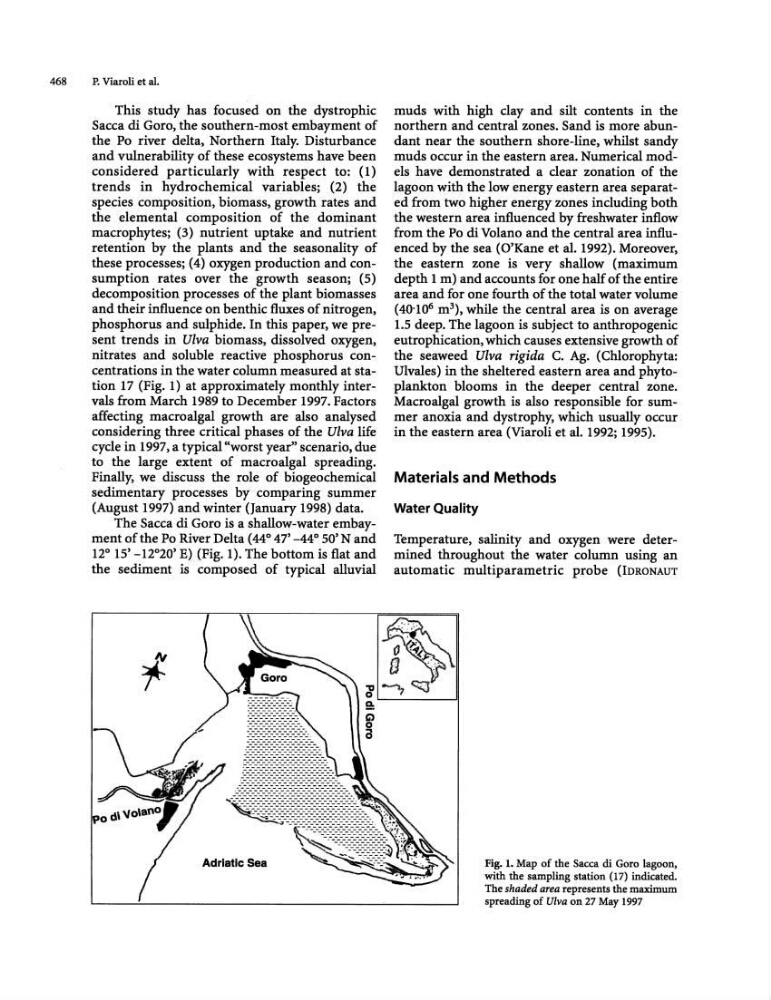
nitrates and soluble reactive phosphorus concentrations in the water column measured at station 17 (Fig. 1) at approximately monthly intervals from March 1989 to December 1997. Factors
affecting macro algal growth are also analysed
considering three critical phases of the Ulva life
cycle in 1997, a typical "worst year" scenario, due
to the large extent of macroalgal spreading.
Finally, we discuss the role of biogeochemical
sedimentary processes by comparing summer
(August 1997) and winter (January 1998) data.
The Sacca di Goro is a shallow-water embayment of the Po River Delta (44° 47' -44 0 50' Nand
12 0 15' -12°20' E) (Fig. 1). The bottom is flat and
the sediment is composed of typical alluvial
Adriatic Sea
muds with high clay and silt contents in the
northern and central zones. Sand is more abundant near the southern shore-line. whilst sandy
muds occur in the eastern area. Numerical models have demonstrated a clear zonation of the
lagoon with the low energy eastern area separated from two higher energy zones including both
the western area influenced by freshwater inflow
from the Po di Volano and the central area influenced by the sea (Q'Kane et al. 1992). Moreover,
the eastern zone is very shallow (maximum
depth 1 m) and accounts for one half of the entire
area and for one fourth of the total water volume
(40-10 6 m 3 ), while the central area is on average
1.5 deep. The lagoon is subject to anthropogenic
eutrophication, which causes extensive growth of
the seaweed Ulva rigida C. Ag. (Chlorophyta:
U1va1es) in the sheltered eastern area and phytoplankton blooms in the deeper central zone.
Macroalgal growth is also responsible for summer anoxia and dystrophy, which usually occur
in the eastern area (Viaroli et al. 1992; 1995).
Materials and Methods
Water Quality
Temperature, salinity and oxygen were determined throughout the water column using an
automatic muitiparametric probe {IDRONAUT
Fig. 1. Map of the Sacca di Goro lagoon,
with the sampling station (17) indicated.
The shaded area represents the maximum
spreading of Ulva on 27 May 1997
P. Viaroli et al.
This study has focused on the dystrophic
Sacca di Goro, the southern-most embayment of
the Po river delta, Northern Italy. Disturbance
and vulnerability of these ecosystems have been
considered particularly with respect to: (1)
trends in hydrochemical variables; (2) the
species composition, biomass, growth rates and
the elemental composition of the dominant
macrophytes; (3) nutrient uptake and nutrient
retention by the plants and the seasonality of
these processes; (4) oxygen production and consumption rates over the growth season; (5)
decomposition processes of the plant biomasses
and their influence on benthic fluxes of nitrogen,
phosphorus and sulphide. In this paper, we present trends in Ulva biomass, dissolved oxygen,
nitrates and soluble reactive phosphorus concentrations in the water column measured at station 17 (Fig. 1) at approximately monthly intervals from March 1989 to December 1997. Factors
affecting macro algal growth are also analysed
considering three critical phases of the Ulva life
cycle in 1997, a typical "worst year" scenario, due
to the large extent of macroalgal spreading.
Finally, we discuss the role of biogeochemical
sedimentary processes by comparing summer
(August 1997) and winter (January 1998) data.
The Sacca di Goro is a shallow-water embayment of the Po River Delta (44° 47' -44 0 50' Nand
12 0 15' -12°20' E) (Fig. 1). The bottom is flat and
the sediment is composed of typical alluvial
Adriatic Sea
muds with high clay and silt contents in the
northern and central zones. Sand is more abundant near the southern shore-line. whilst sandy
muds occur in the eastern area. Numerical models have demonstrated a clear zonation of the
lagoon with the low energy eastern area separated from two higher energy zones including both
the western area influenced by freshwater inflow
from the Po di Volano and the central area influenced by the sea (Q'Kane et al. 1992). Moreover,
the eastern zone is very shallow (maximum
depth 1 m) and accounts for one half of the entire
area and for one fourth of the total water volume
(40-10 6 m 3 ), while the central area is on average
1.5 deep. The lagoon is subject to anthropogenic
eutrophication, which causes extensive growth of
the seaweed Ulva rigida C. Ag. (Chlorophyta:
U1va1es) in the sheltered eastern area and phytoplankton blooms in the deeper central zone.
Macroalgal growth is also responsible for summer anoxia and dystrophy, which usually occur
in the eastern area (Viaroli et al. 1992; 1995).
Materials and Methods
Water Quality
Temperature, salinity and oxygen were determined throughout the water column using an
automatic muitiparametric probe {IDRONAUT
Fig. 1. Map of the Sacca di Goro lagoon,
with the sampling station (17) indicated.
The shaded area represents the maximum
spreading of Ulva on 27 May 1997