

DOC Seasonality in N. Adriatic and Aggregate Formation
463
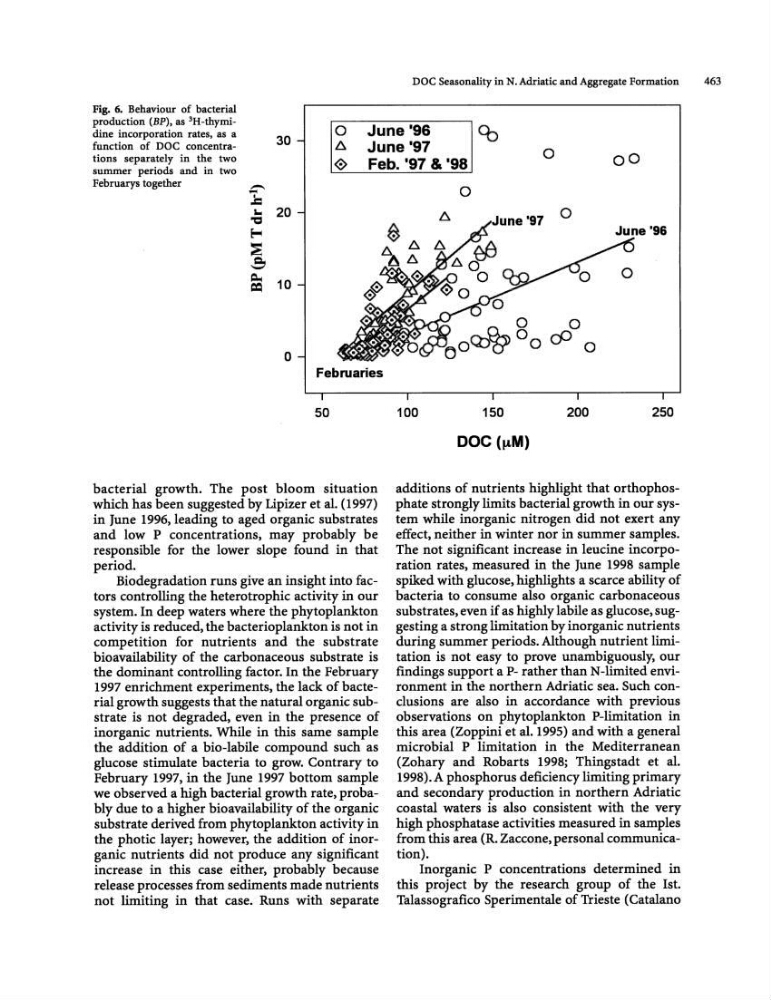
Fig. 6. Behaviour of bacterial
production (BP), as 3H-thymidine incorporation rates, as a
function of DOC concentrations separately in the two
summer periods and in two
Februarystogether
30
a
8
June "96
Cb
June '97
<:> Feb. '97 & '98
a
00
o
Februaries
50
bacterial growth. The post bloom situation
which has been suggested by Lipizer et al. (1997)
in June 1996, leading to aged organic substrates
and low P concentrations, may probably be
responsible for the lower slope found in that
period.
Biodegradation runs give an insight into factors controlling the heterotrophic activity in our
system. In deep waters where the phytoplankton
activity is reduced, the bacterioplankton is not in
competition for nutrients and the substrate
bioavailability of the carbonaceous substrate is
the dominant controlling factor. In the February
1997 enrichment experiments. the lack of bacterial growth suggests that the natural organic substrate is not degraded, even in the presence of
inorganic nutrients. While in this same sample
the addition of a bio-Iabile compound such as
glucose stimulate bacteria to grow. Contrary to
February 1997, in the June 1997 bottom sample
we observed a high bacterial growth rate, probably due to a higher bioavailability of the organic
substrate derived from phytoplankton activity in
the photic layer; however, the addition of inorganic nutrients did not produce any significant
increase in this case either, probably because
release processes from sediments made nutrients
not limiting in that case. Runs with separate
a
a
o
a
a
o~oo cP 0
100
150
200
250
DOC btM)
additions of nutrients highlight that orthophosphate strongly limits bacterial growth in our system while inorganic nitrogen did not exert any
effect, neither in winter nor in summer samples.
The not significant increase in leucine incorporation rates, measured in the June 1998 sample
spiked with glucose, highlights a scarce ability of
bacteria to consume also organic carbonaceous
substrates, even if as highly labile as glucose, suggesting a strong limitation by inorganic nutrients
during summer periods. Although nutrient limitation is not easy to prove unambiguously, our
findings support a P- rather than N-limited environment in the northern Adriatic sea. Such conclusions are also in accordance with previous
observations on phytoplankton P-limitation in
this area (Zoppini et al.1995) and with a general
microbial P limitation in the Mediterranean
(Zohary and Robarts 1998; Thingstadt et al.
1998). A phosphorus deficiency limiting primary
and secondary production in northern Adriatic
coastal waters is also consistent with the very
high phosphatase activities measured in samples
from this area (R. Zaccone, personal communication).
Inorganic P concentrations determined in
this project by the research group of the 1st.
Talassografico Sperimentale of Trieste (Catalano
463
Fig. 6. Behaviour of bacterial
production (BP), as 3H-thymidine incorporation rates, as a
function of DOC concentrations separately in the two
summer periods and in two
Februarystogether
30
a
8
June "96
Cb
June '97
<:> Feb. '97 & '98
a
00
o
Februaries
50
bacterial growth. The post bloom situation
which has been suggested by Lipizer et al. (1997)
in June 1996, leading to aged organic substrates
and low P concentrations, may probably be
responsible for the lower slope found in that
period.
Biodegradation runs give an insight into factors controlling the heterotrophic activity in our
system. In deep waters where the phytoplankton
activity is reduced, the bacterioplankton is not in
competition for nutrients and the substrate
bioavailability of the carbonaceous substrate is
the dominant controlling factor. In the February
1997 enrichment experiments. the lack of bacterial growth suggests that the natural organic substrate is not degraded, even in the presence of
inorganic nutrients. While in this same sample
the addition of a bio-Iabile compound such as
glucose stimulate bacteria to grow. Contrary to
February 1997, in the June 1997 bottom sample
we observed a high bacterial growth rate, probably due to a higher bioavailability of the organic
substrate derived from phytoplankton activity in
the photic layer; however, the addition of inorganic nutrients did not produce any significant
increase in this case either, probably because
release processes from sediments made nutrients
not limiting in that case. Runs with separate
a
a
o
a
a
o~oo cP 0
100
150
200
250
DOC btM)
additions of nutrients highlight that orthophosphate strongly limits bacterial growth in our system while inorganic nitrogen did not exert any
effect, neither in winter nor in summer samples.
The not significant increase in leucine incorporation rates, measured in the June 1998 sample
spiked with glucose, highlights a scarce ability of
bacteria to consume also organic carbonaceous
substrates, even if as highly labile as glucose, suggesting a strong limitation by inorganic nutrients
during summer periods. Although nutrient limitation is not easy to prove unambiguously, our
findings support a P- rather than N-limited environment in the northern Adriatic sea. Such conclusions are also in accordance with previous
observations on phytoplankton P-limitation in
this area (Zoppini et al.1995) and with a general
microbial P limitation in the Mediterranean
(Zohary and Robarts 1998; Thingstadt et al.
1998). A phosphorus deficiency limiting primary
and secondary production in northern Adriatic
coastal waters is also consistent with the very
high phosphatase activities measured in samples
from this area (R. Zaccone, personal communication).
Inorganic P concentrations determined in
this project by the research group of the 1st.
Talassografico Sperimentale of Trieste (Catalano