

30'
45·
30'
44·
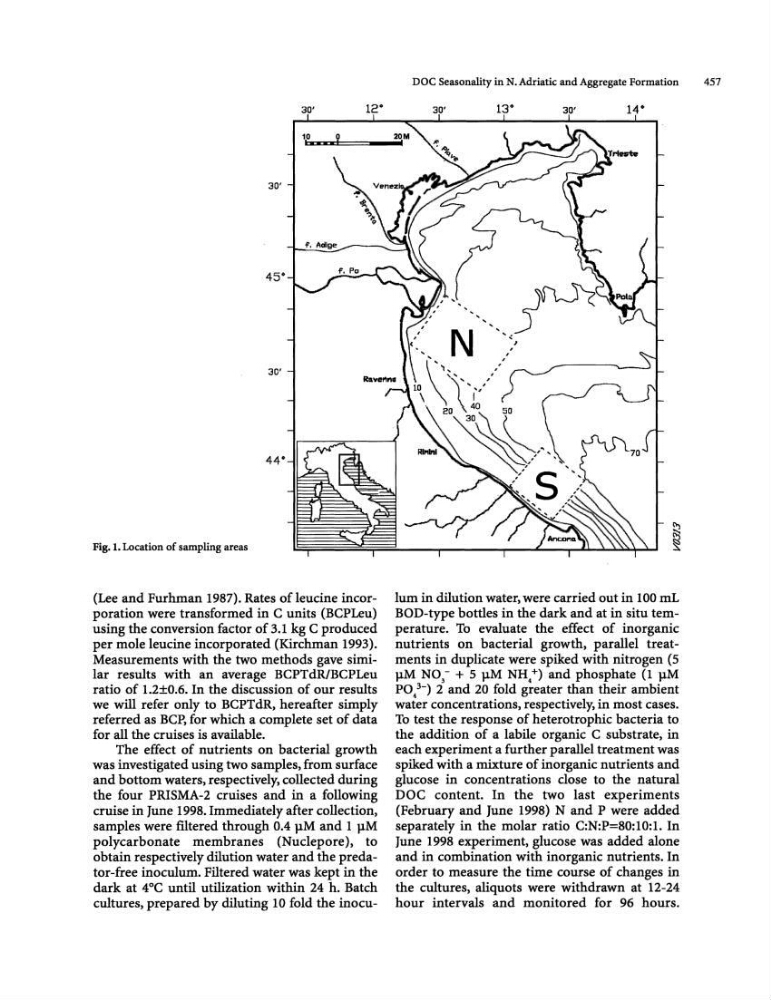
Fig. 1. Location of sampling areas
(Lee and Furhman 1987). Rates of leucine incorporation were transformed in C units (BCPLeu)
using the conversion factor of 3.1 kg C produced
per mole leucine incorporated (Kirchman 1993).
Measurements with the two methods gave similar results with an average BCPTdRlBCPLeu
ratio of 1.2±0.6. In the discussion of our results
we will refer only to BCPT dR, hereafter simply
referred as BCP, for which a complete set of data
for all the cruises is available.
The effect of nutrients on bacterial growth
was investigated using two samples, from surface
and bottom waters, respectively, collected during
the four PRISMA-2 cruises and in a following
cruise in June 1998. Immediately after collection,
samples were ftltered through 0.4 pM and 1 JIM
polycarbonate membranes (Nudepore), to
obtain respectively dilution water and the predator-free inoculum. Filtered water was kept in the
dark at 4°C until utilization within 24 h. Batch
cultures, prepared by diluting 10 fold the inocuDOC Seasonality in N. Adriatic and Aggregate Formation
457
lum in dilution water, were carried out in 100 mL
BOD-type bottles in the dark and at in situ temperature. To evaluate the effect of inorganic
nutrients on bacterial growth, parallel treatments in duplicate were spiked with nitrogen (5
pM N0 3 - + 5 JIM NH/) and phosphate (1 JIM
PO/-) 2 and 20 fold greater than their ambient
water concentrations, respectively, in most cases.
To test the response of heterotrophic bacteria to
the addition of a labile organic C substrate, in
each experiment a further parallel treatment was
spiked with a mixture of inorganic nutrients and
glucose in concentrations close to the natural
DOC content. In the two last experiments
(February and June 1998) Nand P were added
separately in the molar ratio C:N:P=80:10:1. In
June 1998 experiment, glucose was added alone
and in combination with inorganic nutrients. In
order to measure the time course of changes in
the cultures, aliquots were withdrawn at 12-24
hour intervals and monitored for 96 hours.
45·
30'
44·
Fig. 1. Location of sampling areas
(Lee and Furhman 1987). Rates of leucine incorporation were transformed in C units (BCPLeu)
using the conversion factor of 3.1 kg C produced
per mole leucine incorporated (Kirchman 1993).
Measurements with the two methods gave similar results with an average BCPTdRlBCPLeu
ratio of 1.2±0.6. In the discussion of our results
we will refer only to BCPT dR, hereafter simply
referred as BCP, for which a complete set of data
for all the cruises is available.
The effect of nutrients on bacterial growth
was investigated using two samples, from surface
and bottom waters, respectively, collected during
the four PRISMA-2 cruises and in a following
cruise in June 1998. Immediately after collection,
samples were ftltered through 0.4 pM and 1 JIM
polycarbonate membranes (Nudepore), to
obtain respectively dilution water and the predator-free inoculum. Filtered water was kept in the
dark at 4°C until utilization within 24 h. Batch
cultures, prepared by diluting 10 fold the inocuDOC Seasonality in N. Adriatic and Aggregate Formation
457
lum in dilution water, were carried out in 100 mL
BOD-type bottles in the dark and at in situ temperature. To evaluate the effect of inorganic
nutrients on bacterial growth, parallel treatments in duplicate were spiked with nitrogen (5
pM N0 3 - + 5 JIM NH/) and phosphate (1 JIM
PO/-) 2 and 20 fold greater than their ambient
water concentrations, respectively, in most cases.
To test the response of heterotrophic bacteria to
the addition of a labile organic C substrate, in
each experiment a further parallel treatment was
spiked with a mixture of inorganic nutrients and
glucose in concentrations close to the natural
DOC content. In the two last experiments
(February and June 1998) Nand P were added
separately in the molar ratio C:N:P=80:10:1. In
June 1998 experiment, glucose was added alone
and in combination with inorganic nutrients. In
order to measure the time course of changes in
the cultures, aliquots were withdrawn at 12-24
hour intervals and monitored for 96 hours.