

436
M. Fabiano et al.
lable to consumers but. in most cases. it needs to
be fragmented and processed through decomposer pathways to become easily digestible (Hansen
et al. 1992). This gap leads to a well-documented
lack of coupling between primary and secondary
production processes (Carrada and Fresi 1988).
Nevertheless. only few papers dealing with this
matter are detailed up to the biochemical scale of
observation (Sara et al. 1995; Pusceddu et al.
1996. 1997a, 1997b; Pusceddu 1999; Pusceddu et
al.1999).
In the present paper, we describe how some
physical factors (e.g. wind and algal coverage)
might influence spatial distribution and temporal patterns of quality (i.e. biochemical composition) and quantity of suspended and sediment
organic matter in a semi-enclosed marine
system of Western Sicily (Marsala lagoon, WMediterranean). The aim of this paper is to highlight the role of organic detritus as a high-definition descriptor of the trophic state and functioning of Mediterranean coastal lagoons.
Materials and Methods
Study area and Sampling
The study was carried out in the Marsala lagoon,
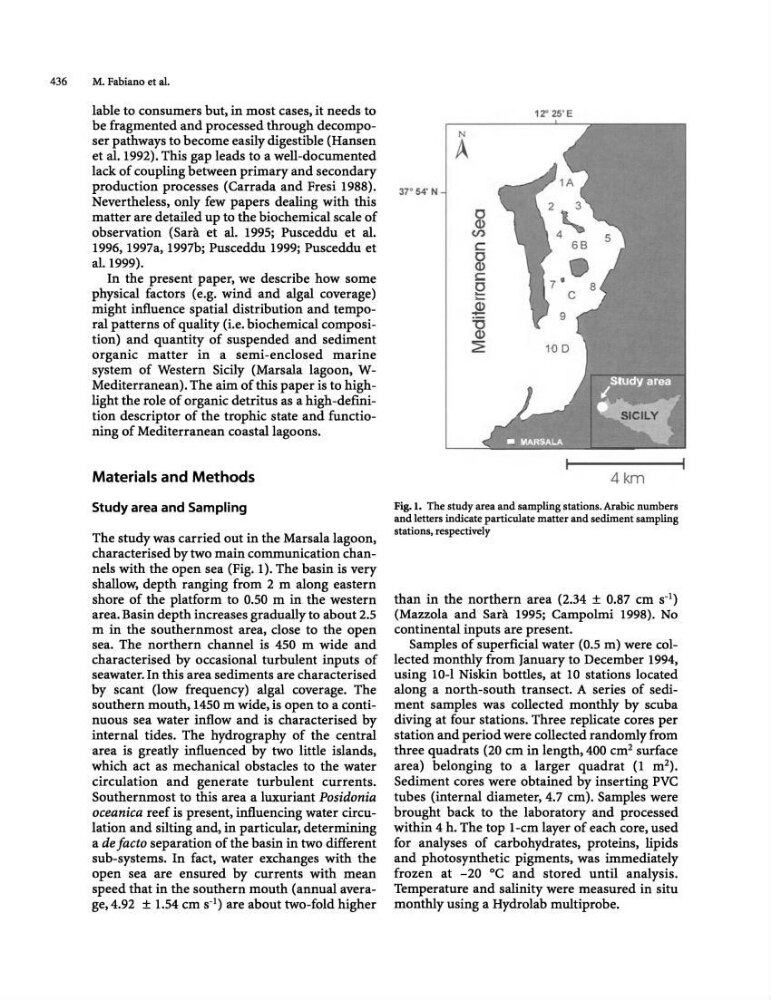
characterised by two main communication channels with the open sea (Fig. 1). The basin is very
shallow, depth ranging from 2 m along eastern
shore of the platform to 0.50 m in the western
area. Basin depth increases gradually to about 2.5
m in the southernmost area, close to the open
sea. The northern channel is 450 m wide and
characterised by occasional turbulent inputs of
seawater. In this area sediments are characterised
by scant (low frequency) algal coverage. The
southern mouth, 1450 m wide, is open to a continuous sea water inflow and is characterised by
internal tides. The hydrography of the central
area is greatly influenced by two little islands,
which act as mechanical obstacles to the water
circulation and generate turbulent currents.
Southernmost to this area a luxuriant Posidonia
oceanica reef is present, influencing water circulation and silting and, in particular, determining
a de facto separation of the basin in two different
sub-systems. In fact. water exchanges with the
open sea are ensured by currents with mean
speed that in the southern mouth (annual average,4.92 ± 1.54 cm S-I) are about two-fold higher
12"25'E
N
A
37 6 54' N
4km
Fig. 1. The study area and sampling stations. Arabic numbers
and letters indicate particulate matter and sediment sampling
stations, respectively
than in the northern area (2.34 ± 0.87 cm S-I)
(Mazzola and Sara 1995; Campolmi 1998). No
continental inputs are present.
Samples of superficial water (0.5 m) were collected monthly from January to December 1994,
using 10-1 Niskin bottles, at 10 stations located
along a north-south transect. A series of sediment samples was collected monthly by scuba
diving at four stations. Three replicate cores per
station and period were collected randomly from
three quadrats (20 cm in length, 400 cm 2 surface
area) belonging to a larger quadrat (l m 2 ).
Sediment cores were obtained by inserting PVC
tubes (internal diameter, 4.7 em). Samples were
brought back to the laboratory and processed
within 4 h. The top l-cm layer of each core, used
for analyses of carbohydrates, proteins, lipids
and photosynthetic pigments, was immediately
frozen at -20 °C and stored until analysis.
Temperature and salinity were measured in situ
monthly using a Hydrolab multiprobe.
M. Fabiano et al.
lable to consumers but. in most cases. it needs to
be fragmented and processed through decomposer pathways to become easily digestible (Hansen
et al. 1992). This gap leads to a well-documented
lack of coupling between primary and secondary
production processes (Carrada and Fresi 1988).
Nevertheless. only few papers dealing with this
matter are detailed up to the biochemical scale of
observation (Sara et al. 1995; Pusceddu et al.
1996. 1997a, 1997b; Pusceddu 1999; Pusceddu et
al.1999).
In the present paper, we describe how some
physical factors (e.g. wind and algal coverage)
might influence spatial distribution and temporal patterns of quality (i.e. biochemical composition) and quantity of suspended and sediment
organic matter in a semi-enclosed marine
system of Western Sicily (Marsala lagoon, WMediterranean). The aim of this paper is to highlight the role of organic detritus as a high-definition descriptor of the trophic state and functioning of Mediterranean coastal lagoons.
Materials and Methods
Study area and Sampling
The study was carried out in the Marsala lagoon,
characterised by two main communication channels with the open sea (Fig. 1). The basin is very
shallow, depth ranging from 2 m along eastern
shore of the platform to 0.50 m in the western
area. Basin depth increases gradually to about 2.5
m in the southernmost area, close to the open
sea. The northern channel is 450 m wide and
characterised by occasional turbulent inputs of
seawater. In this area sediments are characterised
by scant (low frequency) algal coverage. The
southern mouth, 1450 m wide, is open to a continuous sea water inflow and is characterised by
internal tides. The hydrography of the central
area is greatly influenced by two little islands,
which act as mechanical obstacles to the water
circulation and generate turbulent currents.
Southernmost to this area a luxuriant Posidonia
oceanica reef is present, influencing water circulation and silting and, in particular, determining
a de facto separation of the basin in two different
sub-systems. In fact. water exchanges with the
open sea are ensured by currents with mean
speed that in the southern mouth (annual average,4.92 ± 1.54 cm S-I) are about two-fold higher
12"25'E
N
A
37 6 54' N
4km
Fig. 1. The study area and sampling stations. Arabic numbers
and letters indicate particulate matter and sediment sampling
stations, respectively
than in the northern area (2.34 ± 0.87 cm S-I)
(Mazzola and Sara 1995; Campolmi 1998). No
continental inputs are present.
Samples of superficial water (0.5 m) were collected monthly from January to December 1994,
using 10-1 Niskin bottles, at 10 stations located
along a north-south transect. A series of sediment samples was collected monthly by scuba
diving at four stations. Three replicate cores per
station and period were collected randomly from
three quadrats (20 cm in length, 400 cm 2 surface
area) belonging to a larger quadrat (l m 2 ).
Sediment cores were obtained by inserting PVC
tubes (internal diameter, 4.7 em). Samples were
brought back to the laboratory and processed
within 4 h. The top l-cm layer of each core, used
for analyses of carbohydrates, proteins, lipids
and photosynthetic pigments, was immediately
frozen at -20 °C and stored until analysis.
Temperature and salinity were measured in situ
monthly using a Hydrolab multiprobe.