

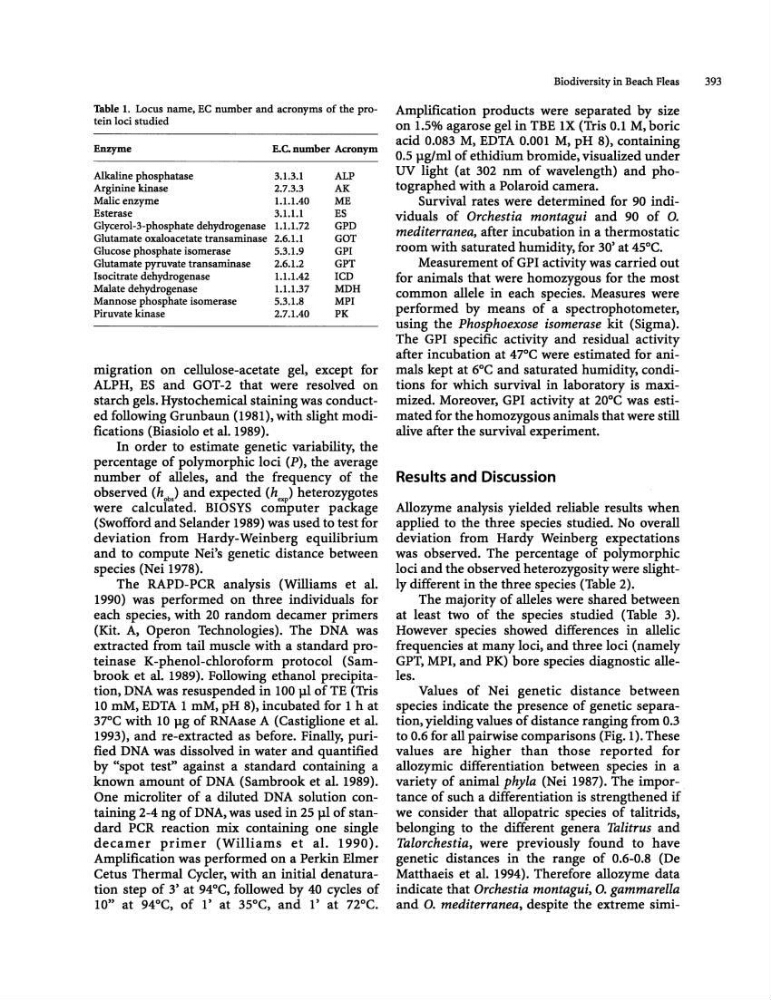
Table 1. Locus name, Ee number and acronyms of the protein loci studied
E.C. number Acronym
Alkaline phosphatase
3.1.3.1
ALP
Arginine kinase
2.7.3.3
AK
Malic enzyme
1.1.1.40
ME
Esterase
3.1.1.1
ES
Glycerol-3-phosphate dehydrogenase 1.1.1.72
GPD
Glutamate oxaloacetate transaminase 2.6.1.1
GOT
Glucose phosphate isomerase
5.3.1.9
GPI
Glutamate pyruvate transaminase
2.6.1.2
GPT
Isocitrate dehydrogenase
1.1.1.42
ICD
Malate dehydrogenase
1.1.1.37
MDH
Mannose phosphate isomerase
5.3.1.8
MPI
Piruvate kinase
2.7.1.40
PK
migration on cellulose-acetate gel. except for
ALPH, ES and GOT-2 that were resolved on
starch gels. Hystochemical staining was conducted following Grunbaun (1981), with slight modifications (Biasiolo et al. 1989),
In order to estimate genetic variability, the
percentage of polymorphic loci (P), the average
number of alleles, and the frequency of the
observed (hob<) and expected (hexp) heterozygotes
were calculated. BIOSYS computer package
(Swofford and Selander 1989) was used to test for
deviation from Hardy-Weinberg equilibrium
and to compute Nei's genetic distance between
species (Nei 1978).
The RAPD-PCR analysis (Williams et al.
1990) was performed on three individuals for
each species, with 20 random decamer primers
(Kit. A, Operon Technologies). The DNA was
extracted from tail muscle with a standard proteinase K-phenol-chloroform protocol (Sambrook et al. 1989). Following ethanol precipitation, DNA was resuspended in 100 pl of TE (This
10 roM, EDT A 1 roM, pH 8), incubated for 1 h at
37°C with 10 }lg of RNAase A (Castiglione et al.
1993), and re-extracted as before. Finally, purified DNA was dissolved in water and quantified
by "spot test" against a standard containing a
known amount of DNA (Sambrook et al. 1989).
One microliter of a diluted DNA solution containing 2-4 ng of DNA, was used in 25 }ll of standard PCR reaction mix containing one single
decamer primer (Williams et al. 1990).
Amplification was performed on a Perkin Elmer
Cetus Thermal Cycler, with an initial denaturation step of 3' at 94°C, followed by 40 cycles of
10" at 94°C, of l' at 35°C, and I' at 72°C.
Biodiversity in Beach Fleas
393
Amplification products were separated by size
on 1.5% agarose gel in THE IX (Tris 0.1 M. boric
acid 0.083 M, EDTA 0.001 M, pH 8), containing
0.5 }lglml of ethidium bromide, visualized under
UV light (at 302 nm of wavelength) and photographed with a Polaroid camera.
Survival rates were determined for 90 individuals of Orchestia montagui and 90 of O.
mediterranea, after incubation in a thermostatic
room with saturated humidity, for 30' at 45°C.
Measurement of GPI activity was carried out
for animals that were homozygous for the most
common allele in each species. Measures were
performed by means of a spectrophotometer,
using the Phosphoexose isomerase kit (Sigma).
The GPI specific activity and residual activity
after incubation at 47°C were estimated for animals kept at 6°C and saturated humidity, conditions for which survival in laboratory is maximized. Moreover, GPI activity at 20°C was estimated for the homozygous animals that were still
alive after the survival experiment.
Results and Discussion
Allozyme analysis yielded reliable results when
applied to the three species studied. No overall
deviation from Hardy Weinberg expectations
was observed. The percentage of polymorphic
loci and the observed heterozygosity were slightly different in the three species (Table 2).
The majority of alleles were shared between
at least two of the species studied (Table 3).
However species showed differences in allelic
frequencies at many loci, and three loci (namely
GPT. MPI, and PK) bore species diagnostic alleles.
Values of Nei genetic distance between
species indicate the presence of genetic separation, yielding values of distance ranging from 0.3
to 0.6 for all pairwise comparisons (Fig. 1). These
values are higher than those reported for
allozymic differentiation between species in a
variety of animal phyla (Nei 1987). The importance of such a differentiation is strengthened if
we consider that allopatric species of talitrids,
belonging to the different genera Talitrus and
Talorchestia, were previously found to have
genetic distances in the range of 0.6-0.8 (De
Matthaeis et al. 1994). Therefore allozyme data
indicate that Orchestia montagui. O. gammarella
and O. mediterranea, despite the extreme simi-
E.C. number Acronym
Alkaline phosphatase
3.1.3.1
ALP
Arginine kinase
2.7.3.3
AK
Malic enzyme
1.1.1.40
ME
Esterase
3.1.1.1
ES
Glycerol-3-phosphate dehydrogenase 1.1.1.72
GPD
Glutamate oxaloacetate transaminase 2.6.1.1
GOT
Glucose phosphate isomerase
5.3.1.9
GPI
Glutamate pyruvate transaminase
2.6.1.2
GPT
Isocitrate dehydrogenase
1.1.1.42
ICD
Malate dehydrogenase
1.1.1.37
MDH
Mannose phosphate isomerase
5.3.1.8
MPI
Piruvate kinase
2.7.1.40
PK
migration on cellulose-acetate gel. except for
ALPH, ES and GOT-2 that were resolved on
starch gels. Hystochemical staining was conducted following Grunbaun (1981), with slight modifications (Biasiolo et al. 1989),
In order to estimate genetic variability, the
percentage of polymorphic loci (P), the average
number of alleles, and the frequency of the
observed (hob<) and expected (hexp) heterozygotes
were calculated. BIOSYS computer package
(Swofford and Selander 1989) was used to test for
deviation from Hardy-Weinberg equilibrium
and to compute Nei's genetic distance between
species (Nei 1978).
The RAPD-PCR analysis (Williams et al.
1990) was performed on three individuals for
each species, with 20 random decamer primers
(Kit. A, Operon Technologies). The DNA was
extracted from tail muscle with a standard proteinase K-phenol-chloroform protocol (Sambrook et al. 1989). Following ethanol precipitation, DNA was resuspended in 100 pl of TE (This
10 roM, EDT A 1 roM, pH 8), incubated for 1 h at
37°C with 10 }lg of RNAase A (Castiglione et al.
1993), and re-extracted as before. Finally, purified DNA was dissolved in water and quantified
by "spot test" against a standard containing a
known amount of DNA (Sambrook et al. 1989).
One microliter of a diluted DNA solution containing 2-4 ng of DNA, was used in 25 }ll of standard PCR reaction mix containing one single
decamer primer (Williams et al. 1990).
Amplification was performed on a Perkin Elmer
Cetus Thermal Cycler, with an initial denaturation step of 3' at 94°C, followed by 40 cycles of
10" at 94°C, of l' at 35°C, and I' at 72°C.
Biodiversity in Beach Fleas
393
Amplification products were separated by size
on 1.5% agarose gel in THE IX (Tris 0.1 M. boric
acid 0.083 M, EDTA 0.001 M, pH 8), containing
0.5 }lglml of ethidium bromide, visualized under
UV light (at 302 nm of wavelength) and photographed with a Polaroid camera.
Survival rates were determined for 90 individuals of Orchestia montagui and 90 of O.
mediterranea, after incubation in a thermostatic
room with saturated humidity, for 30' at 45°C.
Measurement of GPI activity was carried out
for animals that were homozygous for the most
common allele in each species. Measures were
performed by means of a spectrophotometer,
using the Phosphoexose isomerase kit (Sigma).
The GPI specific activity and residual activity
after incubation at 47°C were estimated for animals kept at 6°C and saturated humidity, conditions for which survival in laboratory is maximized. Moreover, GPI activity at 20°C was estimated for the homozygous animals that were still
alive after the survival experiment.
Results and Discussion
Allozyme analysis yielded reliable results when
applied to the three species studied. No overall
deviation from Hardy Weinberg expectations
was observed. The percentage of polymorphic
loci and the observed heterozygosity were slightly different in the three species (Table 2).
The majority of alleles were shared between
at least two of the species studied (Table 3).
However species showed differences in allelic
frequencies at many loci, and three loci (namely
GPT. MPI, and PK) bore species diagnostic alleles.
Values of Nei genetic distance between
species indicate the presence of genetic separation, yielding values of distance ranging from 0.3
to 0.6 for all pairwise comparisons (Fig. 1). These
values are higher than those reported for
allozymic differentiation between species in a
variety of animal phyla (Nei 1987). The importance of such a differentiation is strengthened if
we consider that allopatric species of talitrids,
belonging to the different genera Talitrus and
Talorchestia, were previously found to have
genetic distances in the range of 0.6-0.8 (De
Matthaeis et al. 1994). Therefore allozyme data
indicate that Orchestia montagui. O. gammarella
and O. mediterranea, despite the extreme simi-