

336
L. Rossi and G. Mancinelli
2660
2650
J:
.,.
E
u
~
~
2640
Q
2630
a
I
I
o
4
n. individuals
I
12
I
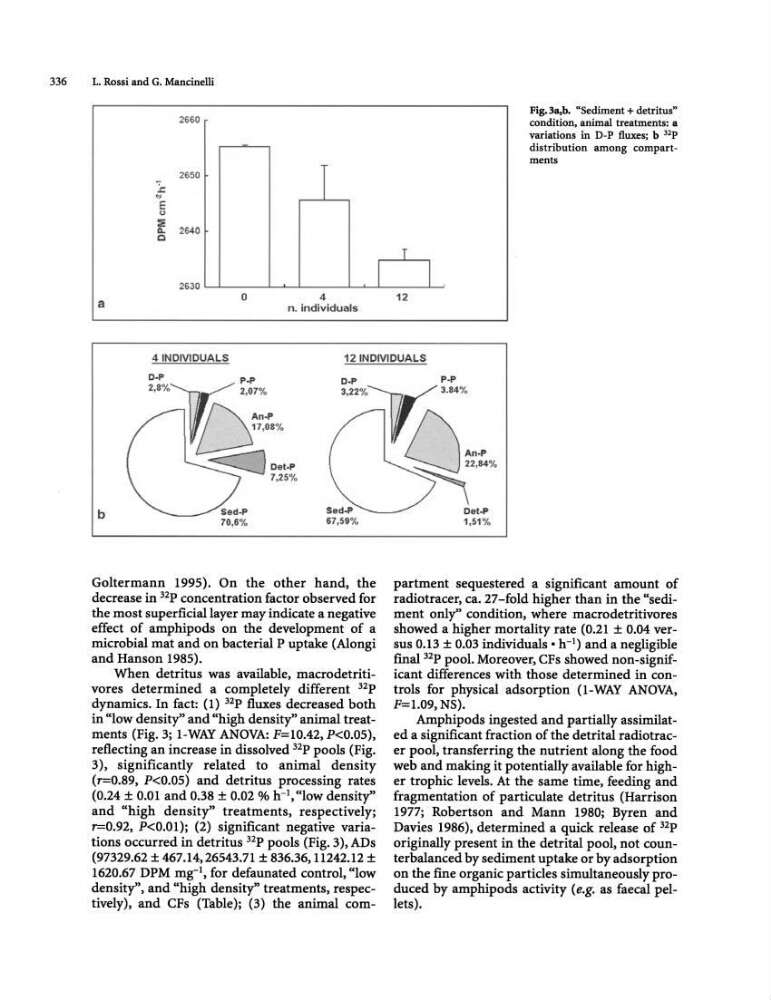
Fig.3a,b. "Sediment + detritus"
condition, animal treatments: a
variations in D-P fluxes; b 32p
distribution among compartments
4 INDIVIDUALS
12 INDIVIDUALS
D.P
pop
"22%~'"" %
WAO".
~' ... %
b
70,6%
Sed.P
67,59%
Goltermann 1995). On the other hand, the
decrease in 32p concentration factor observed for
the most superficial layer may indicate a negative
effect of amphipods on the development of a
microbial mat and on bacterial P uptake (Alongi
and Hanson 1985).
When detritus was available, macrodetritivores determined a completely different 32p
dynamics. In fact: (1) 32p fluxes decreased both
in "low density" and "high density" animal treatments (Fig. 3; I-WAY ANOYA: F=10.42, P<0.05),
reflecting an increase in dissolved 32p pools (Fig.
3), significantly related to animal density
(r=0.89, P
and "high density" treatments, respectively;
r=0.92, P
1620.67 DPM mg- l , for defaunated control, "low
density", and "high density" treatments, respectively), and CFs (Table); (3) the animal comDet-P
1,51 %
partment sequestered a significant amount of
radiotracer, ca. 27-fold higher than in the "sediment only" condition, where macrodetritivores
showed a higher mortality rate (0.21 ± 0.04 versus 0.13 ± 0.03 individuals· h-l) and a negligible
fmal 32p pool. Moreover, CFs showed non-significant differences with those determined in controls for physical adsorption (I-WAY ANOYA,
F=1.09, NS).
Amphipods ingested and partially assimilated a significant fraction of the detrital radiotracer pool, transferring the nutrient along the food
web and making it potentially available for higher trophic levels. At the same time, feeding and
fragmentation of particulate detritus (Harrison
1977; Robertson and Mann 1980; Byren and
Davies 1986), determined a quick release of 32p
originally present in the detrital pool, not counterbalanced by sediment uptake or by adsorption
on the fme organic particles simultaneously produced by amphipods activity (e.g. as faecal pellets).
L. Rossi and G. Mancinelli
2660
2650
J:
.,.
E
u
~
~
2640
Q
2630
a
I
I
o
4
n. individuals
I
12
I
Fig.3a,b. "Sediment + detritus"
condition, animal treatments: a
variations in D-P fluxes; b 32p
distribution among compartments
4 INDIVIDUALS
12 INDIVIDUALS
D.P
pop
"22%~'"" %
WAO".
~' ... %
b
70,6%
Sed.P
67,59%
Goltermann 1995). On the other hand, the
decrease in 32p concentration factor observed for
the most superficial layer may indicate a negative
effect of amphipods on the development of a
microbial mat and on bacterial P uptake (Alongi
and Hanson 1985).
When detritus was available, macrodetritivores determined a completely different 32p
dynamics. In fact: (1) 32p fluxes decreased both
in "low density" and "high density" animal treatments (Fig. 3; I-WAY ANOYA: F=10.42, P<0.05),
reflecting an increase in dissolved 32p pools (Fig.
3), significantly related to animal density
(r=0.89, P
and "high density" treatments, respectively;
r=0.92, P
1620.67 DPM mg- l , for defaunated control, "low
density", and "high density" treatments, respectively), and CFs (Table); (3) the animal comDet-P
1,51 %
partment sequestered a significant amount of
radiotracer, ca. 27-fold higher than in the "sediment only" condition, where macrodetritivores
showed a higher mortality rate (0.21 ± 0.04 versus 0.13 ± 0.03 individuals· h-l) and a negligible
fmal 32p pool. Moreover, CFs showed non-significant differences with those determined in controls for physical adsorption (I-WAY ANOYA,
F=1.09, NS).
Amphipods ingested and partially assimilated a significant fraction of the detrital radiotracer pool, transferring the nutrient along the food
web and making it potentially available for higher trophic levels. At the same time, feeding and
fragmentation of particulate detritus (Harrison
1977; Robertson and Mann 1980; Byren and
Davies 1986), determined a quick release of 32p
originally present in the detrital pool, not counterbalanced by sediment uptake or by adsorption
on the fme organic particles simultaneously produced by amphipods activity (e.g. as faecal pellets).