

(I)
....I
c(
:::)
c
~
c
~
u..
o
w
C!t
~
z
w
U
0::
W
IL
25
20
15
10
5
O ~--..L,o
002
004
0,08
Amphipods and Allochthonous Detritus in Adriatic
315
SPRING
(n. = 247)
D SUMMER (n . = 632)
0,16
0.32
064
1 28
2.56
512
1024 > 10 ,24
WEIGHT CLASS (mg)
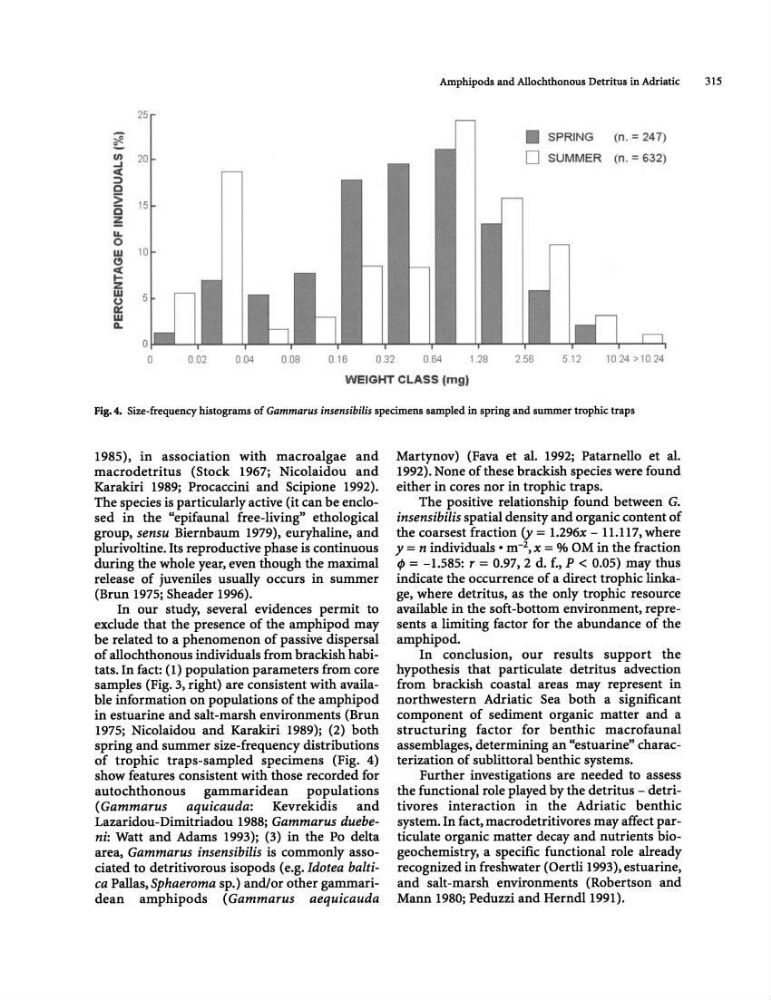
Fig.4. Size-frequency histograms of Gammarus insensibilis specimens sampled in spring and summer trophic traps
1985), in association with macroalgae and
macrodetritus (Stock 1967; Nicolaidou and
Karakiri 1989; Procaccini and Scipione 1992).
The species is particularly active (it can be enclosed in the "epifaunal free-living" ethological
group, sensu Biernbaum 1979), euryhaline, and
plurivoltine. Its reproductive phase is continuous
during the whole year, even though the maximal
release of juveniles usually occurs in summer
(Brun 1975; Sheader 1996).
In our study, several evidences permit to
exclude that the presence of the amp hi pod may
be related to a phenomenon of passive dispersal
of allochthonous individuals from brackish habitats. In fact: (1) population parameters from core
samples (Fig. 3, right) are consistent with available information on populations of the amphipod
in estuarine and salt-marsh environments (Brun
1975; Nicolaidou and Karakiri 1989); (2) both
spring and summer size-frequency distributions
of trophic traps-sampled speCimens (Fig. 4)
show features consistent with those recorded for
autochthonous gammaridean populations
(Gammarus aquicauda: Kevrekidis and
Lazaridou-Dimitriadou 1988; Gammarus duebeni: Watt and Adams 1993); (3) in the Po delta
area, Gammarus insensibilis is commonly associated to detritivorous isopods (e.g. Idotea baltica Pallas, Sphaeroma sp.) and/or other gammaridean amphipods (Gammarus aequicauda
Martynov) (Fava et al. 1992; Patarnello et al.
1992). None of these brackish species were found
either in cores nor in trophic traps.
The positive relationship found between G.
insensibilis spatial density and organic content of
the coarsest fraction (y = 1.296x - 11.117, where
y = n individuals· m- 2 ,x = % OM in the fraction
tP = -l.585: r = 0.97,2 d. f., P < 0.05) may thus
indicate the occurrence of a direct trophic linkage, where detritus, as the only trophic resource
available in the soft-bottom environment, represents a limiting factor for the abundance of the
amphipod.
In conclusion, our results support the
hypothesis that particulate detritus advection
from brackish coastal areas may represent in
northwestern Adriatic Sea both a significant
component of sediment organic matter and a
structuring factor for benthic macrofaunal
assemblages, determining an "estuarine" characterization of sublittoral benthic systems.
Further investigations are needed to assess
the functional role played by the detritus - detritivores interaction in the Adriatic benthic
system. In fact, macrodetritivores may affect particulate organic matter decay and nutrients biogeochemistry, a specific functional role already
recognized in freshwater (Oertli 1993), estuarine,
and salt-marsh environments (Robertson and
Mann 1980; Peduzzi and HerndI1991).
....I
c(
:::)
c
~
c
~
u..
o
w
C!t
~
z
w
U
0::
W
IL
25
20
15
10
5
O ~--..L,o
002
004
0,08
Amphipods and Allochthonous Detritus in Adriatic
315
SPRING
(n. = 247)
D SUMMER (n . = 632)
0,16
0.32
064
1 28
2.56
512
1024 > 10 ,24
WEIGHT CLASS (mg)
Fig.4. Size-frequency histograms of Gammarus insensibilis specimens sampled in spring and summer trophic traps
1985), in association with macroalgae and
macrodetritus (Stock 1967; Nicolaidou and
Karakiri 1989; Procaccini and Scipione 1992).
The species is particularly active (it can be enclosed in the "epifaunal free-living" ethological
group, sensu Biernbaum 1979), euryhaline, and
plurivoltine. Its reproductive phase is continuous
during the whole year, even though the maximal
release of juveniles usually occurs in summer
(Brun 1975; Sheader 1996).
In our study, several evidences permit to
exclude that the presence of the amp hi pod may
be related to a phenomenon of passive dispersal
of allochthonous individuals from brackish habitats. In fact: (1) population parameters from core
samples (Fig. 3, right) are consistent with available information on populations of the amphipod
in estuarine and salt-marsh environments (Brun
1975; Nicolaidou and Karakiri 1989); (2) both
spring and summer size-frequency distributions
of trophic traps-sampled speCimens (Fig. 4)
show features consistent with those recorded for
autochthonous gammaridean populations
(Gammarus aquicauda: Kevrekidis and
Lazaridou-Dimitriadou 1988; Gammarus duebeni: Watt and Adams 1993); (3) in the Po delta
area, Gammarus insensibilis is commonly associated to detritivorous isopods (e.g. Idotea baltica Pallas, Sphaeroma sp.) and/or other gammaridean amphipods (Gammarus aequicauda
Martynov) (Fava et al. 1992; Patarnello et al.
1992). None of these brackish species were found
either in cores nor in trophic traps.
The positive relationship found between G.
insensibilis spatial density and organic content of
the coarsest fraction (y = 1.296x - 11.117, where
y = n individuals· m- 2 ,x = % OM in the fraction
tP = -l.585: r = 0.97,2 d. f., P < 0.05) may thus
indicate the occurrence of a direct trophic linkage, where detritus, as the only trophic resource
available in the soft-bottom environment, represents a limiting factor for the abundance of the
amphipod.
In conclusion, our results support the
hypothesis that particulate detritus advection
from brackish coastal areas may represent in
northwestern Adriatic Sea both a significant
component of sediment organic matter and a
structuring factor for benthic macrofaunal
assemblages, determining an "estuarine" characterization of sublittoral benthic systems.
Further investigations are needed to assess
the functional role played by the detritus - detritivores interaction in the Adriatic benthic
system. In fact, macrodetritivores may affect particulate organic matter decay and nutrients biogeochemistry, a specific functional role already
recognized in freshwater (Oertli 1993), estuarine,
and salt-marsh environments (Robertson and
Mann 1980; Peduzzi and HerndI1991).