

Evolution of the Biological and Edaphic Features in the Oliveri -Tindari Lagoon
309
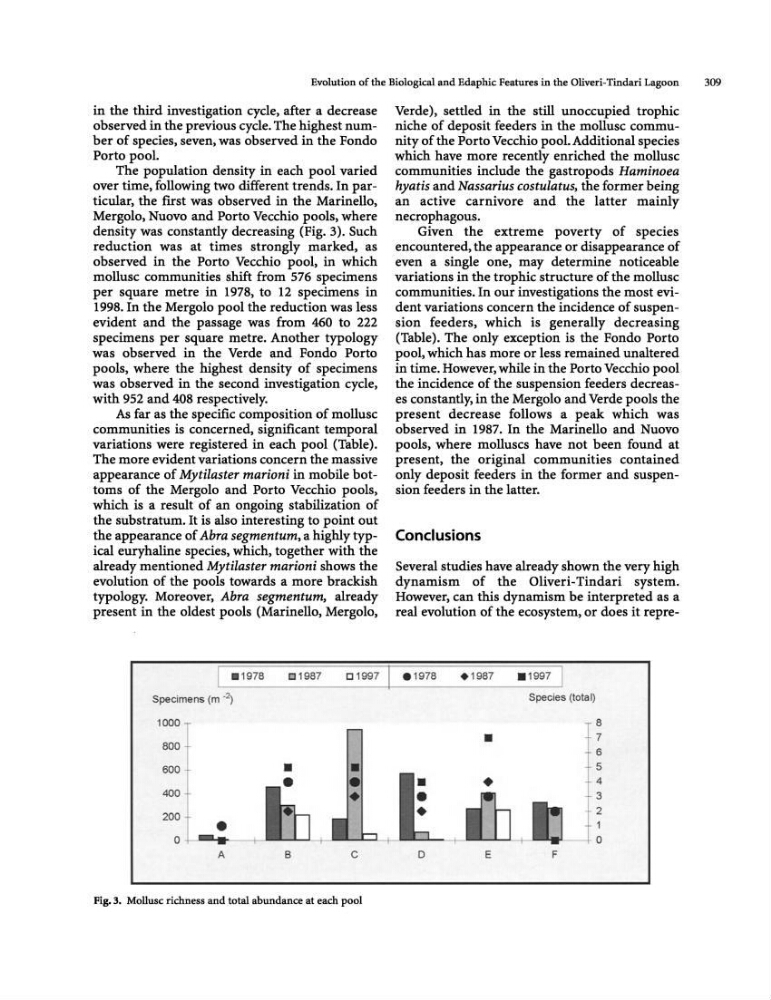
in the third investigation cycle, after a decrease
observed in the previous cycle. The highest number of species, seven, was observed in the Fondo
Porto pool.
The population density in each pool varied
over time, following two different trends. In particular, the flIst was observed in the Marinello,
Mergolo, Nuovo and Porto Vecchio pools, where
density was constantly decreasing (Fig. 3). Such
reduction was at times strongly marked, as
observed in the Porto Vecchio pool, in which
mollusc communities shift from 576 specimens
per square metre in 1978, to 12 specimens in
1998. In the Mergolo pool the reduction was less
evident and the passage was from 460 to 222
specimens per square metre. Another typology
was observed in the Verde and Fondo Porto
pools, where the highest density of specimens
was observed in the second investigation cycle,
with 952 and 408 respectively.
Ai; far as the specific composition of mollusc
communities is concerned, significant temporal
variations were registered in each pool (Table).
The more evident variations concern the massive
appearance of Mytilaster marioni in mobile bottoms of the Mergolo and Porto Vecchio pools,
which is a result of an ongoing stabilization of
the substratum. It is also interesting to point out
the appearance of Abra segmentum, a highly typical euryhaline species, which, together with the
already mentioned Mytilaster marioni shows the
evolution of the pools towards a more brackish
typology. Moreover, Abra segmentum, already
present in the oldest pools (Marinello, Mergolo,
.1978
[J 1987
D 1997
Specimens (m -2)
1000
800
600
400
200
a
A
B
C
Fig. 3. Mollusc richness and total abundance at each pool
Verde), settled in the still unoccupied trophic
niche of deposit feeders in the mollusc community of the Porto Vecchio pool. Additional species
which have more recently enriched the mollusc
communities include the gastropods Haminoea
hyatis and Nassarius costulatus. the former being
an active carnivore and the latter mainly
necrophagous.
Given the extreme poverty of species
encountered, the appearance or disappearance of
even a single one, may determine noticeable
variations in the trophic structure of the mollusc
communities. In our investigations the most evident variations concern the incidence of suspension feeders, which is generally decreasing
(Table). The only exception is the Fonda Porto
pool, which has more or less remained unaltered
in time. However, while in the Porto Vecchio pool
the incidence of the suspension feeders decreases constantly, in the Mergolo and Verde pools the
present decrease follows a peak which was
observed in 1987. In the Marinello and Nuovo
pools, where molluscs have not been found at
present, the original communities contained
only deposit feeders in the former and suspension feeders in the latter.
Conclusions
Several studies have already shown the very high
dynamism of the Oliveri-Tindari system.
However, can this dynamism be interpreted as a
real evolution of the ecosystem, or does it repre.1978
. 1987
. 1997
Species (tota I)
8
•
7
6
5
4
3
2
1
0
0
E
F
309
in the third investigation cycle, after a decrease
observed in the previous cycle. The highest number of species, seven, was observed in the Fondo
Porto pool.
The population density in each pool varied
over time, following two different trends. In particular, the flIst was observed in the Marinello,
Mergolo, Nuovo and Porto Vecchio pools, where
density was constantly decreasing (Fig. 3). Such
reduction was at times strongly marked, as
observed in the Porto Vecchio pool, in which
mollusc communities shift from 576 specimens
per square metre in 1978, to 12 specimens in
1998. In the Mergolo pool the reduction was less
evident and the passage was from 460 to 222
specimens per square metre. Another typology
was observed in the Verde and Fondo Porto
pools, where the highest density of specimens
was observed in the second investigation cycle,
with 952 and 408 respectively.
Ai; far as the specific composition of mollusc
communities is concerned, significant temporal
variations were registered in each pool (Table).
The more evident variations concern the massive
appearance of Mytilaster marioni in mobile bottoms of the Mergolo and Porto Vecchio pools,
which is a result of an ongoing stabilization of
the substratum. It is also interesting to point out
the appearance of Abra segmentum, a highly typical euryhaline species, which, together with the
already mentioned Mytilaster marioni shows the
evolution of the pools towards a more brackish
typology. Moreover, Abra segmentum, already
present in the oldest pools (Marinello, Mergolo,
.1978
[J 1987
D 1997
Specimens (m -2)
1000
800
600
400
200
a
A
B
C
Fig. 3. Mollusc richness and total abundance at each pool
Verde), settled in the still unoccupied trophic
niche of deposit feeders in the mollusc community of the Porto Vecchio pool. Additional species
which have more recently enriched the mollusc
communities include the gastropods Haminoea
hyatis and Nassarius costulatus. the former being
an active carnivore and the latter mainly
necrophagous.
Given the extreme poverty of species
encountered, the appearance or disappearance of
even a single one, may determine noticeable
variations in the trophic structure of the mollusc
communities. In our investigations the most evident variations concern the incidence of suspension feeders, which is generally decreasing
(Table). The only exception is the Fonda Porto
pool, which has more or less remained unaltered
in time. However, while in the Porto Vecchio pool
the incidence of the suspension feeders decreases constantly, in the Mergolo and Verde pools the
present decrease follows a peak which was
observed in 1987. In the Marinello and Nuovo
pools, where molluscs have not been found at
present, the original communities contained
only deposit feeders in the former and suspension feeders in the latter.
Conclusions
Several studies have already shown the very high
dynamism of the Oliveri-Tindari system.
However, can this dynamism be interpreted as a
real evolution of the ecosystem, or does it repre.1978
. 1987
. 1997
Species (tota I)
8
•
7
6
5
4
3
2
1
0
0
E
F