

Deep-sea (250-1,550 m) Benthic Thanatocoenoses from the Southern Tyrrhenian Sea
279
shells, valves, apical and umbonal fragments for
molluscs, whole colonies and colony fragments
for bryozoans, whole tubes and tube fragments
for serpulids. Based on faunal data, stations were
clustered into three bathymetric groups (see
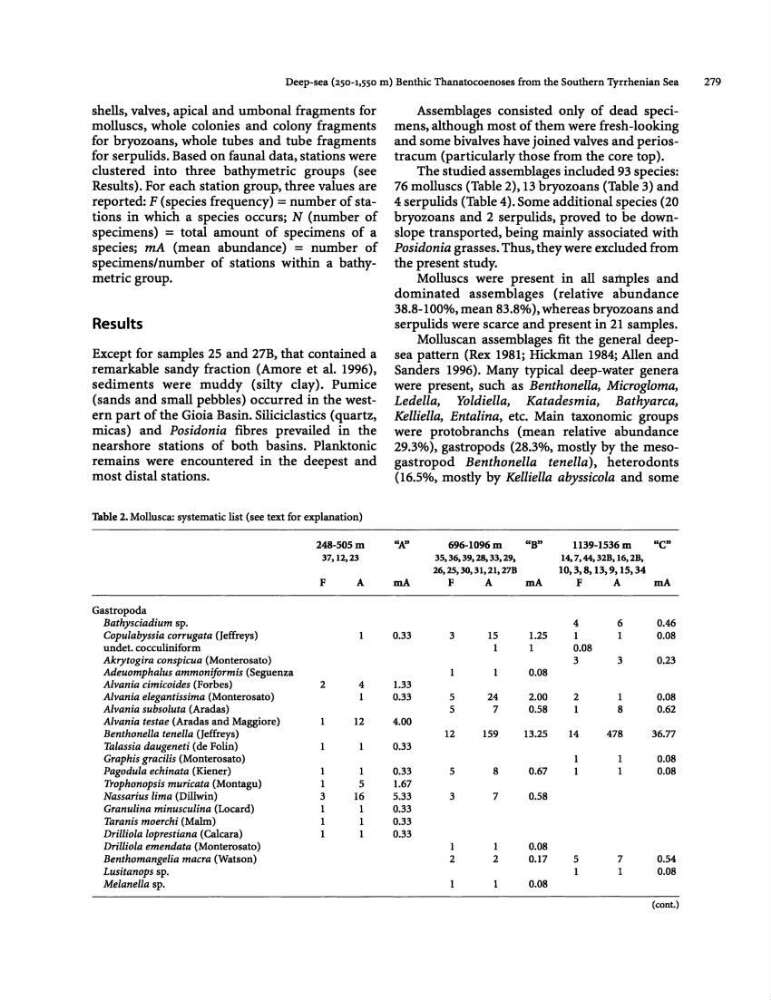
Results), For each station group, three values are
reported: F (species frequency) = number of stations in which a species occurs; N (number of
specimens) = total amount of specimens of a
species; rnA (mean abundance) = number of
specimens/number of stations within a bathymetric group.
Results
Except for samples 25 and 27B. that contained a
remarkable sandy fraction (Amore et al. 1996),
sediments were muddy (silty clay). Pumice
(sands and small pebbles) occurred in the western part of the Gioia Basin. Siliciclastics (quartz,
micas) and Posidonia fibres prevailed in the
nearshore stations of both basins. Planktonic
remains were encountered in the deepest and
most distal stations.
Table 2. Mollusca: systematic list (see text for explanation)
Gastropoda
Bathysciadium sp.
Copulabyssia corrugata (Jeffreys)
undet. coccuJiniform
Akrytogira conspicua (Monterosato)
Adeuomphalus ammoniformis (Seguenza
Alvania cimicoides (Forbes)
Alvania elegantissima (Monterosato)
Alvania subsoluta (Aradas)
Alvania testae (Aradas and Maggiore)
Benthonella tenella (Jeffreys)
Talassia daugeneti (de Folin)
Graphis gracilis (Monterosato)
Pagodula echinata (Kiener)
Trophonopsis muricata (Montagn)
Nassarius lima (Dillwin)
Granulina minusculina (Locard)
Taranis moerchi (Malm)
Drilliola loprestiana (Calcara)
Drilliola emendata (Monterosato)
Benthomangelia macra (Watson)
Lusitanops sp.
Melanella sp.
248-505rn
37,12,23
F
A
2
1
1
3
1
4
12
1
5
16
1
1
Assemblages consisted only of dead specimens, although most of them were fresh-looking
and some bivalves have joined valves and periostracum (particularly those from the core top).
The studied assemblages included 93 species:
76 molluscs (Table 2). 13 bryozoans (Table 3) and
4 serpulids (Table 4). Some additional species (20
bryozoans and 2 serpulids, proved to be downslope transported. being mainly associated with
Posidonia grasses. Thus, they were excluded from
the present study.
Molluscs were present in all samples and
dominated assemblages (relative abundance
38.8-100%, mean 83.8%), whereas bryozoans and
serpulids were scarce and present in 21 samples.
Molluscan assemblages fit the general deepsea pattern (Rex 1981; Hickman 1984; Allen and
Sanders 1996). Many typical deep-water genera
were present, such as Benthonella, Microgloma,
Ledella, Yoldiella, Katadesmia, Bathyarca,
Kelliella, Entalina, etc. Main taxonomic groups
were protobranchs (mean relative abundance
29.3%), gastropods (28.3%, mostly by the mesogastropod Benthonella tenella), heterodonts
(16.5%, mostly by Kelliella abyssicola and some
"A"
696-1096 m
"B"
1139-1536 rn
"C"
35. 36, 39. 28, 33, 29,
14, 7,44. 32B, 16, 2B,.
26, 2S, 30, 31,21,21B
10.3,8,13,9,15,34
rnA
F
A
rnA
F
A
rnA
4
6
0.46
0.33
3
15
1.25
1
1
0.08
1
1
0.08
3
3
0.23
1
0.08
1.33
0.33
5
24
2.00
2
1
0.08
5
"1
0.58
1
8
0.62
4.00
12
159
13.25
14
478
36.77
0.33
1
0.08
0.33
5
8
0.67
0.08
1.67
5.33
3
7
0.58
0.33
0.33
0.33
1
1
0.08
2
2
0.17
5
7
0.54
1
0.08
1
0.08
(ront.)
279
shells, valves, apical and umbonal fragments for
molluscs, whole colonies and colony fragments
for bryozoans, whole tubes and tube fragments
for serpulids. Based on faunal data, stations were
clustered into three bathymetric groups (see
Results), For each station group, three values are
reported: F (species frequency) = number of stations in which a species occurs; N (number of
specimens) = total amount of specimens of a
species; rnA (mean abundance) = number of
specimens/number of stations within a bathymetric group.
Results
Except for samples 25 and 27B. that contained a
remarkable sandy fraction (Amore et al. 1996),
sediments were muddy (silty clay). Pumice
(sands and small pebbles) occurred in the western part of the Gioia Basin. Siliciclastics (quartz,
micas) and Posidonia fibres prevailed in the
nearshore stations of both basins. Planktonic
remains were encountered in the deepest and
most distal stations.
Table 2. Mollusca: systematic list (see text for explanation)
Gastropoda
Bathysciadium sp.
Copulabyssia corrugata (Jeffreys)
undet. coccuJiniform
Akrytogira conspicua (Monterosato)
Adeuomphalus ammoniformis (Seguenza
Alvania cimicoides (Forbes)
Alvania elegantissima (Monterosato)
Alvania subsoluta (Aradas)
Alvania testae (Aradas and Maggiore)
Benthonella tenella (Jeffreys)
Talassia daugeneti (de Folin)
Graphis gracilis (Monterosato)
Pagodula echinata (Kiener)
Trophonopsis muricata (Montagn)
Nassarius lima (Dillwin)
Granulina minusculina (Locard)
Taranis moerchi (Malm)
Drilliola loprestiana (Calcara)
Drilliola emendata (Monterosato)
Benthomangelia macra (Watson)
Lusitanops sp.
Melanella sp.
248-505rn
37,12,23
F
A
2
1
1
3
1
4
12
1
5
16
1
1
Assemblages consisted only of dead specimens, although most of them were fresh-looking
and some bivalves have joined valves and periostracum (particularly those from the core top).
The studied assemblages included 93 species:
76 molluscs (Table 2). 13 bryozoans (Table 3) and
4 serpulids (Table 4). Some additional species (20
bryozoans and 2 serpulids, proved to be downslope transported. being mainly associated with
Posidonia grasses. Thus, they were excluded from
the present study.
Molluscs were present in all samples and
dominated assemblages (relative abundance
38.8-100%, mean 83.8%), whereas bryozoans and
serpulids were scarce and present in 21 samples.
Molluscan assemblages fit the general deepsea pattern (Rex 1981; Hickman 1984; Allen and
Sanders 1996). Many typical deep-water genera
were present, such as Benthonella, Microgloma,
Ledella, Yoldiella, Katadesmia, Bathyarca,
Kelliella, Entalina, etc. Main taxonomic groups
were protobranchs (mean relative abundance
29.3%), gastropods (28.3%, mostly by the mesogastropod Benthonella tenella), heterodonts
(16.5%, mostly by Kelliella abyssicola and some
"A"
696-1096 m
"B"
1139-1536 rn
"C"
35. 36, 39. 28, 33, 29,
14, 7,44. 32B, 16, 2B,.
26, 2S, 30, 31,21,21B
10.3,8,13,9,15,34
rnA
F
A
rnA
F
A
rnA
4
6
0.46
0.33
3
15
1.25
1
1
0.08
1
1
0.08
3
3
0.23
1
0.08
1.33
0.33
5
24
2.00
2
1
0.08
5
"1
0.58
1
8
0.62
4.00
12
159
13.25
14
478
36.77
0.33
1
0.08
0.33
5
8
0.67
0.08
1.67
5.33
3
7
0.58
0.33
0.33
0.33
1
1
0.08
2
2
0.17
5
7
0.54
1
0.08
1
0.08
(ront.)