

268
E. Dae1li and A. Occhipinti Ambrogi
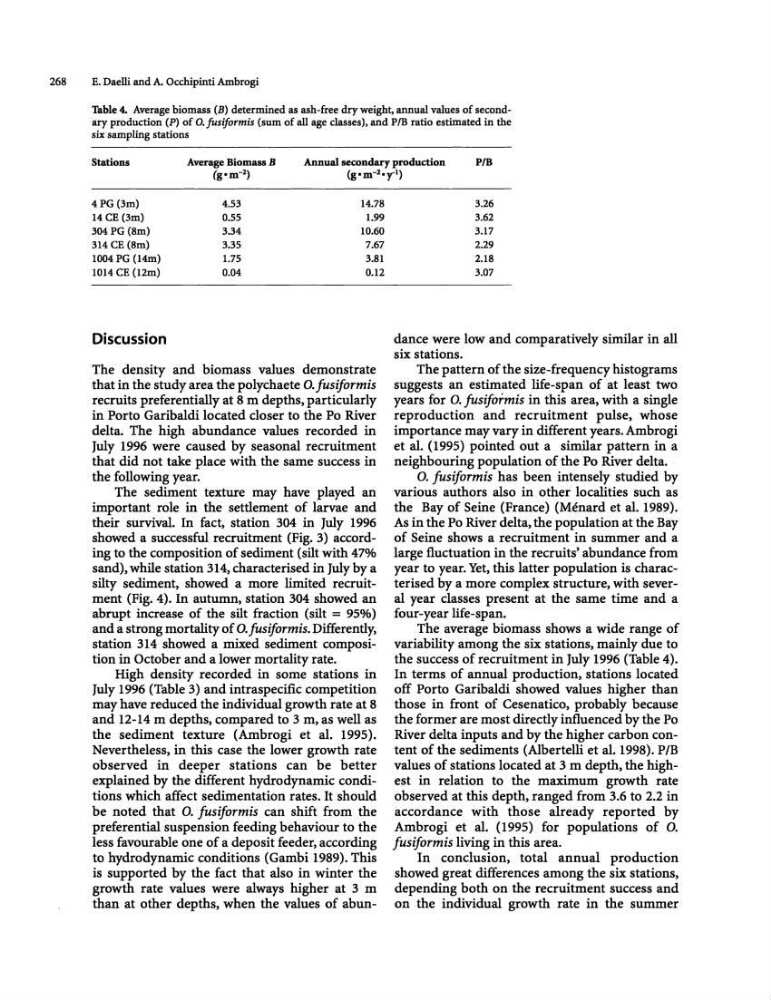
Table 4. Average biomass (B) determined as ash -free dry weight, annual values of secondary production (P) of D.fusiformis (sum of all age classes), and PIB ratio estimated in the
six sampling stations
Stations
Average Biomass B
Annual secondary production
PIB
(gam- Z )
(gom-Z.yl)
4PG (3m)
4.53
14.78
14 CE (3m)
0.55
1.99
304PG (8m)
3.34
10.60
314CE (8m)
3.35
7.67
1004 PG (14m)
1.75
3.81
1014 CE (12m)
0.04
0.12
Discussion
The density and biomass values demonstrate
that in the study area the polychaete O. fusiformis
recruits preferentially at 8 m depths, particularly
in Porto Garibaldi located doser to the Po River
delta. The high abundance values recorded in
July 1996 were caused by seasonal recruitment
that did not take place with the same success in
the following year.
The sediment texture may have played an
important role in the settlement of larvae and
their survival. In fact, station 304 in July 1996
showed a successful recruitment (Fig. 3) according to the composition of sediment (silt with 47%
sand), while station 314, characterised in July by a
silty sediment, showed a more limited recruitment (Fig. 4). In autumn, station 304 showed an
abrupt increase of the silt fraction (silt = 95%)
and a strong mortality of O. fusiformis. Differently,
station 314 showed a mixed sediment composition in October and a lower mortality rate.
High density recorded in some stations in
July 1996 (Table 3) and intraspecific competition
may have reduced the individual growth rate at 8
and 12-14 m depths, compared to 3 m, as well as
the sediment texture (Ambrogi et al. 1995).
Nevertheless, in this case the lower growth rate
observed in deeper stations can be better
explained by the different hydrodynamic conditions which affect sedimentation rates. It should
be noted that O. fusiformis can shift from the
preferential suspension feeding behaviour to the
less favourable one of a deposit feeder, according
to hydrodynamic conditions (Gambi 1989). This
is supported by the fact that also in winter the
growth rate values were always higher at 3 m
than at other depths, when the values of abun3.26
3.62
3.17
2.29
2.18
3.07
dance were low and comparatively similar in all
six stations.
The pattern of the size-frequency histograms
suggests an estimated life-span of at least two
years for O. fusiform is in this area, with a single
reproduction and recruitment pulse, whose
importance may vary in different years. Ambrogi
et al. (1995) pointed out a similar pattern in a
neighbouring population of the Po River delta. .
O. fusiformis has been intensely studied by
various authors also in other localities such as
the Bay of Seine (France) (Menard et al. 1989).
As in the Po River delta, the population at the Bay
of Seine shows a recruitment in summer and a
large fluctuation in the recruits' abundance from
year to year. Yet, this latter population is characterised by a more complex structure, with several year classes present at the same time and a
four-year life-span.
The average biomass shows a wide range of
variability among the six stations, mainly due to
the success of recruitment in July 1996 (Table 4).
In terms of annual production, stations located
off Porto Garibaldi showed values higher than
those in front of Cesenatico, probably because
the former are most directly influenced by the Po
River delta inputs and by the higher carbon content of the sediments (Albertelli et al. 1998). PIB
values of stations located at 3 m depth, the highest in relation to the maximum growth rate
observed at this depth, ranged from 3.6 to 2.2 in
accordance with those already reported by
Ambrogi et a1. (1995) for populations of O.
fusiformis living in this area.
In conclusion, total annual production
showed great differences among the six stations,
depending both on the recruitment success and
on the individual growth rate in the summer
E. Dae1li and A. Occhipinti Ambrogi
Table 4. Average biomass (B) determined as ash -free dry weight, annual values of secondary production (P) of D.fusiformis (sum of all age classes), and PIB ratio estimated in the
six sampling stations
Stations
Average Biomass B
Annual secondary production
PIB
(gam- Z )
(gom-Z.yl)
4PG (3m)
4.53
14.78
14 CE (3m)
0.55
1.99
304PG (8m)
3.34
10.60
314CE (8m)
3.35
7.67
1004 PG (14m)
1.75
3.81
1014 CE (12m)
0.04
0.12
Discussion
The density and biomass values demonstrate
that in the study area the polychaete O. fusiformis
recruits preferentially at 8 m depths, particularly
in Porto Garibaldi located doser to the Po River
delta. The high abundance values recorded in
July 1996 were caused by seasonal recruitment
that did not take place with the same success in
the following year.
The sediment texture may have played an
important role in the settlement of larvae and
their survival. In fact, station 304 in July 1996
showed a successful recruitment (Fig. 3) according to the composition of sediment (silt with 47%
sand), while station 314, characterised in July by a
silty sediment, showed a more limited recruitment (Fig. 4). In autumn, station 304 showed an
abrupt increase of the silt fraction (silt = 95%)
and a strong mortality of O. fusiformis. Differently,
station 314 showed a mixed sediment composition in October and a lower mortality rate.
High density recorded in some stations in
July 1996 (Table 3) and intraspecific competition
may have reduced the individual growth rate at 8
and 12-14 m depths, compared to 3 m, as well as
the sediment texture (Ambrogi et al. 1995).
Nevertheless, in this case the lower growth rate
observed in deeper stations can be better
explained by the different hydrodynamic conditions which affect sedimentation rates. It should
be noted that O. fusiformis can shift from the
preferential suspension feeding behaviour to the
less favourable one of a deposit feeder, according
to hydrodynamic conditions (Gambi 1989). This
is supported by the fact that also in winter the
growth rate values were always higher at 3 m
than at other depths, when the values of abun3.26
3.62
3.17
2.29
2.18
3.07
dance were low and comparatively similar in all
six stations.
The pattern of the size-frequency histograms
suggests an estimated life-span of at least two
years for O. fusiform is in this area, with a single
reproduction and recruitment pulse, whose
importance may vary in different years. Ambrogi
et al. (1995) pointed out a similar pattern in a
neighbouring population of the Po River delta. .
O. fusiformis has been intensely studied by
various authors also in other localities such as
the Bay of Seine (France) (Menard et al. 1989).
As in the Po River delta, the population at the Bay
of Seine shows a recruitment in summer and a
large fluctuation in the recruits' abundance from
year to year. Yet, this latter population is characterised by a more complex structure, with several year classes present at the same time and a
four-year life-span.
The average biomass shows a wide range of
variability among the six stations, mainly due to
the success of recruitment in July 1996 (Table 4).
In terms of annual production, stations located
off Porto Garibaldi showed values higher than
those in front of Cesenatico, probably because
the former are most directly influenced by the Po
River delta inputs and by the higher carbon content of the sediments (Albertelli et al. 1998). PIB
values of stations located at 3 m depth, the highest in relation to the maximum growth rate
observed at this depth, ranged from 3.6 to 2.2 in
accordance with those already reported by
Ambrogi et a1. (1995) for populations of O.
fusiformis living in this area.
In conclusion, total annual production
showed great differences among the six stations,
depending both on the recruitment success and
on the individual growth rate in the summer