

256
A. Covazzi Harriague et al.
induced sediment characteristics (grain size,
organic matter and hydrocarbon contents), by
means of correlative methods.
Material and Methods
Study Site and Sampling
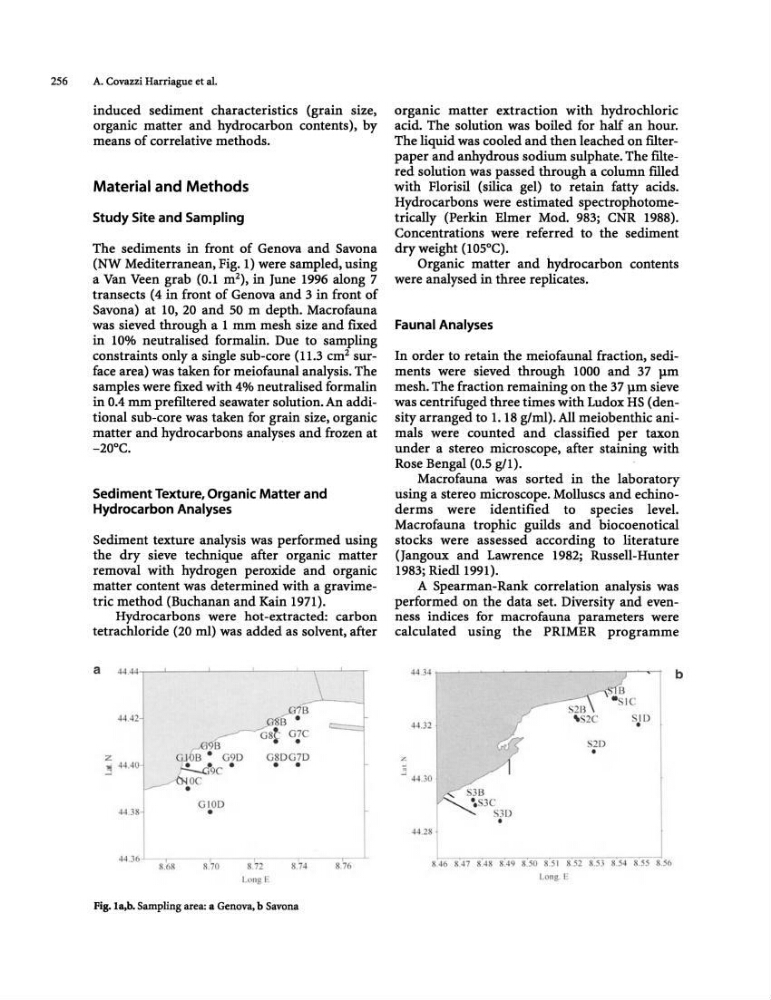
The sediments in front of Genova and Savona
(NW Mediterranean, Fig. 1) were sampled, using
a Van Veen grab (O.l m 2 ), in June 1996 along 7
transects (4 in front of Genova and 3 in front of
Savona) at 10, 20 and 50 m depth. Macrofauna
was sieved through a 1 mm mesh size and fixed
in 10% neutralised formalin. Due to sampling
constraints only a single sub-core (11.3 cm 2 surface area) was taken for meiofaunal analysis. The
samples were fixed with 4% neutralised formalin
in 0.4 mm prefIltered seawater solution. An additional sub-core was taken for grain size, organic
matter and hydrocarbons analyses and frozen at
-20°C.
.
Sediment Texture, Organic Matter and
Hydrocarbon Analyses
Sediment texture analysis was performed using
the dry sieve technique after organic matter
removal with hydrogen peroxide and organic
matter content was determined with a gravimetric method (Buchanan and Kain 1971).
Hydrocarbons were hot-extracted: carbon
tetrachloride (20 ml) was added as solvent, after
44..l2
z
S 44.40
•
GIOD
44.38
•
44 .36
I
,
8.6
8.70
B
B •
G8~ G] C
G8DG7D
8.'72
Long E
• •
8.74
Fig. la,b. Sampling area: a Genova, b Savona
8.76
organic matter extraction with hydrochloric
acid. The solution was boiled for half an hour.
The liquid was cooled and then leached on fIlterpaper and anhydrous sodium sulphate. The fIltered solution was passed through a column fIlled
with Florisil (silica gel) to retain fatty acids.
Hydrocarbons were estimated spectrophotometrically (Perkin Elmer Mod. 983; CNR 1988).
Concentrations were referred to the sediment
dry weight (!OSOC).
Organic matter and hydrocarbon contents
were analysed in three replicates.
Faunal Analyses
In order to retain the meiofaunal fraction, sediments were sieved through 1000 and 37 JllIl
mesh. The fraction remaining on the 37 }lm sieve
was centrifuged three times with Ludox HS (density arranged to 1. 18 glmI). All meiobenthic animals were counted and classified per taxon
under a stereo microscope, after staining with
Rose Bengal (0.5 gil).
Macrofauna was sorted in the laboratory
using a stereo microscope. Molluscs and echinoderms were identified to species level.
Macrofauna trophic guilds and biocoenotical
stocks were assessed according to literature
Oangoux and Lawrence 1982; Russell-Hunter
1983; Riedl 1991).
A Spearman-Rank correlation analysis was
performed on the data set. Diversity and evenness indices for macrofauna parameters were
calculated using the PRIMER programme
~
~
44 .34 t--~--~--------r-""""
44.]2
S2D
•
44 .30
-M .28
8,46 8.47 8.48 8,.1'1 8.50 8.51 8.52 8.53 8.54 8.55 8.56
Long. C
b
A. Covazzi Harriague et al.
induced sediment characteristics (grain size,
organic matter and hydrocarbon contents), by
means of correlative methods.
Material and Methods
Study Site and Sampling
The sediments in front of Genova and Savona
(NW Mediterranean, Fig. 1) were sampled, using
a Van Veen grab (O.l m 2 ), in June 1996 along 7
transects (4 in front of Genova and 3 in front of
Savona) at 10, 20 and 50 m depth. Macrofauna
was sieved through a 1 mm mesh size and fixed
in 10% neutralised formalin. Due to sampling
constraints only a single sub-core (11.3 cm 2 surface area) was taken for meiofaunal analysis. The
samples were fixed with 4% neutralised formalin
in 0.4 mm prefIltered seawater solution. An additional sub-core was taken for grain size, organic
matter and hydrocarbons analyses and frozen at
-20°C.
.
Sediment Texture, Organic Matter and
Hydrocarbon Analyses
Sediment texture analysis was performed using
the dry sieve technique after organic matter
removal with hydrogen peroxide and organic
matter content was determined with a gravimetric method (Buchanan and Kain 1971).
Hydrocarbons were hot-extracted: carbon
tetrachloride (20 ml) was added as solvent, after
44..l2
z
S 44.40
•
GIOD
44.38
•
44 .36
I
,
8.6
8.70
B
B •
G8~ G] C
G8DG7D
8.'72
Long E
• •
8.74
Fig. la,b. Sampling area: a Genova, b Savona
8.76
organic matter extraction with hydrochloric
acid. The solution was boiled for half an hour.
The liquid was cooled and then leached on fIlterpaper and anhydrous sodium sulphate. The fIltered solution was passed through a column fIlled
with Florisil (silica gel) to retain fatty acids.
Hydrocarbons were estimated spectrophotometrically (Perkin Elmer Mod. 983; CNR 1988).
Concentrations were referred to the sediment
dry weight (!OSOC).
Organic matter and hydrocarbon contents
were analysed in three replicates.
Faunal Analyses
In order to retain the meiofaunal fraction, sediments were sieved through 1000 and 37 JllIl
mesh. The fraction remaining on the 37 }lm sieve
was centrifuged three times with Ludox HS (density arranged to 1. 18 glmI). All meiobenthic animals were counted and classified per taxon
under a stereo microscope, after staining with
Rose Bengal (0.5 gil).
Macrofauna was sorted in the laboratory
using a stereo microscope. Molluscs and echinoderms were identified to species level.
Macrofauna trophic guilds and biocoenotical
stocks were assessed according to literature
Oangoux and Lawrence 1982; Russell-Hunter
1983; Riedl 1991).
A Spearman-Rank correlation analysis was
performed on the data set. Diversity and evenness indices for macrofauna parameters were
calculated using the PRIMER programme
~
~
44 .34 t--~--~--------r-""""
44.]2
S2D
•
44 .30
-M .28
8,46 8.47 8.48 8,.1'1 8.50 8.51 8.52 8.53 8.54 8.55 8.56
Long. C
b