

246
M. Cormaci et al.
arenites but the island of St Nicola is composed
of more recent rocks like Pliocene dolomites
(Rizzi Longo 1972).
The phytobenthos of the Tremiti Islands has,
to date, been studied only from the floristic point
of view and rather poorly too. The first publication on the area is that of Pignatti et al. (1967)
who listed 70 species from the island of St
Domino. Then, some more floristic data were
reported by Giaccone (I969) who listed 75
species from the island of Caprara and 90 species
from St Domino. Rizzi Longo (1972) who listed
260 species from the archipelago and Giaccone
(1978) who, in his check-list of the Adriatic Sea,
reported 3 new species. Finally, 18 additional
new species from the archipelago were more
recently reported by Solazzi et ala (1991-94).
From the above literature data, appropriately
updated from both taxonomic and nomenclatural points of view, the benthic marine flora of the
Tremiti Islands consists of 281 accepted taxa at
specific and infraspecific level, Cyanophyta
excluded.
In order to evaluate changes that have possibly occurred in the phytobenthic communities in
the last three decades, within the frame of the
Project C.N.R. Prisma 2, sub-project 3, both benthic flora and vegetation of the above Islands were
studied. In the paper by Cormaci and Furnari
(1999), the first considerations on differences
between the present flora and that from literature
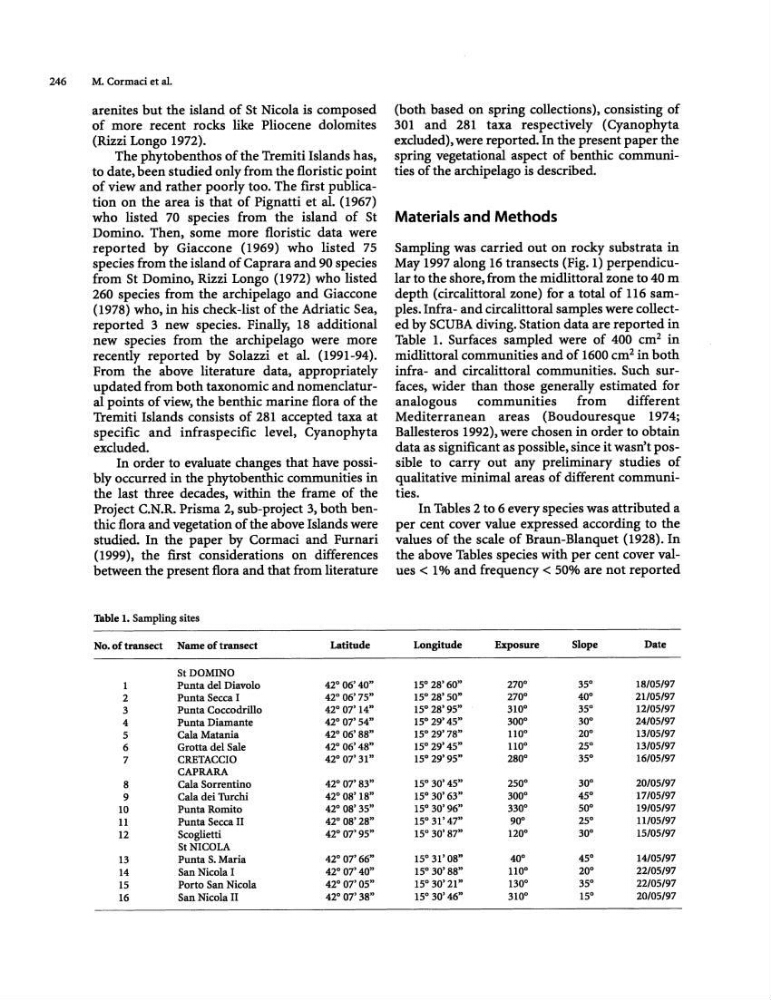
Table 1. Sampling sites
No. of transect Name of transect
Latitude
StDOMINO
1
Punta del Diavolo
42° 06'40"
2
Punta Secca I
42° 06'75"
3
Punta Coccodri1lo
42° 07' 14"
4
Punta Diamante
42° 07' 54"
5
Cala Matania
42" 06' 88"
6
GroUa del Sale
42" 06'48'"
7
CRETACCIO
42" 07' 31"
CAPRARA
8
Cala Sorrentino
42" 07' 83"
9
Cala dei Turchi
42° 08' 18"
10
Punta Romito
42° 08' 35"
11
Punta Secca II
42° 08'28"
12
ScogIietti
42°07'95"
StNICOLA
13
Punta S. Maria
42" 07' 66"
14
San Nicola I
42° 07'40"
15
Porto San Nicola
42° 07' 05"
16
San Nicola II
42° 07' 38"
(both based on spring collections), consisting of
301 and 281 taxa respectively (Cyanophyta
excluded), were reported In the present paper the
spring vegetational aspect of benthic communities of the archipelago is described
Materials and Methods
Sampling was carried out on rocky substrata in
May 1997 along 16 transects (Fig. 1) perpendicular to the shore, from the midlittoral zone to 40 m
depth (circalittoral zone) for a total of 116 samples. Infra- and circalittoral samples were collected by SCUBA diving. Station data are reported in
Table 1. Surfaces sampled were of 400 cm 2 in
midlittoral communities and of 1600 cm 2 in both
infra- and drcalittoral communities. Such surfaces, wider than those generally estimated for
analogous communities from
different
Mediterranean areas (Boudouresque 1974;
Ballesteros 1992), were chosen in order to obtain
data as significant as possible, since it wasn't possible to carry out any preliminary studies of
qualitative minimal areas of different communities.
In Tables 2 to 6 every species was attributed a
per cent cover value expressed according to the
values of the scale of Braun-Blanquet (1928). In
the above Tables species with per cent cover values < 1% and frequency < 50% are not reported
Longitude
Exposure
Slope
Date
15° 28'60"
270 0
35°
18/05/97
15° 28' 50"
270 0
40·
21/05/97
15° 28'95"
310°
35°
12/05/97
IS" 29' 45"
300"
30"
24105197
IS" 29'78"
110"
20"
13/05/97
15° 29' 45"
110"
25°
13/05/97
IS" 29'95"
280 0
35°
16/05/97
15" 30' 45"
250"
30°
20/05/97
15° 30'63"
300"
45°
17/05/97
15" 30'96"
330"
50°
19/05/97
15° 31' 47"
90·
25°
11/05/97
IS" 30' 87"
120 0
30·
15/05/97
15° 31'08"
40·
45°
14/05/97
15° 30' 88"
110"
20"
22/05/97
15° 30' 21"
130°
35"
22/05/97
15° 30'46"
310°
15 0
2Q/05/97
M. Cormaci et al.
arenites but the island of St Nicola is composed
of more recent rocks like Pliocene dolomites
(Rizzi Longo 1972).
The phytobenthos of the Tremiti Islands has,
to date, been studied only from the floristic point
of view and rather poorly too. The first publication on the area is that of Pignatti et al. (1967)
who listed 70 species from the island of St
Domino. Then, some more floristic data were
reported by Giaccone (I969) who listed 75
species from the island of Caprara and 90 species
from St Domino. Rizzi Longo (1972) who listed
260 species from the archipelago and Giaccone
(1978) who, in his check-list of the Adriatic Sea,
reported 3 new species. Finally, 18 additional
new species from the archipelago were more
recently reported by Solazzi et ala (1991-94).
From the above literature data, appropriately
updated from both taxonomic and nomenclatural points of view, the benthic marine flora of the
Tremiti Islands consists of 281 accepted taxa at
specific and infraspecific level, Cyanophyta
excluded.
In order to evaluate changes that have possibly occurred in the phytobenthic communities in
the last three decades, within the frame of the
Project C.N.R. Prisma 2, sub-project 3, both benthic flora and vegetation of the above Islands were
studied. In the paper by Cormaci and Furnari
(1999), the first considerations on differences
between the present flora and that from literature
Table 1. Sampling sites
No. of transect Name of transect
Latitude
StDOMINO
1
Punta del Diavolo
42° 06'40"
2
Punta Secca I
42° 06'75"
3
Punta Coccodri1lo
42° 07' 14"
4
Punta Diamante
42° 07' 54"
5
Cala Matania
42" 06' 88"
6
GroUa del Sale
42" 06'48'"
7
CRETACCIO
42" 07' 31"
CAPRARA
8
Cala Sorrentino
42" 07' 83"
9
Cala dei Turchi
42° 08' 18"
10
Punta Romito
42° 08' 35"
11
Punta Secca II
42° 08'28"
12
ScogIietti
42°07'95"
StNICOLA
13
Punta S. Maria
42" 07' 66"
14
San Nicola I
42° 07'40"
15
Porto San Nicola
42° 07' 05"
16
San Nicola II
42° 07' 38"
(both based on spring collections), consisting of
301 and 281 taxa respectively (Cyanophyta
excluded), were reported In the present paper the
spring vegetational aspect of benthic communities of the archipelago is described
Materials and Methods
Sampling was carried out on rocky substrata in
May 1997 along 16 transects (Fig. 1) perpendicular to the shore, from the midlittoral zone to 40 m
depth (circalittoral zone) for a total of 116 samples. Infra- and circalittoral samples were collected by SCUBA diving. Station data are reported in
Table 1. Surfaces sampled were of 400 cm 2 in
midlittoral communities and of 1600 cm 2 in both
infra- and drcalittoral communities. Such surfaces, wider than those generally estimated for
analogous communities from
different
Mediterranean areas (Boudouresque 1974;
Ballesteros 1992), were chosen in order to obtain
data as significant as possible, since it wasn't possible to carry out any preliminary studies of
qualitative minimal areas of different communities.
In Tables 2 to 6 every species was attributed a
per cent cover value expressed according to the
values of the scale of Braun-Blanquet (1928). In
the above Tables species with per cent cover values < 1% and frequency < 50% are not reported
Longitude
Exposure
Slope
Date
15° 28'60"
270 0
35°
18/05/97
15° 28' 50"
270 0
40·
21/05/97
15° 28'95"
310°
35°
12/05/97
IS" 29' 45"
300"
30"
24105197
IS" 29'78"
110"
20"
13/05/97
15° 29' 45"
110"
25°
13/05/97
IS" 29'95"
280 0
35°
16/05/97
15" 30' 45"
250"
30°
20/05/97
15° 30'63"
300"
45°
17/05/97
15" 30'96"
330"
50°
19/05/97
15° 31' 47"
90·
25°
11/05/97
IS" 30' 87"
120 0
30·
15/05/97
15° 31'08"
40·
45°
14/05/97
15° 30' 88"
110"
20"
22/05/97
15° 30' 21"
130°
35"
22/05/97
15° 30'46"
310°
15 0
2Q/05/97