

238
C. Cerrano et al.
60 ~--------------------------------------------.
50
~ 40
II)
o
c..
~ 30
u
... c
Q)
I:
~ 20
10
o
15·20 m
20·25 m
25·30 m
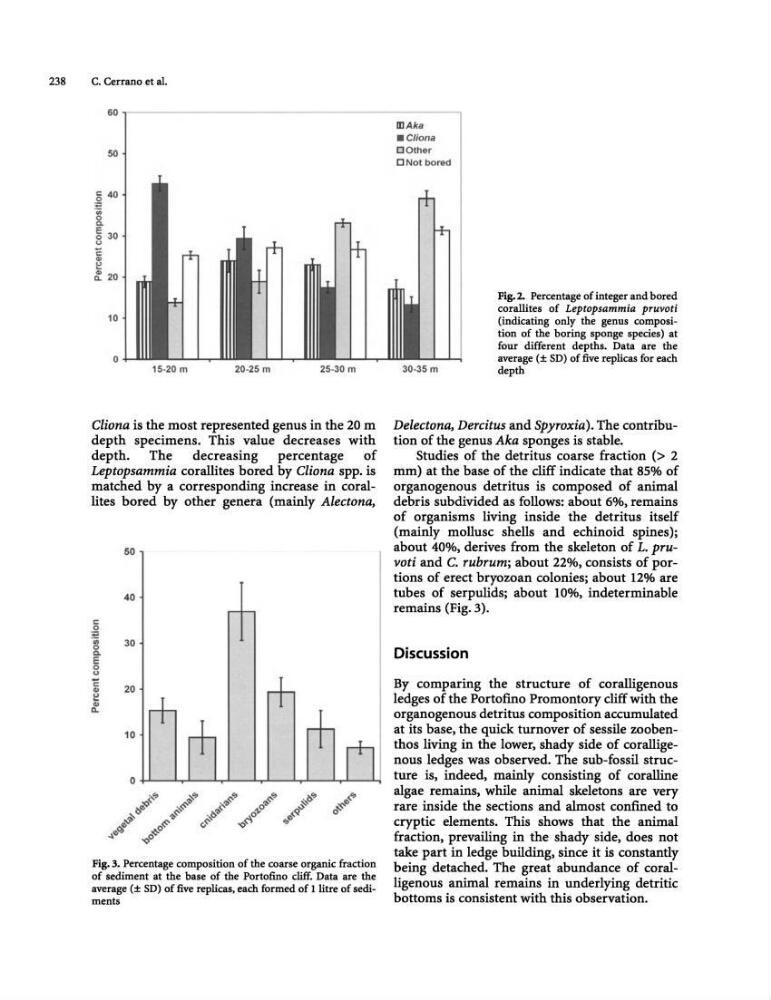
Cliona is the most represented genus in the 20 m
depth specimens. This value decreases with
depth. The decreasing percentage of
Leptopsammia corallites bored by Cliona spp. is
matched by a corresponding increase in corallites bored by other genera (mainly Alectona,
c
o
:.E
(/)
o
0.
S
o
u
50
40
30
C
Q)
20
I: Q)
11.
10
o -
Fig. 3. Percentage composition of the coarse organic fraction
of sediment at the base of the Portofino cliff. Data are the
average (± SD) of five replicas, each formed of 1 litre of sediments
IDAka
.Cliona
[lOther
DNot bored
30· 35 m
Fig. 2. Percentage of integer and bored
corallites of Leptopsammia pruvoti
(indicating only the genus composition of the boring sponge species) at
four different depths. Data are the
average (± SD) of five replicas for each
depth
Delectona, Dercitus and Spyroxia). The contribution of the genus Aka sponges is stable.
Studies of the detritus coarse fraction (> 2
mm) at the base of the cliff indicate that 85% of
organogenous detritus is composed of animal
debris subdivided as follows: about 6%, remains
of organisms living inside the detritus itself
(mainly mollusc shells and echinoid spines);
about 40%, derives from the skeleton of L. pruvoti and C. rubrum; about 22%, consists of portions of erect bryozoan colonies; about 12% are
tubes of serpulids; about 10%, indeterminable
remains (Fig. 3).
Discussion
By comparing the structure of coralligenous
ledges of the Portofino Promontory cliff with the
organogenous detritus composition accumulated
at its base, the quick turnover of sessile zoobenthos living in the lower, shady side of coralligenous ledges was observed. The sub-fossil structure is, indeed, mainly consisting of coralline
algae remains, while animal skeletons are very
rare inside the sections and almost confined to
cryptic elements. This shows that the animal
fraction, prevailing in the shady side, does not
take part in ledge building, since it is constantly
being detached. The great abundance of coralligenous animal remains in underlying detritic
bottoms is consistent with this observation.
C. Cerrano et al.
60 ~--------------------------------------------.
50
~ 40
II)
o
c..
~ 30
u
... c
Q)
I:
~ 20
10
o
15·20 m
20·25 m
25·30 m
Cliona is the most represented genus in the 20 m
depth specimens. This value decreases with
depth. The decreasing percentage of
Leptopsammia corallites bored by Cliona spp. is
matched by a corresponding increase in corallites bored by other genera (mainly Alectona,
c
o
:.E
(/)
o
0.
S
o
u
50
40
30
C
Q)
20
I: Q)
11.
10
o -
Fig. 3. Percentage composition of the coarse organic fraction
of sediment at the base of the Portofino cliff. Data are the
average (± SD) of five replicas, each formed of 1 litre of sediments
IDAka
.Cliona
[lOther
DNot bored
30· 35 m
Fig. 2. Percentage of integer and bored
corallites of Leptopsammia pruvoti
(indicating only the genus composition of the boring sponge species) at
four different depths. Data are the
average (± SD) of five replicas for each
depth
Delectona, Dercitus and Spyroxia). The contribution of the genus Aka sponges is stable.
Studies of the detritus coarse fraction (> 2
mm) at the base of the cliff indicate that 85% of
organogenous detritus is composed of animal
debris subdivided as follows: about 6%, remains
of organisms living inside the detritus itself
(mainly mollusc shells and echinoid spines);
about 40%, derives from the skeleton of L. pruvoti and C. rubrum; about 22%, consists of portions of erect bryozoan colonies; about 12% are
tubes of serpulids; about 10%, indeterminable
remains (Fig. 3).
Discussion
By comparing the structure of coralligenous
ledges of the Portofino Promontory cliff with the
organogenous detritus composition accumulated
at its base, the quick turnover of sessile zoobenthos living in the lower, shady side of coralligenous ledges was observed. The sub-fossil structure is, indeed, mainly consisting of coralline
algae remains, while animal skeletons are very
rare inside the sections and almost confined to
cryptic elements. This shows that the animal
fraction, prevailing in the shady side, does not
take part in ledge building, since it is constantly
being detached. The great abundance of coralligenous animal remains in underlying detritic
bottoms is consistent with this observation.