

222
S. Vizzini et al.
one month along a Posidonia oceanica transect
(-1, -3, -5, -15 metres depth) by means of a
hand-towed net (Russo et al. 1985).
Samples were fixed in formalin (10%
buffered in sea-water) and the classic biometric
(total length, standard length, head length, adhesive disk length, ocular diameter, maximum
width) and meristic (dorsal fm rays, anal fin rays,
caudal fin rays) measurements were carried out.
Differences in the biometric and meristic relationships between O. gracilis from the two study
sites were tested using t-test, after the verification of the normality.
Feeding and foraging habits were investigated in the specimens from the "Stagnone di
Marsala". A subs ample of 20 specimens for each
season was dissected under a stereomicroscope.
The prey were counted and identified. The percentage contribution of each prey taxon to the
total prey volume was estimated visually.
Quantitative and qualitative stomach content
analysis was carried out using both simple (percentage of number, percentage of occurrence and
percentage of volume of prey) (Hyslop 1980) and
compound indexes (lRI: index of relative importance) (Pinkas et al. 1971). The lRl was standardised to 100% by calculating the percentage of the
total lRI contributed by each prey type and
ranged from 0 (absent from diet) to 100 (the
only prey consumed).
Results
Biometric and Meristic Characters
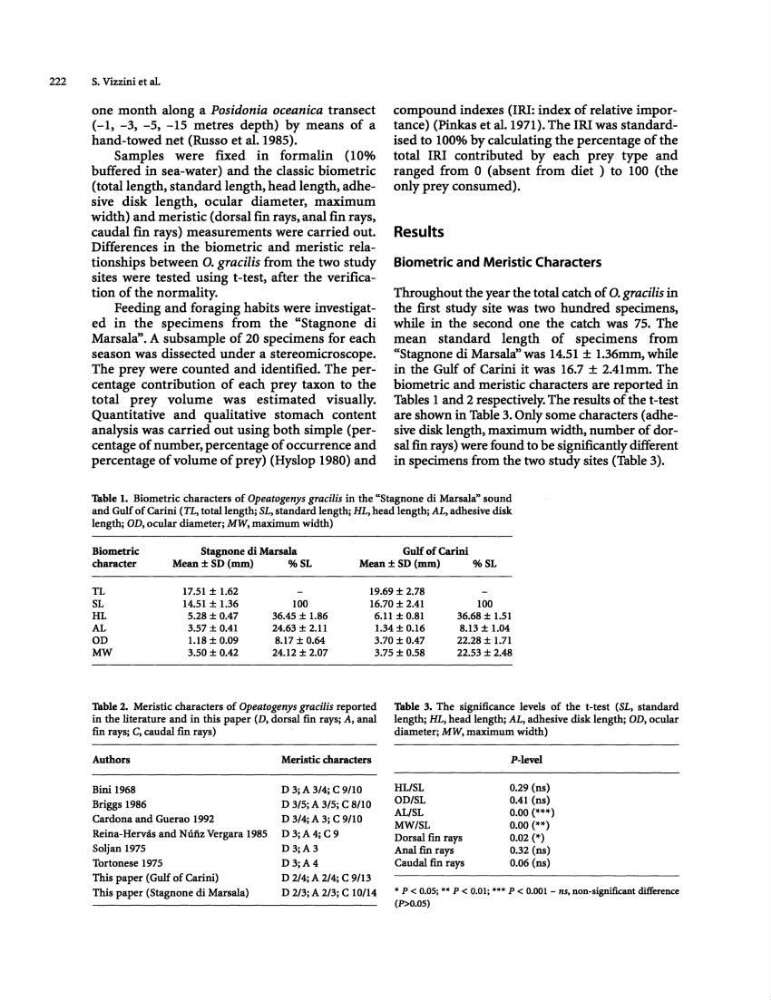
Throughout the year the total catch of O. gracilis in
the first study site was two hundred specimens,
while in the second one the catch was 75. The
mean standard length of specimens from
"Stagnone di Marsala» was 14.51 ± 1.36mm, while
in the Gulf of Carini it was 16.7 ± 2.41mm. The
biometric and meristic characters are reported in
Tables 1 and 2 respectively. The results of the t-test
are shown in Table 3. Only some characters (adhesive disk length. maximum width, number of dorsal fin rays) were found to be significantly different
in specimens from the two study sites (Table 3).
Table 1. Biometric characters of Opeatogenys gracilis in the "Stagnone di Marsala" sound
and Gulf of Carini (TL, total length; SL, standard length; HL, head length; AL, adhesive disk
length; OD, ocular diameter; MW, maximum width)
Biometric
character
Stagnone di Marsala
Gulf of Carini
Mean ± SD (mm)
% 5L
Mean ± 5D (mm)
% SL
TL
SL
HL
AL
OD
MW
17.51 ± 1.62
14.51 ± 1.36
5.28 ± 0.47
3.57 ± 0.41
1.18 ± 0.09
3.50± 0.42
100
36.45 ± 1.86
24.63 ± 2.11
8.17 ± 0.64
24.12 ± 2.07
19.69 ± 2.78
16.70 ± 2.41
6.11 ± 0.81
1.34 ± 0.16
3.70± 0.47
3.75 ± O.S8
100
36.68 ± 1.51
8.13 ± 1.04
22.28 ± 1.71
22.53 ± 2.48
Table 2. Meristic characters of Opeatogenys gracilis reported
in the literature and in this paper (D, dorsal fm rays; A, anal
fm rays; C, caudal fin rays)
Table 3. The significance levels of the t-test (SL, standard
length; HL, head length; AL, adhesive disk length; OD, ocular
diameter; MW, maximum width)
Authors
Bini 1968
Briggs 1986
Cardona and Guerao 1992
Reina-Hems and Nuftz Vergara 1985
Soljan 1975
Tortonese 1975
This paper (Gulf of Carini)
This paper (Stagnone di Marsala)
Meristic characters
D 3; A 3/4; C 9110
D 3/5; A 3/5; C 8110
D 3/4; A 3; C 9/10
D 3;A4; C9
D3;A 3
D3;A4
D 2/4; A 2/4; C 9/13
D 2/3; A 2/3; C 10114
HUSL
OD/5L
AUSL
MW/SL
Dorsal fin rays
Anal fin rays
Caudal fm rays
P-level
0.29 (ns)
0.41 (ns)
0.00 ( ...... )
0.00 ( .... )
0.02 ( .. )
0.32 (ns)
0.06 (ns)
" P < 0.05; ** P < 0.01; *** P < 0.001 - ns, non-significant difference
(P>O.05)
S. Vizzini et al.
one month along a Posidonia oceanica transect
(-1, -3, -5, -15 metres depth) by means of a
hand-towed net (Russo et al. 1985).
Samples were fixed in formalin (10%
buffered in sea-water) and the classic biometric
(total length, standard length, head length, adhesive disk length, ocular diameter, maximum
width) and meristic (dorsal fm rays, anal fin rays,
caudal fin rays) measurements were carried out.
Differences in the biometric and meristic relationships between O. gracilis from the two study
sites were tested using t-test, after the verification of the normality.
Feeding and foraging habits were investigated in the specimens from the "Stagnone di
Marsala". A subs ample of 20 specimens for each
season was dissected under a stereomicroscope.
The prey were counted and identified. The percentage contribution of each prey taxon to the
total prey volume was estimated visually.
Quantitative and qualitative stomach content
analysis was carried out using both simple (percentage of number, percentage of occurrence and
percentage of volume of prey) (Hyslop 1980) and
compound indexes (lRI: index of relative importance) (Pinkas et al. 1971). The lRl was standardised to 100% by calculating the percentage of the
total lRI contributed by each prey type and
ranged from 0 (absent from diet) to 100 (the
only prey consumed).
Results
Biometric and Meristic Characters
Throughout the year the total catch of O. gracilis in
the first study site was two hundred specimens,
while in the second one the catch was 75. The
mean standard length of specimens from
"Stagnone di Marsala» was 14.51 ± 1.36mm, while
in the Gulf of Carini it was 16.7 ± 2.41mm. The
biometric and meristic characters are reported in
Tables 1 and 2 respectively. The results of the t-test
are shown in Table 3. Only some characters (adhesive disk length. maximum width, number of dorsal fin rays) were found to be significantly different
in specimens from the two study sites (Table 3).
Table 1. Biometric characters of Opeatogenys gracilis in the "Stagnone di Marsala" sound
and Gulf of Carini (TL, total length; SL, standard length; HL, head length; AL, adhesive disk
length; OD, ocular diameter; MW, maximum width)
Biometric
character
Stagnone di Marsala
Gulf of Carini
Mean ± SD (mm)
% 5L
Mean ± 5D (mm)
% SL
TL
SL
HL
AL
OD
MW
17.51 ± 1.62
14.51 ± 1.36
5.28 ± 0.47
3.57 ± 0.41
1.18 ± 0.09
3.50± 0.42
100
36.45 ± 1.86
24.63 ± 2.11
8.17 ± 0.64
24.12 ± 2.07
19.69 ± 2.78
16.70 ± 2.41
6.11 ± 0.81
1.34 ± 0.16
3.70± 0.47
3.75 ± O.S8
100
36.68 ± 1.51
8.13 ± 1.04
22.28 ± 1.71
22.53 ± 2.48
Table 2. Meristic characters of Opeatogenys gracilis reported
in the literature and in this paper (D, dorsal fm rays; A, anal
fm rays; C, caudal fin rays)
Table 3. The significance levels of the t-test (SL, standard
length; HL, head length; AL, adhesive disk length; OD, ocular
diameter; MW, maximum width)
Authors
Bini 1968
Briggs 1986
Cardona and Guerao 1992
Reina-Hems and Nuftz Vergara 1985
Soljan 1975
Tortonese 1975
This paper (Gulf of Carini)
This paper (Stagnone di Marsala)
Meristic characters
D 3; A 3/4; C 9110
D 3/5; A 3/5; C 8110
D 3/4; A 3; C 9/10
D 3;A4; C9
D3;A 3
D3;A4
D 2/4; A 2/4; C 9/13
D 2/3; A 2/3; C 10114
HUSL
OD/5L
AUSL
MW/SL
Dorsal fin rays
Anal fin rays
Caudal fm rays
P-level
0.29 (ns)
0.41 (ns)
0.00 ( ...... )
0.00 ( .... )
0.02 ( .. )
0.32 (ns)
0.06 (ns)
" P < 0.05; ** P < 0.01; *** P < 0.001 - ns, non-significant difference
(P>O.05)