

216
N. Ungaro and G. Marano
Lat. N
j! . . . ·j-j·i· .. ·
4200
Southern
Adriatic
Sea
41 .50
4100
not trawlable area
4050
ITALY
15.50
16.00
16.50
17 .00
17.50
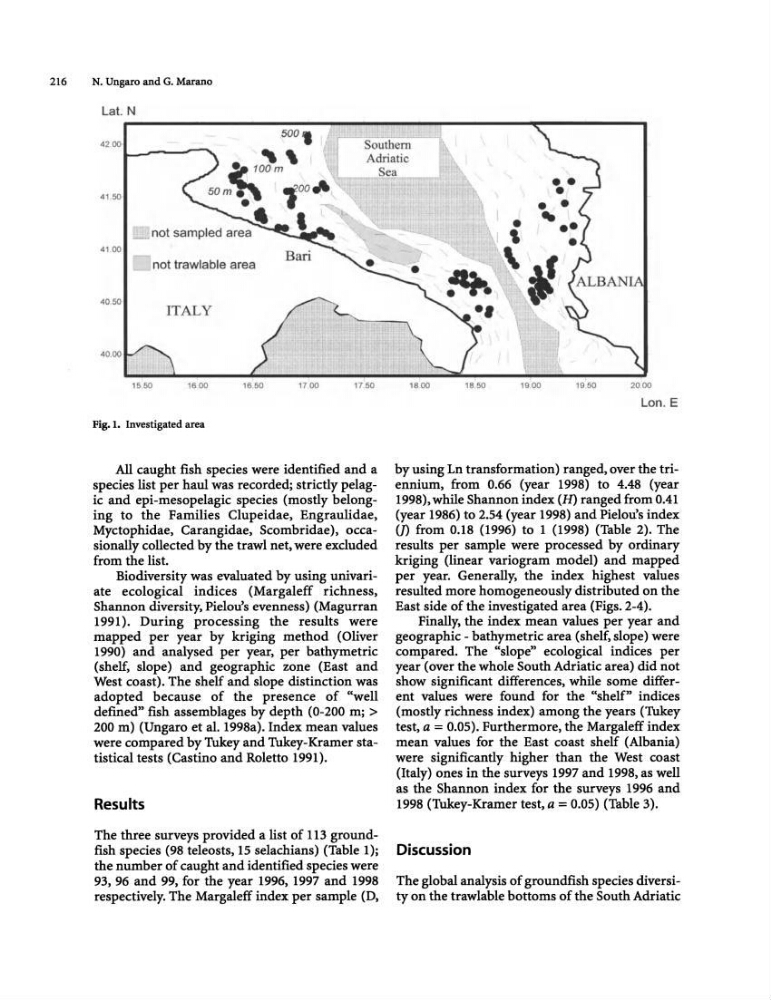
Fig. 1. Investigated area
All caught fish species were identified and a
species list per haul was recorded; strictly pelagic and epi-mesopelagic species (mostly belonging to the Families Clupeidae, Engraulidae,
Myctophidae, Carangidae, Scombridae), occasionally collected by the trawl net, were excluded
from the list.
Biodiversity was evaluated by using univariate ecological indices (Margaleff richness,
Shannon diversity, Pielou's evenness) (Magurran
1991). During processing the results were
mapped per year by kriging method (Oliver
1990) and analysed per year, per bathymetric
(shelf, slope) and geographic zone (East and
West coast). The shelf and slope distinction was
adopted because of the presence of "well
defined" fish assemblages by depth (0-200 mj >
200 m) (Ungaro et al. 1998a). Index mean values
were compared by Tukey and Tukey-Kramer statistical tests (Castino and Roletto 1991).
Results
The three surveys provided a list of 113 groundfish species (98 teleosts, 15 selachians) (Table 1);
the number of caught and identified species were
93,96 and 99, for the year 1996, 1997 and 1998
respectively. The Margaleff index per sample (D,
18.00
18 .50
19.00
19.50
2000
Lan. E
by using Ln transformation) ranged, over the triennium, from 0.66 (year 1998) to 4.48 (year
1998), while Shannon index (H) ranged from 0.41
(year 1986) to 2.54 (year 1998) and Pielou's index
(J) from 0.18 (1996) to 1 (1998) (Table 2). The
results per sample were processed by ordinary
kriging (linear variogram model) and mapped
per year. Generally, the index highest values
resulted more homogeneously distributed on the
East side of the investigated area (Figs. 2-4).
Finally, the index mean values per year and
geographic - bathymetric area (shelf, slope) were
compared. The "slope" ecological indices per
year (over the whole South Adriatic area) did not
show significant differences, while some different values were found for the "shelf" indices
(mostly richness index) among the years (Tukey
test, a = 0.05). Furthermore, the Margaleff index
mean values for the East coast shelf (Albania)
were significantly higher than the West coast
(Italy) ones in the surveys 1997 and 1998) as well
as the Shannon index for the surveys 1996 and
1998 (Tukey-Kramer test, a = 0.05) (Table 3).
Discussion
The global analysis of groundfish species diversity on the trawlable bottoms of the South Adriatic
N. Ungaro and G. Marano
Lat. N
j! . . . ·j-j·i· .. ·
4200
Southern
Adriatic
Sea
41 .50
4100
not trawlable area
4050
ITALY
15.50
16.00
16.50
17 .00
17.50
Fig. 1. Investigated area
All caught fish species were identified and a
species list per haul was recorded; strictly pelagic and epi-mesopelagic species (mostly belonging to the Families Clupeidae, Engraulidae,
Myctophidae, Carangidae, Scombridae), occasionally collected by the trawl net, were excluded
from the list.
Biodiversity was evaluated by using univariate ecological indices (Margaleff richness,
Shannon diversity, Pielou's evenness) (Magurran
1991). During processing the results were
mapped per year by kriging method (Oliver
1990) and analysed per year, per bathymetric
(shelf, slope) and geographic zone (East and
West coast). The shelf and slope distinction was
adopted because of the presence of "well
defined" fish assemblages by depth (0-200 mj >
200 m) (Ungaro et al. 1998a). Index mean values
were compared by Tukey and Tukey-Kramer statistical tests (Castino and Roletto 1991).
Results
The three surveys provided a list of 113 groundfish species (98 teleosts, 15 selachians) (Table 1);
the number of caught and identified species were
93,96 and 99, for the year 1996, 1997 and 1998
respectively. The Margaleff index per sample (D,
18.00
18 .50
19.00
19.50
2000
Lan. E
by using Ln transformation) ranged, over the triennium, from 0.66 (year 1998) to 4.48 (year
1998), while Shannon index (H) ranged from 0.41
(year 1986) to 2.54 (year 1998) and Pielou's index
(J) from 0.18 (1996) to 1 (1998) (Table 2). The
results per sample were processed by ordinary
kriging (linear variogram model) and mapped
per year. Generally, the index highest values
resulted more homogeneously distributed on the
East side of the investigated area (Figs. 2-4).
Finally, the index mean values per year and
geographic - bathymetric area (shelf, slope) were
compared. The "slope" ecological indices per
year (over the whole South Adriatic area) did not
show significant differences, while some different values were found for the "shelf" indices
(mostly richness index) among the years (Tukey
test, a = 0.05). Furthermore, the Margaleff index
mean values for the East coast shelf (Albania)
were significantly higher than the West coast
(Italy) ones in the surveys 1997 and 1998) as well
as the Shannon index for the surveys 1996 and
1998 (Tukey-Kramer test, a = 0.05) (Table 3).
Discussion
The global analysis of groundfish species diversity on the trawlable bottoms of the South Adriatic