

4
G. Aiello et aL
morphological break, which normally separates
the continental shelf from the upper slope, is
not clearly identified, while offshore the
Posillipo hill a morphological break is present
near the 90 m isobath. Such a complex physiography is accounted for by the interference of
subaerial and submarine volcanism coupled to
tectonism and linear erosion operated by the
Dohrn and Magnaghi canyons and their tributary channels.
The whole continental shelf is covered by
recent « 10 k years) drape and most of the
seabed features have been recognised through
seismic interpretation in Holocene sediments
(Fig. 3); where the resolution of profiles does not
allow the identification of the Holocene drape,
the analysis of bottom samples (box-cores) has
confirmed the wide occurrence of a thin veneer
of recent sediments.
Multibeam data show the occurrence of two
non volcanic bathymetric highs located next to
the heads of the Dohrn canyon at the centre of
the bay. Seismic stratigraphy reveals that they
consist of deltaic sediments arranged with clinoform patterns and related to the distal part of a
fossil prograding wedge fed by the paleo-Sarno
80m
nw
gOm
80 m
90m
100m
110 m
river. These remnants have an elevation with
respect to the surrounding average depth that is
in the order of 20-30 m. This anomaly can be
accounted for by the differential erosion that has
occurred during the shelf subaerial exposure
related to eustatic lowstand. Seismic evidence
allows to infer a pre- "Campanian Ignimbrite"
age (e.g. 35 ka) of this erosional phase.
In the Torre del Greco offshore area submerged or buried parasitic vents, genetically
related to the Somma-Vesuvius volcano, appear
concentrated along a NE-SW trend. A tectonic
lineament, showing evidence of normal faulting,
has been previously suggested by Finetti and
Morelli (1974) in the Somma Vesuvius area, based
on the interpretation of multichannel seismic
profiles. In the offshore region between Torre del
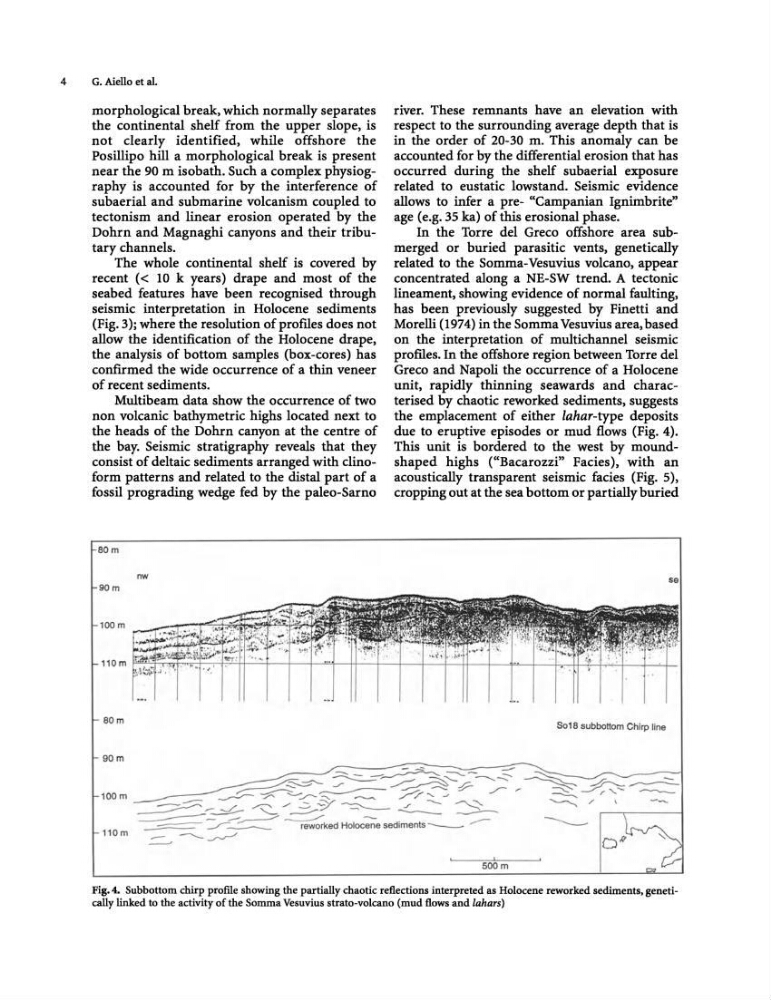
Greco and Napoli the occurrence of a Holocene
unit, rapidly thinning seawards and characterised by chaotic reworked sediments, suggests
the emplacement of either lahar-type deposits
due to eruptive episodes or mud flows (Fig. 4).
This unit is bordered to the west by moundshaped highs ("Bacarozzi" Facies). with an
acoustically transparent seismic facies (Fig. 5),
cropping out at the sea bottom or partially buried
se
S018 subbottom Chirp line
Fig.4. Subbottom chirp profile showing the partially chaotic reflections interpreted as Holocene reworked sediments, genetically linked to the activity of the Somma Vesuvius strato-volcano (mud flows and lahars)
G. Aiello et aL
morphological break, which normally separates
the continental shelf from the upper slope, is
not clearly identified, while offshore the
Posillipo hill a morphological break is present
near the 90 m isobath. Such a complex physiography is accounted for by the interference of
subaerial and submarine volcanism coupled to
tectonism and linear erosion operated by the
Dohrn and Magnaghi canyons and their tributary channels.
The whole continental shelf is covered by
recent « 10 k years) drape and most of the
seabed features have been recognised through
seismic interpretation in Holocene sediments
(Fig. 3); where the resolution of profiles does not
allow the identification of the Holocene drape,
the analysis of bottom samples (box-cores) has
confirmed the wide occurrence of a thin veneer
of recent sediments.
Multibeam data show the occurrence of two
non volcanic bathymetric highs located next to
the heads of the Dohrn canyon at the centre of
the bay. Seismic stratigraphy reveals that they
consist of deltaic sediments arranged with clinoform patterns and related to the distal part of a
fossil prograding wedge fed by the paleo-Sarno
80m
nw
gOm
80 m
90m
100m
110 m
river. These remnants have an elevation with
respect to the surrounding average depth that is
in the order of 20-30 m. This anomaly can be
accounted for by the differential erosion that has
occurred during the shelf subaerial exposure
related to eustatic lowstand. Seismic evidence
allows to infer a pre- "Campanian Ignimbrite"
age (e.g. 35 ka) of this erosional phase.
In the Torre del Greco offshore area submerged or buried parasitic vents, genetically
related to the Somma-Vesuvius volcano, appear
concentrated along a NE-SW trend. A tectonic
lineament, showing evidence of normal faulting,
has been previously suggested by Finetti and
Morelli (1974) in the Somma Vesuvius area, based
on the interpretation of multichannel seismic
profiles. In the offshore region between Torre del
Greco and Napoli the occurrence of a Holocene
unit, rapidly thinning seawards and characterised by chaotic reworked sediments, suggests
the emplacement of either lahar-type deposits
due to eruptive episodes or mud flows (Fig. 4).
This unit is bordered to the west by moundshaped highs ("Bacarozzi" Facies). with an
acoustically transparent seismic facies (Fig. 5),
cropping out at the sea bottom or partially buried
se
S018 subbottom Chirp line
Fig.4. Subbottom chirp profile showing the partially chaotic reflections interpreted as Holocene reworked sediments, genetically linked to the activity of the Somma Vesuvius strato-volcano (mud flows and lahars)