

188
O. Sidoti et al.
the neritic system, collected in June. Cluster A)
included all coastal samples collected in June.
Clusters A2 and Al included, respectively, offshore
and coastal samples collected in AugustSeptember.
Winter'97
The abundance and biomass of zooplankton
ranged from 263-8825 indJm 3 and 2.19-51.58
mg/m3, respectively; the means ± SD were
1760±1472 ind/m 3 and 14.87±9.04 mglm 3 • There
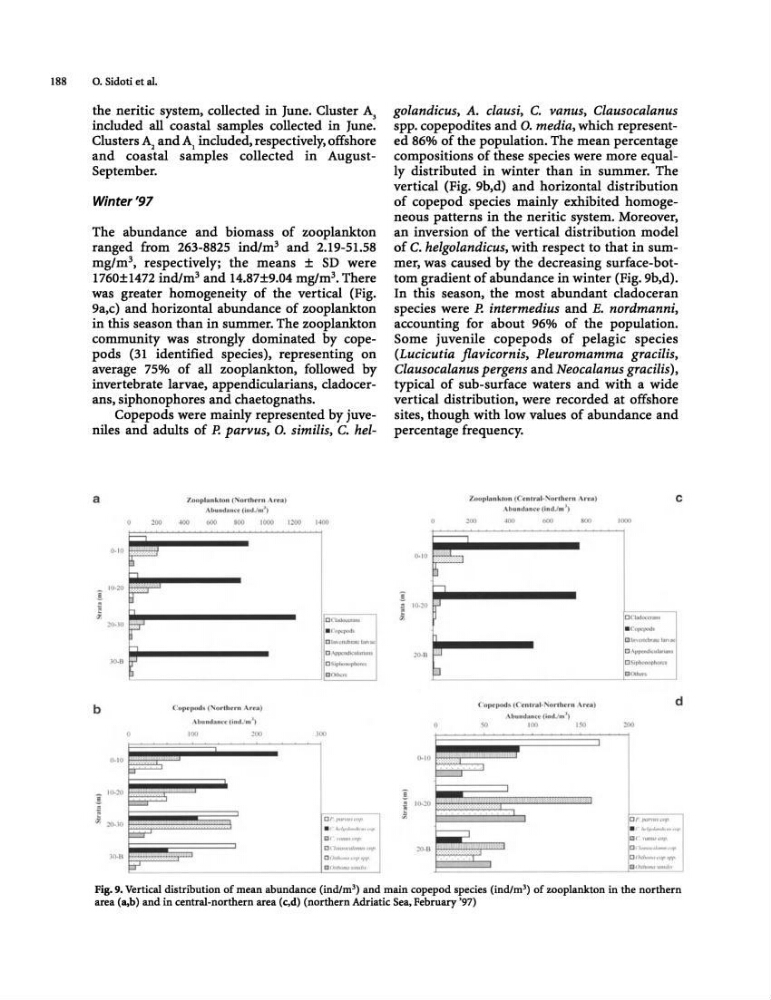
was greater homogeneity of the vertical (Fig.
9a,c) and horizontal abundance of zooplankton
in this season than in summer. The zooplankton
community was strongly dominated by copepods (31 identified species), representing on
average 75% of all zooplankton, followed by
invertebrate larvae, appendicularians, cladocerans, siphonophores and chaetognaths.
Copepods were mainly represented by juveniles and adults of P. parvus, O. similis, C. hela
b
7...onllblnkton (i"o ..-lhcFn A reI' )
,\ buud fl ll.('(' (i nd .lrn")
200
400
600
800
1000
1200
Hoo
O-IO ~ '
31>-0 :: .• :::.:." ..
I=!'
C O(lf' l'ods (. o rfher'n , 1- \ ('('iI}
t\bulltinn[" t (inc.l J Il /.I)
100
O[I"'~rldjl'lilC'l.!lf\IJC
O "'~r'IJKlIl;IIIiJII)
O "'llpbollOpilOrn
D OII~f
)00
D f',irI:/nl1hWp
. t' ",·IJo.~>I..l ... /"'",.{,..,.
D ( "fmmo(j,I,I,W\ (l".
D (hllJ
-
golandicus, A. clausi, C. van us, Clausocalanus
spp. copepodites and O. media, which represented 86% of the population. The mean percentage
compositions of these species were more equally distributed in winter than in summer. The
vertical (Fig. 9b,d) and horizontal distribution
of copepod species mainly exhibited homogeneous patterns in the neritic system. Moreover,
an inversion of the vertical distribution model
of C. helgolandicus, with respect to that in summer, was caused by the decreasing surface-bottom gradient of abundance in winter (Fig. 9b,d).
In this season, the most abundant cladoceran
species were P. intermedius and E. nordmanni,
accounting for about 96% of the population.
Some juvenile copepods of pelagic species
(Lucicutia jlavicornis, Pleuromamma gracilis,
Clausocalanus pergens and Neocalanus gracilis),
typical of sub-surface waters and with a wide
vertical distribution, were recorded at offshore
sites, though with low values of abundance and
percentage frequency.
o
ZnolllllnklOn (C't ntrnt-J orlht'rn J- \ rt!u I
Abund:In("e (Int.l J Il1 J)
200
800
("U I1\: II(Jtb ( eli ((' al~ NO"lht: .. u ... \I"t~IJ
blmdlll1((' ( ind./Ill')
50
100
ISO
1000
D Cbdoccr.lIn!j
WII I\(nd,)lflN~ bJ'\1lC
I!I r\ppcrld",,,I:t.fwu
c
d
200
( ) ' I o ii; ~ "" ~
f---l
~
:!O-B "", •
.,.""",,",,,,.~,.~,.,,~. I' I'··
OJ' pflnlj"~'"
. t' 1w1,.~.J.M~J ...... H'f'
C e' 'l~j~OIJI.
C ~)tl'It1fJ("·(J(lIJ'I'
C (J/lhIJfM fjlmh,Fig. 9. Vertical distribution of mean abundance (indJm 3 ) and main copepod species (ind/m 3 ) of zooplankton in the northern
area (a,b) and in central-northern area (c,d) (northern Adriatic Sea, February '97)
O. Sidoti et al.
the neritic system, collected in June. Cluster A)
included all coastal samples collected in June.
Clusters A2 and Al included, respectively, offshore
and coastal samples collected in AugustSeptember.
Winter'97
The abundance and biomass of zooplankton
ranged from 263-8825 indJm 3 and 2.19-51.58
mg/m3, respectively; the means ± SD were
1760±1472 ind/m 3 and 14.87±9.04 mglm 3 • There
was greater homogeneity of the vertical (Fig.
9a,c) and horizontal abundance of zooplankton
in this season than in summer. The zooplankton
community was strongly dominated by copepods (31 identified species), representing on
average 75% of all zooplankton, followed by
invertebrate larvae, appendicularians, cladocerans, siphonophores and chaetognaths.
Copepods were mainly represented by juveniles and adults of P. parvus, O. similis, C. hela
b
7...onllblnkton (i"o ..-lhcFn A reI' )
,\ buud fl ll.('(' (i nd .lrn")
200
400
600
800
1000
1200
Hoo
O-IO ~ '
31>-0 :: .• :::.:." ..
I=!'
C O(lf' l'ods (. o rfher'n , 1- \ ('('iI}
t\bulltinn[" t (inc.l J Il /.I)
100
O[I"'~rldjl'lilC'l.!lf\IJC
O "'~r'IJKlIl;IIIiJII)
O "'llpbollOpilOrn
D OII~f
)00
D f',irI:/nl1hWp
. t' ",·IJo.~>I..l ... /"'",.{,..,.
D ( "fmmo(j,I,I,W\ (l".
D (hllJ
-
golandicus, A. clausi, C. van us, Clausocalanus
spp. copepodites and O. media, which represented 86% of the population. The mean percentage
compositions of these species were more equally distributed in winter than in summer. The
vertical (Fig. 9b,d) and horizontal distribution
of copepod species mainly exhibited homogeneous patterns in the neritic system. Moreover,
an inversion of the vertical distribution model
of C. helgolandicus, with respect to that in summer, was caused by the decreasing surface-bottom gradient of abundance in winter (Fig. 9b,d).
In this season, the most abundant cladoceran
species were P. intermedius and E. nordmanni,
accounting for about 96% of the population.
Some juvenile copepods of pelagic species
(Lucicutia jlavicornis, Pleuromamma gracilis,
Clausocalanus pergens and Neocalanus gracilis),
typical of sub-surface waters and with a wide
vertical distribution, were recorded at offshore
sites, though with low values of abundance and
percentage frequency.
o
ZnolllllnklOn (C't ntrnt-J orlht'rn J- \ rt!u I
Abund:In("e (Int.l J Il1 J)
200
800
("U I1\: II(Jtb ( eli ((' al~ NO"lht: .. u ... \I"t~IJ
blmdlll1((' ( ind./Ill')
50
100
ISO
1000
D Cbdoccr.lIn!j
WII I\(nd,)lflN~ bJ'\1lC
I!I r\ppcrld",,,I:t.fwu
c
d
200
( ) ' I o ii; ~ "" ~
f---l
~
:!O-B "", •
.,.""",,",,,,.~,.~,.,,~. I' I'··
OJ' pflnlj"~'"
. t' 1w1,.~.J.M~J ...... H'f'
C e' 'l~j~OIJI.
C ~)tl'It1fJ("·(J(lIJ'I'
C (J/lhIJfM fjlmh,Fig. 9. Vertical distribution of mean abundance (indJm 3 ) and main copepod species (ind/m 3 ) of zooplankton in the northern
area (a,b) and in central-northern area (c,d) (northern Adriatic Sea, February '97)