

182
O. Sidoti et al.
Materials and Methods
Study Area
The northern Adriatic basin is delimited in the
south off Ancona, with varying depths from
around 30 m to about 70 m (Franco 1983). The
circulation and distribution of the water masses
are strongly influenced by the bottom morphology (Franco et al. 1982), by meteorological conditions (Buljan and Zore-Armanda 1976; Franco
1973,1983; Franco et al. 1982) and by large fresh
water contributions from Italian rivers (Fonda
Umani et al. 1994). In the northern basin, a
frontal system is established throughout most of
the year (Franco 1983; Fonda Umani et al. 1992),
which clearly separates the neritic eutrophic
waters from the oligo-mesotrophic offshore
ones, producing two independent and ecologically different systems (Fonda Umani et al. 1994).
These characteristics determine cyclic variations
of the vertical stability of the water column; in
winter, there is complete instability, while a clear
stratification is evident during the rest of the
year (Fonda Umani et al.1992).
The central basin, from Ancona south to a
transverse line off Pescara (Artegiani et al.1993),
exhibits a north to south transition in its feaa W'~ ____________________________ - .
N
~
! ,n :~7. : ,. ~
I' I"'~:I
. ~
, ..
,so
tures. It is characterized by increasing depths of
the bottom until the meso-Adriatic depths. In
this area, the characteristics of the neighbouring
basins alternately prevail, during the year.
Sampling Procedures
Within the framework of the Prism a 2 Project,
four oceanographic cruises were carried out -
two in the northern Adriatic Sea (June 1996 and
February 1997) and two in the central Adriatic
(August-September 1996 and February-March
1997). In the northern Adriatic, two sampling
zones were chosen: the first north off Ravenna
(northern area), the second north off Ancona
(central-northern area). Two hundred and four
samples were collected by the electronic multinet
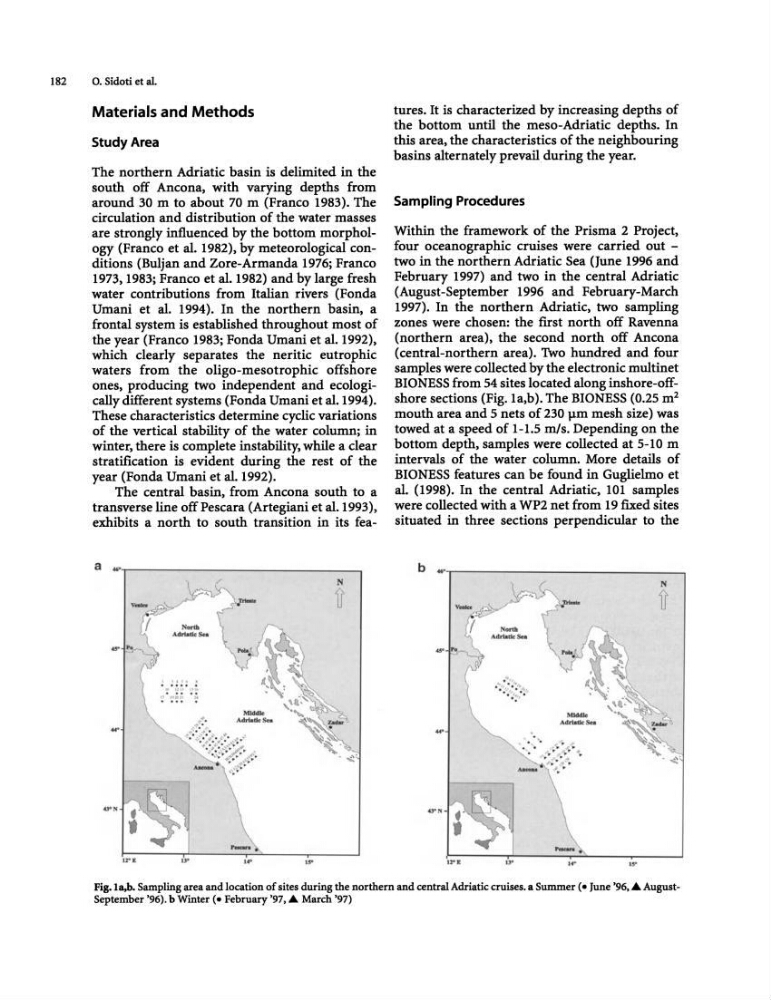
BIONESS from 54 sites located along inshore-offshore sections (Fig.la,b). The BIONESS (0.25 m 2
mouth area and 5 nets of 230 pm mesh size) was
towed at a speed of 1-1.5 m/s. Depending on the
bottom depth, samples were collected at 5-10 m
intervals of the water column. More details of
BIONESS features can be found in Guglielmo et
al. (1998). In the central Adriatic, 101 samples
were collected with a WP2 net from 19 fixed sites
situated in three sections perpendicular to the
b W'~------_ _____________________ - ,
N
~
...
WN
........
,..
'"
Fig. la.b. Sampling area and location of sites during the northern and central Adriatic cruises. a Summer (e June '96,. AugustSeptember '96). b Winter (e February '97,. March '97)
O. Sidoti et al.
Materials and Methods
Study Area
The northern Adriatic basin is delimited in the
south off Ancona, with varying depths from
around 30 m to about 70 m (Franco 1983). The
circulation and distribution of the water masses
are strongly influenced by the bottom morphology (Franco et al. 1982), by meteorological conditions (Buljan and Zore-Armanda 1976; Franco
1973,1983; Franco et al. 1982) and by large fresh
water contributions from Italian rivers (Fonda
Umani et al. 1994). In the northern basin, a
frontal system is established throughout most of
the year (Franco 1983; Fonda Umani et al. 1992),
which clearly separates the neritic eutrophic
waters from the oligo-mesotrophic offshore
ones, producing two independent and ecologically different systems (Fonda Umani et al. 1994).
These characteristics determine cyclic variations
of the vertical stability of the water column; in
winter, there is complete instability, while a clear
stratification is evident during the rest of the
year (Fonda Umani et al.1992).
The central basin, from Ancona south to a
transverse line off Pescara (Artegiani et al.1993),
exhibits a north to south transition in its feaa W'~ ____________________________ - .
N
~
! ,n :~7. : ,. ~
I' I"'~:I
. ~
, ..
,so
tures. It is characterized by increasing depths of
the bottom until the meso-Adriatic depths. In
this area, the characteristics of the neighbouring
basins alternately prevail, during the year.
Sampling Procedures
Within the framework of the Prism a 2 Project,
four oceanographic cruises were carried out -
two in the northern Adriatic Sea (June 1996 and
February 1997) and two in the central Adriatic
(August-September 1996 and February-March
1997). In the northern Adriatic, two sampling
zones were chosen: the first north off Ravenna
(northern area), the second north off Ancona
(central-northern area). Two hundred and four
samples were collected by the electronic multinet
BIONESS from 54 sites located along inshore-offshore sections (Fig.la,b). The BIONESS (0.25 m 2
mouth area and 5 nets of 230 pm mesh size) was
towed at a speed of 1-1.5 m/s. Depending on the
bottom depth, samples were collected at 5-10 m
intervals of the water column. More details of
BIONESS features can be found in Guglielmo et
al. (1998). In the central Adriatic, 101 samples
were collected with a WP2 net from 19 fixed sites
situated in three sections perpendicular to the
b W'~------_ _____________________ - ,
N
~
...
WN
........
,..
'"
Fig. la.b. Sampling area and location of sites during the northern and central Adriatic cruises. a Summer (e June '96,. AugustSeptember '96). b Winter (e February '97,. March '97)