

166
M. Campolmi et al.
a
MAR.
"
1&~~~\. 8' 3:15
J!\.
.C.
' "
5:25
b
C.c.O.N. pvc.
2O:od' ..
• " ... ~o:~a A.M.
9:10
"
HAA.
0
c
":R.
1.(. AM .
. •
04:00
21:00
18:0009:00
f'V
C.U :~.
.
00:00
d
MAl'( •
.
I.C.I.e.
.
fg:~
~2:00
AM .
10:0008:1)0
.
~/:UU~. tm
13:00
3:00
A.c.
0
A.c.
0
3:00
AG.
"
05:00
A.G.
0
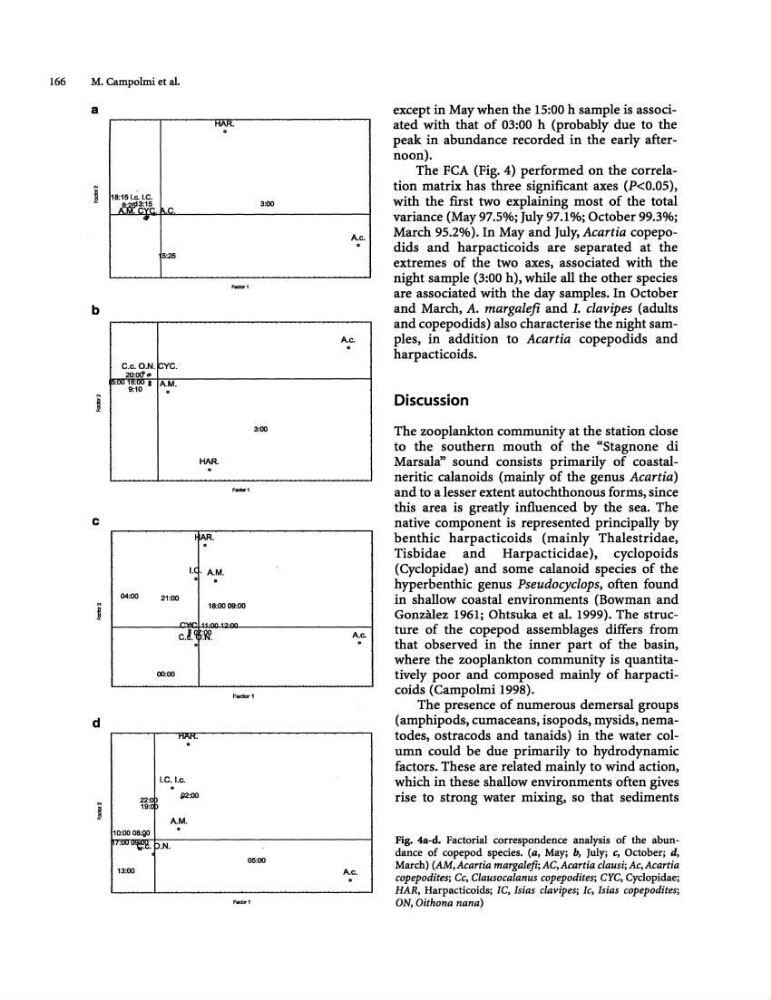
except in May when the 15:00 h sample is associated with that of 03:00 h (probably due to the
peak in abundance recorded in the early afternoon).
The FCA (Fig. 4) performed on the correlation matrix has three significant axes (P
variance (May 97.5%: July 97.1%: October 99.3%;
March 95.2%). In May and July, Acartia copepodids and harpacticoids are separated at the
extremes of the two axes, associated with the
night sample (3:00 h). while all the other species
are associated with the day samples. In October
and March, A. margaleft and 1. clavi pes (adults
and copepodids) also characterise the night samples, in addition to Acartia copepodids and
harpacticoids.
Discussion
The zooplankton community at the station dose
to the southern mouth of the "Stagnone di
Marsala" sound consists primarily of coastalneritic calanoids (mainly of the genus Acartia)
and to a lesser extent autochthonous forms, since
this area is greatly influenced by the sea. The
native component is represented principally by
benthic harpacticoids (mainly Thalestridae,
Tisbidae and Harpacticidae), cyclopoids
(Cydopidae) and some calanoid species of the
hyperbenthic genus Pseudocyclops, often found
in shallow coastal environments (Bowman and
Gonzalez 1961: Ohtsuka et aI. 1999). The structure of the copepod assemblages differs from
that observed in the inner part of the basin,
where the zooplankton community is quantitatively poor and composed mainly of harpacticoids (Campolmi 1998).
The presence of numerous demersal groups
(amphipods, cumaceans, isopods, mysids, nematodes, ostracods and tanaids) in the water column could be due primarily to hydrodynamic
factors. These are related mainly to wind action,
which in these shallow environments often gives
rise to strong water mixing, so that sediments
Fig. 4a-d. Factorial correspondence analysis of the abundance of copepod species. (a, May; b, July; c, October; d,
March) (AM, Acartia margalefi; AG, Acartia clausi; Ac, Acartia
eopepodites; Ce, Clausoealanus eopepodites; CYC, Cyclopidaej
HAR, Harpacticoids; IC, Isias clavi pes; Ie, Isias eopepodites;
ON, Oithona nana)
M. Campolmi et al.
a
MAR.
"
1&~~~\. 8' 3:15
J!\.
.C.
' "
5:25
b
C.c.O.N. pvc.
2O:od' ..
• " ... ~o:~a A.M.
9:10
"
HAA.
0
c
":R.
1.(. AM .
. •
04:00
21:00
18:0009:00
f'V
C.U :~.
.
00:00
d
MAl'( •
.
I.C.I.e.
.
fg:~
~2:00
AM .
10:0008:1)0
.
~/:UU~. tm
13:00
3:00
A.c.
0
A.c.
0
3:00
AG.
"
05:00
A.G.
0
except in May when the 15:00 h sample is associated with that of 03:00 h (probably due to the
peak in abundance recorded in the early afternoon).
The FCA (Fig. 4) performed on the correlation matrix has three significant axes (P
variance (May 97.5%: July 97.1%: October 99.3%;
March 95.2%). In May and July, Acartia copepodids and harpacticoids are separated at the
extremes of the two axes, associated with the
night sample (3:00 h). while all the other species
are associated with the day samples. In October
and March, A. margaleft and 1. clavi pes (adults
and copepodids) also characterise the night samples, in addition to Acartia copepodids and
harpacticoids.
Discussion
The zooplankton community at the station dose
to the southern mouth of the "Stagnone di
Marsala" sound consists primarily of coastalneritic calanoids (mainly of the genus Acartia)
and to a lesser extent autochthonous forms, since
this area is greatly influenced by the sea. The
native component is represented principally by
benthic harpacticoids (mainly Thalestridae,
Tisbidae and Harpacticidae), cyclopoids
(Cydopidae) and some calanoid species of the
hyperbenthic genus Pseudocyclops, often found
in shallow coastal environments (Bowman and
Gonzalez 1961: Ohtsuka et aI. 1999). The structure of the copepod assemblages differs from
that observed in the inner part of the basin,
where the zooplankton community is quantitatively poor and composed mainly of harpacticoids (Campolmi 1998).
The presence of numerous demersal groups
(amphipods, cumaceans, isopods, mysids, nematodes, ostracods and tanaids) in the water column could be due primarily to hydrodynamic
factors. These are related mainly to wind action,
which in these shallow environments often gives
rise to strong water mixing, so that sediments
Fig. 4a-d. Factorial correspondence analysis of the abundance of copepod species. (a, May; b, July; c, October; d,
March) (AM, Acartia margalefi; AG, Acartia clausi; Ac, Acartia
eopepodites; Ce, Clausoealanus eopepodites; CYC, Cyclopidaej
HAR, Harpacticoids; IC, Isias clavi pes; Ie, Isias eopepodites;
ON, Oithona nana)