

Mesozooplankton in a Mediterranean Coastal Sound (Stagnone di Marsala, Western Siclly)
159
evident in all the surveys and appeared to be
influenced by the tidal cycle. The current direction rotated approximately 180 0 at 6-h intervals,
so that four current phases took place over the 24h period, two at about 45 0 (N/E) and the other two
at about 225 D (SIW). The incoming current (N/E)
was generally recorded during high tide while the
outgoing current (SIW) was recorded during low
tide, except in May (15:00 h) when an outgoing
current was recorded during high tide. This was
probably due to the effect of the S/E wind, pushing the waters out of the basin. The opposition of
the two driving forces (tide and wind) gives rise
to marked turbulence and water mixing.
The current speed was very variable and did
not exhibit a clear cyclic component. The highest
current speed (26 cm/s) was recorded in a NIE
direction, but high speed (24.2 em/s) was also
recorded in the opposite direction (S/W).
Zooplankton
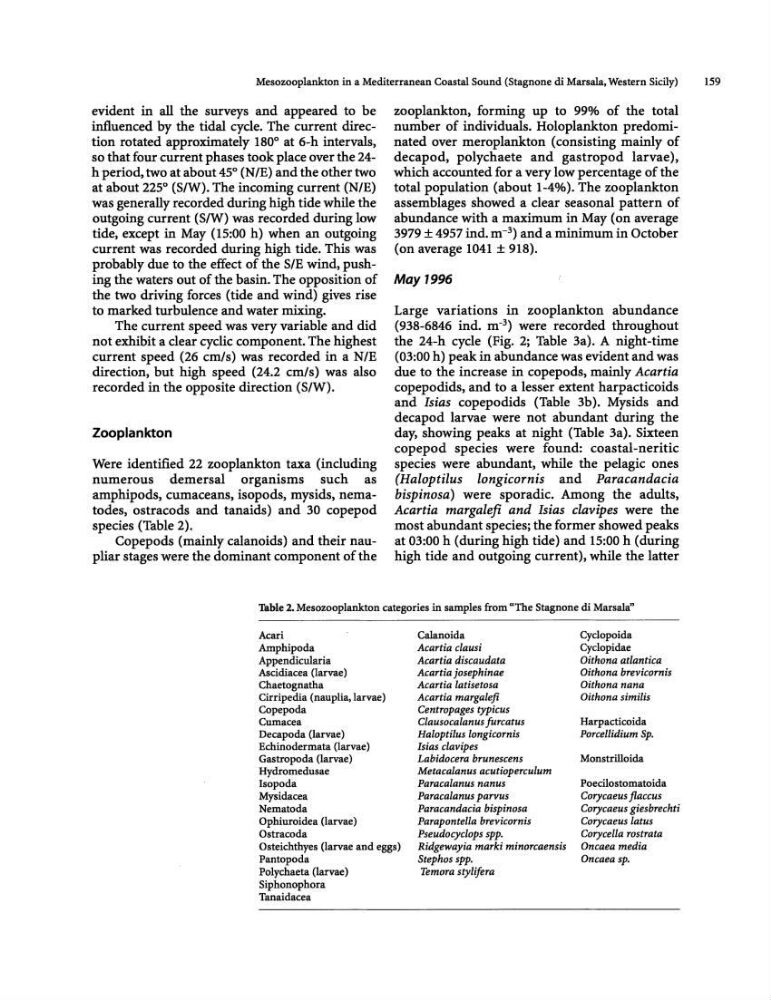
Were identified 22 zooplankton taxa (including
numerous demersal organisms such as
amphipods, cumaceans, isopods, mysids, nematodes, ostracods and tanaids) and 30 copepod
species (Table 2).
Copepods (mainly calanoids) and their naupHar stages were the dominant component of the
zooplankton, forming up to 99% of the total
number of individuals. Holoplankton predominated over meroplankton (consisting mainly of
decapod, polychaete and gastropod larvae),
which accounted for a very low percentage of the
total population (about 1-4%). The zooplankton
assemblages showed a clear seasonal pattern of
abundance with a maximum in May (on average
3979 ± 4957 indo m- 3 ) and a minimum in October
(on average 1041 ± 918).
May 1996
Large variations in zooplankton abundance
(938-6846 indo m- 3 ) were recorded throughout
the 24-h cycle (Fig. 2; Table 3a). A night-time
(03:00 h) peak in abundance was evident and was
due to the increase in copepods, mainly Acartia
copepodids, and to a lesser extent harpacticoids
and Isias copepodids (Table 3b). Mysids and
decapod larvae were not abundant during the
day, showing peaks at night (Table 3a). Sixteen
copepod species were found: coastal-neritic
species were abundant, while the pelagic ones
(Haloptilus longicornis and Paracandacia
bispinosa) were sporadic. Among the adults,
Acartia margaleft and Isias clavipes were the
most abundant species; the former showed peaks
at 03:00 h (during high tide) and 15:00 h (during
high tide and outgoing current), while the latter
Table 2. Mesozooplankton categories in samples from "The Stagnone di Marsala'"
Acari
Arophipoda
Appendicularia
Ascidiacea (larvae)
Chaetognatha
Cirripedia (nauplia,larvae)
Copepoda
Cumacea
Decapoda (larvae)
Echinodermata (larvae)
Gastropoda (larvae)
Hydromedusae
Isopoda
Mysidacea
Nematoda
Ophiuroidea (larvae)
Ostracoda
Osteichthyes (larvae and eggs)
Pantopoda
Polychaeta (larvae)
Siphonophora
Tanaidacea
Calanoida
Acartia clausi
Acartia discaudata
Acartia josephinae
Acartia latisetosa
Acartia margaleft
Centro pages typicus
Clausocalanus fureatu!>
Haloptilus longicornis
Isias clavi pes
Labidocera brunescens
Metaealanus acutioperculum
Paracalanus nanus
Paracalanus parvus
Paracandacia bispinosa
Parapontella brevicornis
Pseudocyclops spp.
Ridgewayia mark; minorcaensis
Stephos spp.
Temora stylifera
Cyc1opoida
Cyc10pidae
Oithona atlantica
Oithona brevicornis
Oithona nana
Oithona similis
Harpacticoida
Porcellidium Sp.
Monstrilloida
Poecilostomatoida
Corycaeus fiaccus
Corycaeus giesbrechti
Corycaeus latus
Corycella rostrata
Oneaea media
Oncaeasp.
159
evident in all the surveys and appeared to be
influenced by the tidal cycle. The current direction rotated approximately 180 0 at 6-h intervals,
so that four current phases took place over the 24h period, two at about 45 0 (N/E) and the other two
at about 225 D (SIW). The incoming current (N/E)
was generally recorded during high tide while the
outgoing current (SIW) was recorded during low
tide, except in May (15:00 h) when an outgoing
current was recorded during high tide. This was
probably due to the effect of the S/E wind, pushing the waters out of the basin. The opposition of
the two driving forces (tide and wind) gives rise
to marked turbulence and water mixing.
The current speed was very variable and did
not exhibit a clear cyclic component. The highest
current speed (26 cm/s) was recorded in a NIE
direction, but high speed (24.2 em/s) was also
recorded in the opposite direction (S/W).
Zooplankton
Were identified 22 zooplankton taxa (including
numerous demersal organisms such as
amphipods, cumaceans, isopods, mysids, nematodes, ostracods and tanaids) and 30 copepod
species (Table 2).
Copepods (mainly calanoids) and their naupHar stages were the dominant component of the
zooplankton, forming up to 99% of the total
number of individuals. Holoplankton predominated over meroplankton (consisting mainly of
decapod, polychaete and gastropod larvae),
which accounted for a very low percentage of the
total population (about 1-4%). The zooplankton
assemblages showed a clear seasonal pattern of
abundance with a maximum in May (on average
3979 ± 4957 indo m- 3 ) and a minimum in October
(on average 1041 ± 918).
May 1996
Large variations in zooplankton abundance
(938-6846 indo m- 3 ) were recorded throughout
the 24-h cycle (Fig. 2; Table 3a). A night-time
(03:00 h) peak in abundance was evident and was
due to the increase in copepods, mainly Acartia
copepodids, and to a lesser extent harpacticoids
and Isias copepodids (Table 3b). Mysids and
decapod larvae were not abundant during the
day, showing peaks at night (Table 3a). Sixteen
copepod species were found: coastal-neritic
species were abundant, while the pelagic ones
(Haloptilus longicornis and Paracandacia
bispinosa) were sporadic. Among the adults,
Acartia margaleft and Isias clavipes were the
most abundant species; the former showed peaks
at 03:00 h (during high tide) and 15:00 h (during
high tide and outgoing current), while the latter
Table 2. Mesozooplankton categories in samples from "The Stagnone di Marsala'"
Acari
Arophipoda
Appendicularia
Ascidiacea (larvae)
Chaetognatha
Cirripedia (nauplia,larvae)
Copepoda
Cumacea
Decapoda (larvae)
Echinodermata (larvae)
Gastropoda (larvae)
Hydromedusae
Isopoda
Mysidacea
Nematoda
Ophiuroidea (larvae)
Ostracoda
Osteichthyes (larvae and eggs)
Pantopoda
Polychaeta (larvae)
Siphonophora
Tanaidacea
Calanoida
Acartia clausi
Acartia discaudata
Acartia josephinae
Acartia latisetosa
Acartia margaleft
Centro pages typicus
Clausocalanus fureatu!>
Haloptilus longicornis
Isias clavi pes
Labidocera brunescens
Metaealanus acutioperculum
Paracalanus nanus
Paracalanus parvus
Paracandacia bispinosa
Parapontella brevicornis
Pseudocyclops spp.
Ridgewayia mark; minorcaensis
Stephos spp.
Temora stylifera
Cyc1opoida
Cyc10pidae
Oithona atlantica
Oithona brevicornis
Oithona nana
Oithona similis
Harpacticoida
Porcellidium Sp.
Monstrilloida
Poecilostomatoida
Corycaeus fiaccus
Corycaeus giesbrechti
Corycaeus latus
Corycella rostrata
Oneaea media
Oncaeasp.