

144
R. Bruno et al.
Tyrrhenian
Sea
S . Agata
(J
Aeolian Islands
o
Study area
d i Milite llo
Cap
Sicily
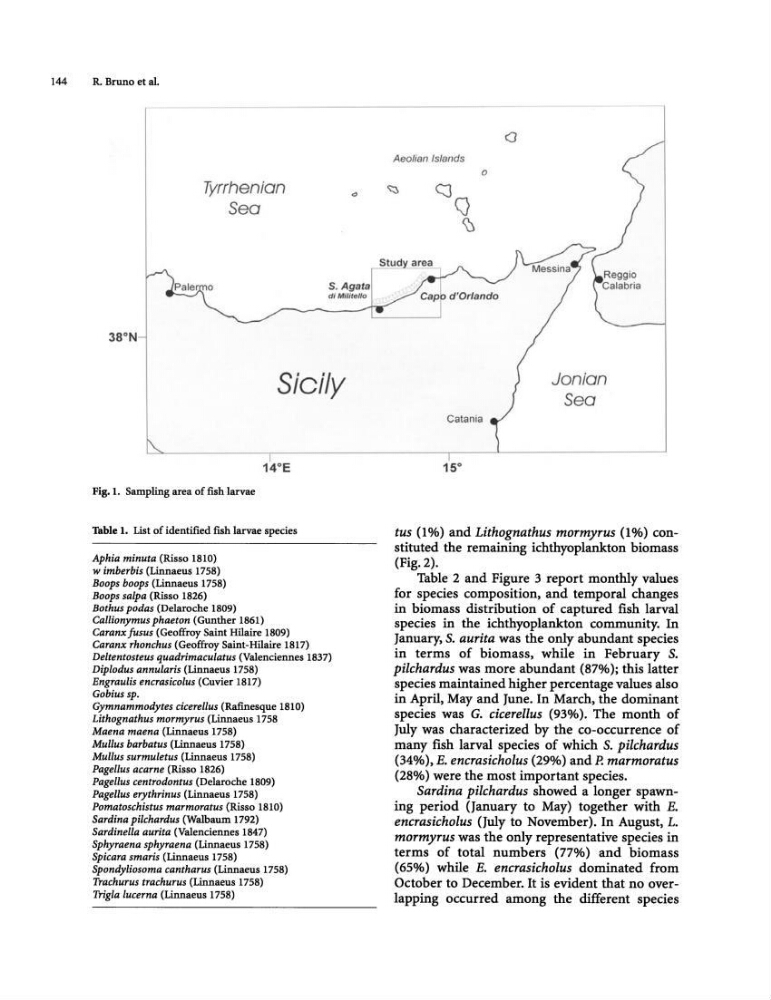
Fig. 1. Sampling area of fish larvae
Table 1. List of identified fish larvae species
Aphia minuta (Risso 1810)
w imberbis (Linnaeus 1758)
Boops boops (Linnaeus 1758)
Boops salpa (Risso 1826)
Bothus podas (Delaroche 1809)
Callionymus phaeton (Gunther 1861)
Caranx fusus (Geoffroy Saint Hilaire 1809)
Caranx rhonchus (Geoffroy Saint-Hilaire 1817)
Deltentosteus quadrimaculatus (Valenciennes 1837)
Diplodus annularis (Linnaeus 1758)
Engraulis encrasicolus (Cuvier 1817)
Gobius sp.
Gymnammodytes cicerellus (Rafinesque 1810)
Lithognathus mormyrus (Linnaeus 1758
Maena maena (Linnaeus 1758)
Mullus barbatus (Linnaeus 1758)
Mullus surmuletus (Linnaeus 1758)
Pagellus acarne (Risso 1826)
Pagellus centrodontus (Delaroche 1809)
Pagellus erythrinus (Linnaeus 1758)
Pomatoschistus marmoratus (Risso 1810)
Sardina pilchardus (Walbaum 1792)
Sardinella aurita (Valenciennes 1847)
Sphyraena sphyraena (Linnaeus 1758)
Spicara smaris (Linnaeus 1758)
Spondyliosoma cantharus (Linnaeus 1758)
Trachurus trachurus (Linnaeus 1758)
Trigla lucerna (Linnaeus 1758)
Jon ian
Sea
tus (1%) and Lithognathus mormyrus (1%) constituted the remaining ichthyoplankton biomass
(Fig. 2).
Table 2 and Figure 3 report monthly values
for species composition, and temporal changes
in biomass distribution of captured fish larval
species in the ichthyoplankton community. In
January, S. aurita was the only abundant species
in terms of biomass, while in February S.
pilchardus was more abundant (87%); this latter
species maintained higher percentage values also
in April, May and June. In March, the dominant
species was G. cicerellus (93%). The month of
July was characterized by the co-occurrence of
many fish larval species of which S. pilchardus
(34%), E. encrasicholus (29%) and P. marmoratus
(28%) were the most important species.
Sardina pilchardus showed a longer spawning period (January to May) together with E.
encrasicholus (July to November). In August, L.
mormyrus was the only representative species in
terms of total numbers (77%) and biomass
(65%) while E. encrasicholus dominated from
October to December. It is evident that no overlapping occurred among the different species
R. Bruno et al.
Tyrrhenian
Sea
S . Agata
(J
Aeolian Islands
o
Study area
d i Milite llo
Cap
Sicily
Fig. 1. Sampling area of fish larvae
Table 1. List of identified fish larvae species
Aphia minuta (Risso 1810)
w imberbis (Linnaeus 1758)
Boops boops (Linnaeus 1758)
Boops salpa (Risso 1826)
Bothus podas (Delaroche 1809)
Callionymus phaeton (Gunther 1861)
Caranx fusus (Geoffroy Saint Hilaire 1809)
Caranx rhonchus (Geoffroy Saint-Hilaire 1817)
Deltentosteus quadrimaculatus (Valenciennes 1837)
Diplodus annularis (Linnaeus 1758)
Engraulis encrasicolus (Cuvier 1817)
Gobius sp.
Gymnammodytes cicerellus (Rafinesque 1810)
Lithognathus mormyrus (Linnaeus 1758
Maena maena (Linnaeus 1758)
Mullus barbatus (Linnaeus 1758)
Mullus surmuletus (Linnaeus 1758)
Pagellus acarne (Risso 1826)
Pagellus centrodontus (Delaroche 1809)
Pagellus erythrinus (Linnaeus 1758)
Pomatoschistus marmoratus (Risso 1810)
Sardina pilchardus (Walbaum 1792)
Sardinella aurita (Valenciennes 1847)
Sphyraena sphyraena (Linnaeus 1758)
Spicara smaris (Linnaeus 1758)
Spondyliosoma cantharus (Linnaeus 1758)
Trachurus trachurus (Linnaeus 1758)
Trigla lucerna (Linnaeus 1758)
Jon ian
Sea
tus (1%) and Lithognathus mormyrus (1%) constituted the remaining ichthyoplankton biomass
(Fig. 2).
Table 2 and Figure 3 report monthly values
for species composition, and temporal changes
in biomass distribution of captured fish larval
species in the ichthyoplankton community. In
January, S. aurita was the only abundant species
in terms of biomass, while in February S.
pilchardus was more abundant (87%); this latter
species maintained higher percentage values also
in April, May and June. In March, the dominant
species was G. cicerellus (93%). The month of
July was characterized by the co-occurrence of
many fish larval species of which S. pilchardus
(34%), E. encrasicholus (29%) and P. marmoratus
(28%) were the most important species.
Sardina pilchardus showed a longer spawning period (January to May) together with E.
encrasicholus (July to November). In August, L.
mormyrus was the only representative species in
terms of total numbers (77%) and biomass
(65%) while E. encrasicholus dominated from
October to December. It is evident that no overlapping occurred among the different species