

A O'3C Study on Organic Matter in Semi -enclosed Mediterranean Marine System
111
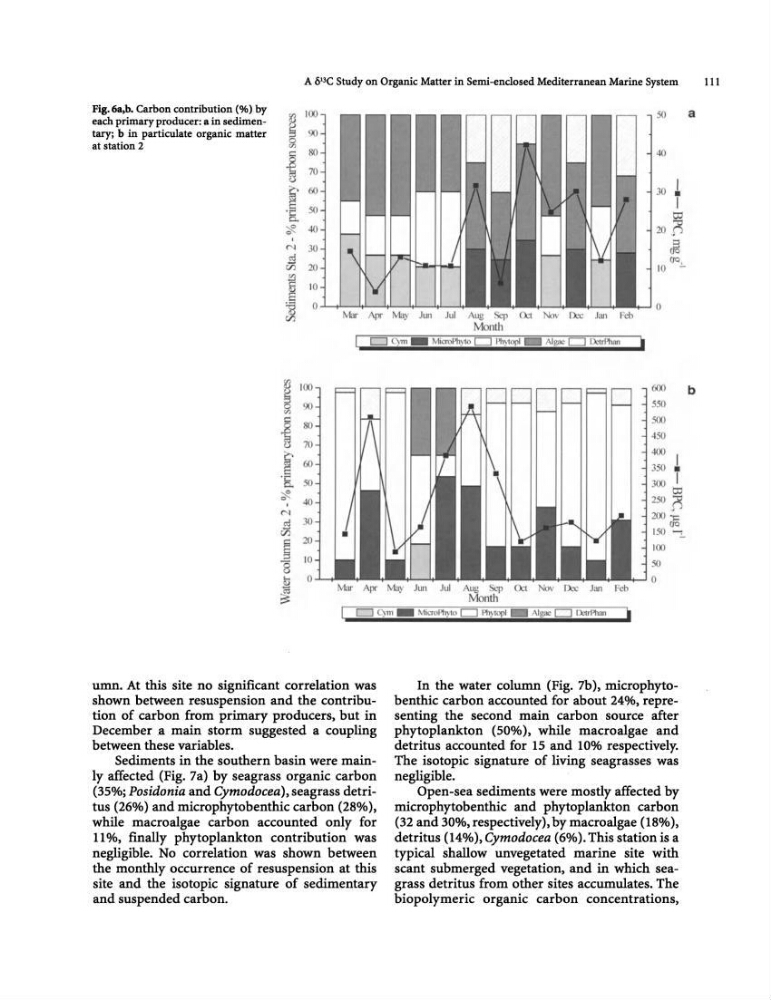
Fig.6a,h. Carbon contribution (%) by
i
100
each primary producer: a in sedimentary; b in particulate organic matter
90
at station 2
Ul
.s
80
13
70
.~
60
50
...
0:::!i: 40
0
50
a
4()
30
1
•
1
sg
20
I
<'l
30
S
CJ)
20
~
(1Q ,
10
-
.' :3
s::: 10
.§
13
0
0
C/:J
D Cym _
MicroPhyto D Phytopl
AIg..'IC c::::J DctrPhiUl
•
600
b
550
500
450
400 1
350 •
300 1
250 ~~
200 "'s::
ISO ~
100
50
o
Mar Apr May Jun Jul Aug Scp ();t Nov Dx Jan Feb
Month
D cym _
MicroPhyto CJ Phytopl
Algae D furPhan
umn. At this site no significant correlation was
shown between resuspension and the contribution of carbon from primary producers, but in
December a main storm suggested a coupling
between these variables.
Sediments in the southern basin were mainly affected (Fig. 7a) by seagrass organic carbon
(35%; Posidonia and Cymodocea), seagrass detritus (26%) and microphytobenthic carbon (28%),
while macroalgae carbon accounted only for
11 %, finally phytoplankton contribution was
negligible. No correlation was shown between
the monthly occurrence of resuspension at this
site and the isotopic signature of sedimentary
and suspended carbon.
In the water column (Fig. 7b), microphytobenthic carbon accounted for about 24%, representing the second main carbon source after
phytoplankton (50%), while macro algae and
detritus accounted for 15 and 10% respectively.
The isotopic signature of living seagrasses was
negligible.
Open -sea sediments were mostly affected by
microphytobenthic and phytoplankton carbon
(32 and 30%, respectively), by macroalgae (18%),
detritus (14%), Cymodocea (6%). This station is a
typical shallow unvegetated marine site with
scant submerged vegetation, and in which seagrass detritus from other sites accumulates. The
biopolymeric organic carbon concentrations,
111
Fig.6a,h. Carbon contribution (%) by
i
100
each primary producer: a in sedimentary; b in particulate organic matter
90
at station 2
Ul
.s
80
13
70
.~
60
50
...
0:::!i: 40
0
50
a
4()
30
1
•
1
sg
20
I
<'l
30
S
CJ)
20
~
(1Q ,
10
-
.' :3
s::: 10
.§
13
0
0
C/:J
D Cym _
MicroPhyto D Phytopl
AIg..'IC c::::J DctrPhiUl
•
600
b
550
500
450
400 1
350 •
300 1
250 ~~
200 "'s::
ISO ~
100
50
o
Mar Apr May Jun Jul Aug Scp ();t Nov Dx Jan Feb
Month
D cym _
MicroPhyto CJ Phytopl
Algae D furPhan
umn. At this site no significant correlation was
shown between resuspension and the contribution of carbon from primary producers, but in
December a main storm suggested a coupling
between these variables.
Sediments in the southern basin were mainly affected (Fig. 7a) by seagrass organic carbon
(35%; Posidonia and Cymodocea), seagrass detritus (26%) and microphytobenthic carbon (28%),
while macroalgae carbon accounted only for
11 %, finally phytoplankton contribution was
negligible. No correlation was shown between
the monthly occurrence of resuspension at this
site and the isotopic signature of sedimentary
and suspended carbon.
In the water column (Fig. 7b), microphytobenthic carbon accounted for about 24%, representing the second main carbon source after
phytoplankton (50%), while macro algae and
detritus accounted for 15 and 10% respectively.
The isotopic signature of living seagrasses was
negligible.
Open -sea sediments were mostly affected by
microphytobenthic and phytoplankton carbon
(32 and 30%, respectively), by macroalgae (18%),
detritus (14%), Cymodocea (6%). This station is a
typical shallow unvegetated marine site with
scant submerged vegetation, and in which seagrass detritus from other sites accumulates. The
biopolymeric organic carbon concentrations,