

106
A. Mazzola et al.
quence, the distribution of organic matter is
highly variable in these systems.
The Stagnone di Marsala is a Mediterranean
semi-enclosed marine system in which the food
chain is largely constrained by detritus originating from seagrasses (mainly Posidonia oceanica
and Cymodocea nodosa) (Pusceddu et al. 1999;
Sara et al. 1999). Despite the oligotrophy of its
waters, the Stagnone functions as a detrital trap
(Pusceddu et al. 1999), although different zones
can be individuated as a function of the different
degrees of resuspension-sedimentation-lateral
drifting processes. In these zones particulate and
sedimentary organic matter seem to be available
for consumers in different ways and at different
times.
It is thus important to provide information
on the role and contribution of each organic
matter source to the trophic pathway and to
investigate in what way this organic matter is distributed among the different loops of the trophic
web. Since little information exists on
Mediterranean areas (Dauby 1989; Jennings et al.
1997), in this study we used stable carbon isotopic analysis to determine the monthly contribution of carbon from each primary producer,
both in the sediment and in the water column. By
comparing the data from this analysis with those
regarding sedimentary and particulate biopolymeric organic carbon, we aim at investigating the
role of each carbon source in determining the
temporal and spatial variability of organic matter available to consumers.
Description of the Study Site
The study was carried out in a semi-enclosed
marine system (15 km2,37" 52'N, 12° 28'E),characterised by two main communication channels
with the open sea. A platform separates the rest
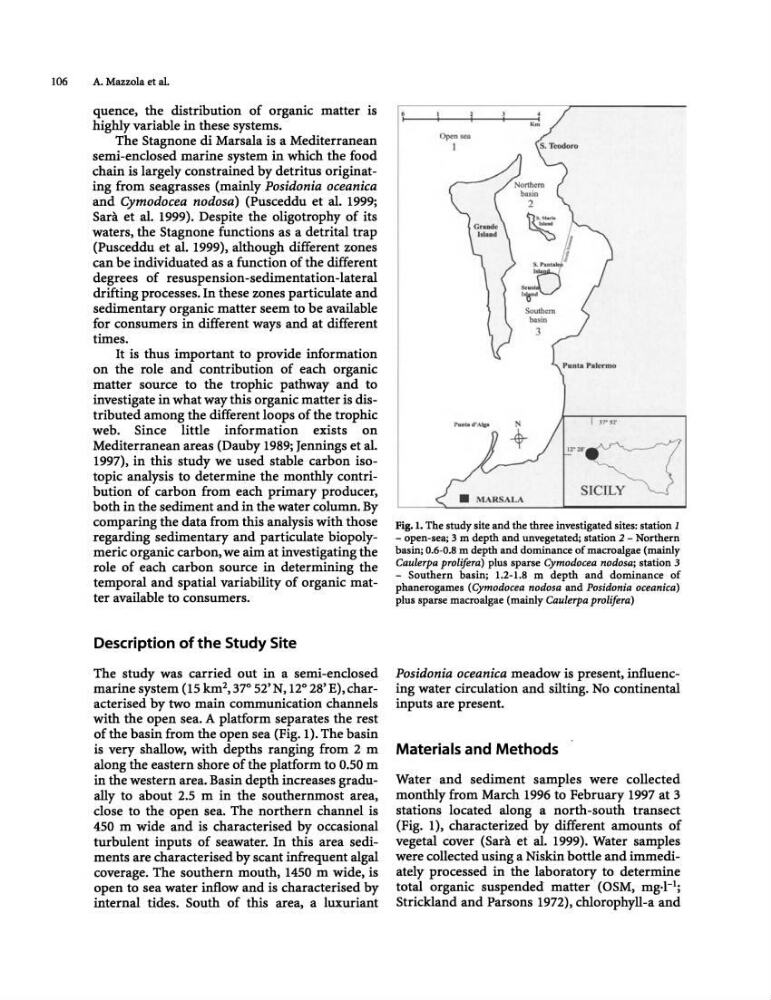
of the basin from the open sea (Fig. 1). The basin
is very shallow, with depths ranging from 2 m
along the eastern shore of the platform to 0.50 m
in the western area. Basin depth increases gradually to about 2.5 m in the southernmost area,
close to the open sea. The northern channel is
450 m wide and is characterised by occasional
turbulent inputs of seawater. In this area sediments are characterised by scant infrequent algal
coverage. The southern mouth, 1450 m wide, is
open to sea water inflow and is characterised by
internal tides. South of this area, a luxuriant
Open sea
1
Fig. 1. The study site and the three investigated sites: station 1
- open-sea; 3 m depth and unvegetated; station 2 - Northern
basin; 0.6-0.8 m depth and dominance of macroalgae (mainly
Caulerpa prolifera) plus sparse Cymodocea nodosa; station 3
- Southern basin; 1.2-1.8 m depth and dominance of
phanerogames (Cymodocea nodosa and Posidonia oceanica)
plus sparse macroalgae (mainly Caulerpa prolifera)
Posidonia oceanica meadow is present, influencing water circulation and silting. No continental
inputs are present.
Materials and Methods
Water and sediment samples were collected
monthly from March 1996 to February 1997 at 3
stations located along a north-south transect
(Fig. 1), characterized by different amounts of
vegetal cover (Sara et al. 1999). Water samples
were collected using a Niskin bottle and immediately processed in the laboratory to determine
total organic suspended matter (OSM, mg·I- 1 ;
Strickland and Parsons 1972), chlorophyll-a and
A. Mazzola et al.
quence, the distribution of organic matter is
highly variable in these systems.
The Stagnone di Marsala is a Mediterranean
semi-enclosed marine system in which the food
chain is largely constrained by detritus originating from seagrasses (mainly Posidonia oceanica
and Cymodocea nodosa) (Pusceddu et al. 1999;
Sara et al. 1999). Despite the oligotrophy of its
waters, the Stagnone functions as a detrital trap
(Pusceddu et al. 1999), although different zones
can be individuated as a function of the different
degrees of resuspension-sedimentation-lateral
drifting processes. In these zones particulate and
sedimentary organic matter seem to be available
for consumers in different ways and at different
times.
It is thus important to provide information
on the role and contribution of each organic
matter source to the trophic pathway and to
investigate in what way this organic matter is distributed among the different loops of the trophic
web. Since little information exists on
Mediterranean areas (Dauby 1989; Jennings et al.
1997), in this study we used stable carbon isotopic analysis to determine the monthly contribution of carbon from each primary producer,
both in the sediment and in the water column. By
comparing the data from this analysis with those
regarding sedimentary and particulate biopolymeric organic carbon, we aim at investigating the
role of each carbon source in determining the
temporal and spatial variability of organic matter available to consumers.
Description of the Study Site
The study was carried out in a semi-enclosed
marine system (15 km2,37" 52'N, 12° 28'E),characterised by two main communication channels
with the open sea. A platform separates the rest
of the basin from the open sea (Fig. 1). The basin
is very shallow, with depths ranging from 2 m
along the eastern shore of the platform to 0.50 m
in the western area. Basin depth increases gradually to about 2.5 m in the southernmost area,
close to the open sea. The northern channel is
450 m wide and is characterised by occasional
turbulent inputs of seawater. In this area sediments are characterised by scant infrequent algal
coverage. The southern mouth, 1450 m wide, is
open to sea water inflow and is characterised by
internal tides. South of this area, a luxuriant
Open sea
1
Fig. 1. The study site and the three investigated sites: station 1
- open-sea; 3 m depth and unvegetated; station 2 - Northern
basin; 0.6-0.8 m depth and dominance of macroalgae (mainly
Caulerpa prolifera) plus sparse Cymodocea nodosa; station 3
- Southern basin; 1.2-1.8 m depth and dominance of
phanerogames (Cymodocea nodosa and Posidonia oceanica)
plus sparse macroalgae (mainly Caulerpa prolifera)
Posidonia oceanica meadow is present, influencing water circulation and silting. No continental
inputs are present.
Materials and Methods
Water and sediment samples were collected
monthly from March 1996 to February 1997 at 3
stations located along a north-south transect
(Fig. 1), characterized by different amounts of
vegetal cover (Sara et al. 1999). Water samples
were collected using a Niskin bottle and immediately processed in the laboratory to determine
total organic suspended matter (OSM, mg·I- 1 ;
Strickland and Parsons 1972), chlorophyll-a and