

88
P.lrato et al.
a
2500
2000
~
~ 1500
(/)
(1)
'"
~ 1000
E
c:
500
o -!-_.L-_ _
digestive gland
o Tapes
Ill! SCBPharca
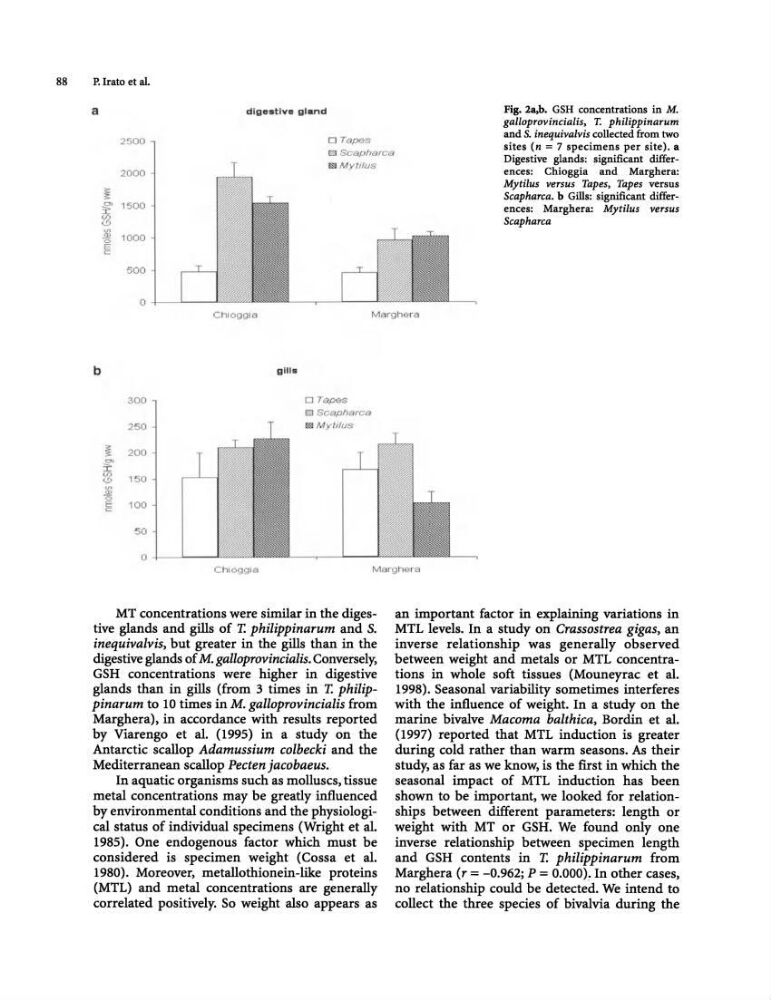
Fig. 2a,b. GSH concentrations in M.
galloprovincialis, T. philippinarum
and S. inequivalvis collected from two
sites (n = 7 specimens per site). a
Digestive glands: significant differences: Chioggia and Marghera:
Mytilus versus Tapes, Tapes versus
Scapharca. b Gills: significant differences: Marghera: Mytilus versus
Scapharca
C hi Oggl8
Margher a
b
gills
300
o Tapes
Ill! Scapharca
250
I§ljI MilIus
~ 200
~ V) 150
(1)
OJ>
Q)
"0
E
100
c:
50
0
ChiOggl8
Marghera
MT concentrations were similar in the digestive glands and gills of T. philippinarum and S.
inequivalvis, but greater in the gills than in the
digestive glands of M. galloprovincialis. Conversely,
GSH concentrations were higher in digestive
glands than in gills (from 3 times in T. philippinarum to 10 times in M. galloprovincialis from
Marghera), in accordance with results reported
by Viarengo et al. (1995) in a study on the
Antarctic scallop Adamussium colbecki and the
Mediterranean scallop Pecten jacobaeus.
In aquatic organisms such as molluscs, tissue
metal concentrations may be greatly influenced
by enviromilental conditions and the physiological status of individual specimens (Wright et al.
1985). One endogenous factor which must be
considered is specimen weight (Cossa et al.
1980). Moreover, metallothionein-like proteins
(MTL) and metal concentrations are generally
correlated positively. So weight also appears as
an important factor in explaining variations in
MTL levels. In a study on Crassostrea gigas, an
inverse relationship was generally observed
between weight and metals or MTL concentrations in whole soft tissues (Mouneyrac et al.
1998). Seasonal variability sometimes interferes
with the influence of weight. In a study on the
marine bivalve Macoma balthica, Bordin et al.
(1997) reported that MTL induction is greater
during cold rather than warm seasons. As their
study, as far as we know, is the fust in which the
seasonal impact of MTL induction has been
shown to be important, we looked for relationships between different parameters: length or
weight with MT or GSH. We found only one
inverse relationship between specimen length
and GSH contents in T. philippinarum from
Marghera (r = -0.962; P = O.OOO)~ In other cases,
no relationship could be detected. We intend to
collect the three species of bivalvia during the
P.lrato et al.
a
2500
2000
~
~ 1500
(/)
(1)
'"
~ 1000
E
c:
500
o -!-_.L-_ _
digestive gland
o Tapes
Ill! SCBPharca
Fig. 2a,b. GSH concentrations in M.
galloprovincialis, T. philippinarum
and S. inequivalvis collected from two
sites (n = 7 specimens per site). a
Digestive glands: significant differences: Chioggia and Marghera:
Mytilus versus Tapes, Tapes versus
Scapharca. b Gills: significant differences: Marghera: Mytilus versus
Scapharca
C hi Oggl8
Margher a
b
gills
300
o Tapes
Ill! Scapharca
250
I§ljI MilIus
~ 200
~ V) 150
(1)
OJ>
Q)
"0
E
100
c:
50
0
ChiOggl8
Marghera
MT concentrations were similar in the digestive glands and gills of T. philippinarum and S.
inequivalvis, but greater in the gills than in the
digestive glands of M. galloprovincialis. Conversely,
GSH concentrations were higher in digestive
glands than in gills (from 3 times in T. philippinarum to 10 times in M. galloprovincialis from
Marghera), in accordance with results reported
by Viarengo et al. (1995) in a study on the
Antarctic scallop Adamussium colbecki and the
Mediterranean scallop Pecten jacobaeus.
In aquatic organisms such as molluscs, tissue
metal concentrations may be greatly influenced
by enviromilental conditions and the physiological status of individual specimens (Wright et al.
1985). One endogenous factor which must be
considered is specimen weight (Cossa et al.
1980). Moreover, metallothionein-like proteins
(MTL) and metal concentrations are generally
correlated positively. So weight also appears as
an important factor in explaining variations in
MTL levels. In a study on Crassostrea gigas, an
inverse relationship was generally observed
between weight and metals or MTL concentrations in whole soft tissues (Mouneyrac et al.
1998). Seasonal variability sometimes interferes
with the influence of weight. In a study on the
marine bivalve Macoma balthica, Bordin et al.
(1997) reported that MTL induction is greater
during cold rather than warm seasons. As their
study, as far as we know, is the fust in which the
seasonal impact of MTL induction has been
shown to be important, we looked for relationships between different parameters: length or
weight with MT or GSH. We found only one
inverse relationship between specimen length
and GSH contents in T. philippinarum from
Marghera (r = -0.962; P = O.OOO)~ In other cases,
no relationship could be detected. We intend to
collect the three species of bivalvia during the