

::l-~-- --~--~
300
t
200
J \
100
1995
:::J 400
o
o
~ 300
~ 200J·
~100
400
300
200
100
1996
\
'\
/ \
, 'Jan Feb Mar Apr ay Jun Jul Aug Sep Oct Nov Dec
-Macoma-Iarvae - - algal cells
5.1 Nutrients, Algae and Zooplankton
89
3Xl0 7
400
2x10⁷
300
200
7
lxl0
100
::J
7 ...... 0 300
2x10 =g 8
Q) 'ii 200
7.!:!.. m
lxl0
2:
~ 100
300
200
100
-----,-3Xl0 7
1994
1995
"- /
-,
/ V
"' /
1996
Jan Feb Mar Apr May Jun Jul Aug Sep Oct Nov Oec
_
Mytilus-Iarvae - -algal cells
I 1-2x10⁷
i
lxl0 7
l2x10 7 2'
I ~
I
"
r1X107 ......
I
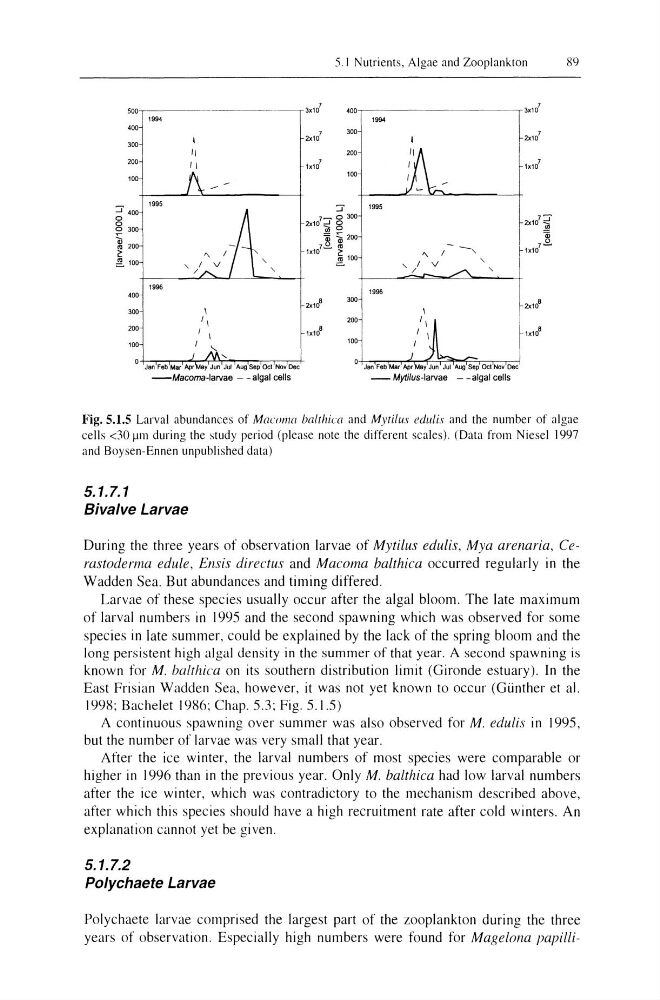
Fig. 5.1.5 Larval abundances of Maconw ba/rhica and Mytilus edulis and the number of algae
cells <30 !-till during the study period (please note the different scales). (Data frolll Niesel 1997
and Boysen-Ennen unpuhlished datal
5.1.7.1
Bivalve Larvae
During the three years of observation larvae of Mytilus edulis, Mya arenaria, Cerastoderma edule, Ensis directus and Macoma balthica occurred regularly in the
Wadden Sea. But abundances and timing differed.
Larvae of these species usually occur after the algal bloom. The late maximum
of larval numbers in 1995 and the second spawning which was observed for some
species in late summer, could be explained by the lack of the spring bloom and the
long persistent high algal density in the summer of that year. A second spawning is
known for M. halthica on its southern distribution limit (Gironde estuary). In the
East Frisian Wadden Sea, however, it was not yet known to occur (Gunther et al.
1998; Bachelet 1986; Chap. 5.3; Fig. 5.1.5)
A continuous spawning over summer was also observed for M. edulis in 1995,
but the number of larvae was very small that year.
After the ice winter, the larval numbers of most species were comparable or
higher in 1996 than in the previous year. Only M. balthica had low larval numbers
after the ice winter, which was contradictory to the mechanism described above,
after which this species should have a high recruitment rate after cold winters. An
explanation cannot yet be given.
5.1.7.2
Polychaete Larvae
Polychaete larvae comprised the largest part of the zooplankton during the three
years of observation. Especially high numbers were found for MaRe/ona papilli-
300
t
200
J \
100
1995
:::J 400
o
o
~ 300
~ 200J·
~100
400
300
200
100
1996
\
'\
/ \
, 'Jan Feb Mar Apr ay Jun Jul Aug Sep Oct Nov Dec
-Macoma-Iarvae - - algal cells
5.1 Nutrients, Algae and Zooplankton
89
3Xl0 7
400
2x10⁷
300
200
7
lxl0
100
::J
7 ...... 0 300
2x10 =g 8
Q) 'ii 200
7.!:!.. m
lxl0
2:
~ 100
300
200
100
-----,-3Xl0 7
1994
1995
"- /
-,
/ V
"' /
1996
Jan Feb Mar Apr May Jun Jul Aug Sep Oct Nov Oec
_
Mytilus-Iarvae - -algal cells
I 1-2x10⁷
i
lxl0 7
l2x10 7 2'
I ~
I
"
r1X107 ......
I
Fig. 5.1.5 Larval abundances of Maconw ba/rhica and Mytilus edulis and the number of algae
cells <30 !-till during the study period (please note the different scales). (Data frolll Niesel 1997
and Boysen-Ennen unpuhlished datal
5.1.7.1
Bivalve Larvae
During the three years of observation larvae of Mytilus edulis, Mya arenaria, Cerastoderma edule, Ensis directus and Macoma balthica occurred regularly in the
Wadden Sea. But abundances and timing differed.
Larvae of these species usually occur after the algal bloom. The late maximum
of larval numbers in 1995 and the second spawning which was observed for some
species in late summer, could be explained by the lack of the spring bloom and the
long persistent high algal density in the summer of that year. A second spawning is
known for M. halthica on its southern distribution limit (Gironde estuary). In the
East Frisian Wadden Sea, however, it was not yet known to occur (Gunther et al.
1998; Bachelet 1986; Chap. 5.3; Fig. 5.1.5)
A continuous spawning over summer was also observed for M. edulis in 1995,
but the number of larvae was very small that year.
After the ice winter, the larval numbers of most species were comparable or
higher in 1996 than in the previous year. Only M. balthica had low larval numbers
after the ice winter, which was contradictory to the mechanism described above,
after which this species should have a high recruitment rate after cold winters. An
explanation cannot yet be given.
5.1.7.2
Polychaete Larvae
Polychaete larvae comprised the largest part of the zooplankton during the three
years of observation. Especially high numbers were found for MaRe/ona papilli-