

5.1 Nutrients, Algae and Zooplankton
P.7
5.1.6
Relations Between Phytoplankton and Copepods
Copepods are the main group of the holozooplankton. In winter they dominate the
zooplankton composition (see Sect. 5.IA) and they reach maximum abundances in
summer when nauplius and copepodite stages occur. The copepods Acartia clausi,
Temora /ongicornis, Centropages hamates and Pseudocalanus elongatus were
frequently recorded in the backbarrier system of Spiekeroog.
Copepods are omnivore (Valiela 1995). Their food consists of detritus, bacteria,
algae, ciliates and nauplius stages of other copepods. Larvae of polychaetes and
molluscs were also preyed upon. The feeding behaviour of the copepod is widely
debated (Donaghay & Small 1979; Irigoien et al. 1996). Some species of copepods
feed selectively on a specific particle size, others are non-selective with regard to
particle size. The ability to switch between different prey sizes and prey species
has also been recorded for some copepod species (Valiela 1995). Since not every
potential food source of copepods could be studied in ELA W AT, only a relation
between copepod numbers and algal densities is presented in the following. Because of the wide food spectrum of copepods, not the number of small algal cells,
but the total amount of algal cells was chosen for the comparison.
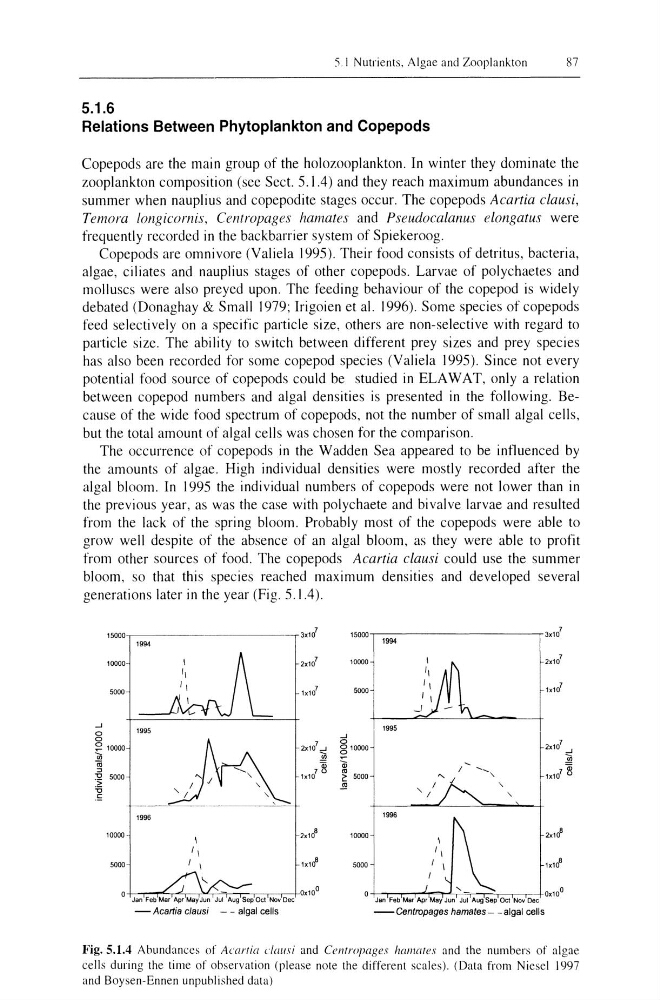
The occurrence of copepods in the Wadden Sea appeared to be influenced by
the amounts of algae. High individual densities were mostly recorded after the
algal bloom. In 1995 the individual numbers of copepods were not lower than in
the previous year, as was the case with polychaete and bivalve larvae and resulted
from the lack of the spring bloom. Probably most of the copepods were able to
grow well despite of the absence of an algal bloom, as they were able to profit
from other sources of food. The copepods Acartia clausi could use the summer
bloom, so that this species reached maximum densities and developed several
generations later in the year (Fig. 5.IA).
15000
3x1l
15000
3X10 7
1994
1994
10000
2x10 7
10000
\
2Xll
1\
5000
7
5000
1\
lxll
·lxl0
I \
_I
...J
1995
1995
0
0
...J
~ 10000
'h<10 7 ...J
0
2xtl...J
U;
El 8 10000
El
iii
,1l
Q;
~
=>
A
' "
I
~~\,
lxll ~
'tJ 5000
lxl0
~ 5000
·5
I
J
\,
~
'6
\, I
"
."'
,
-- ... _ - - - -
1996
1996
100002xl0 8
10000
2xl0B
5000
lxl0 B
5000
1xl0 8
OxtOn
Oxl00
Jan Feb Mar Apr MayJun Jul Aug Sep Oct Nov Dec
Jan Feb Mar Apr May Jun Jut Aug Sep Oct Nov Dec
- Acartia clausi - - algal cells
-Centropages hamates- -algal cells
Fig. 5.1.4 Abundances of Amrlia c/(lusi and Cenrropages hamates and the numbers of algae
cells during the time of observation (please note the different scales). (Data from Niesel 1997
and Boysen-Ennen unpublished data)
P.7
5.1.6
Relations Between Phytoplankton and Copepods
Copepods are the main group of the holozooplankton. In winter they dominate the
zooplankton composition (see Sect. 5.IA) and they reach maximum abundances in
summer when nauplius and copepodite stages occur. The copepods Acartia clausi,
Temora /ongicornis, Centropages hamates and Pseudocalanus elongatus were
frequently recorded in the backbarrier system of Spiekeroog.
Copepods are omnivore (Valiela 1995). Their food consists of detritus, bacteria,
algae, ciliates and nauplius stages of other copepods. Larvae of polychaetes and
molluscs were also preyed upon. The feeding behaviour of the copepod is widely
debated (Donaghay & Small 1979; Irigoien et al. 1996). Some species of copepods
feed selectively on a specific particle size, others are non-selective with regard to
particle size. The ability to switch between different prey sizes and prey species
has also been recorded for some copepod species (Valiela 1995). Since not every
potential food source of copepods could be studied in ELA W AT, only a relation
between copepod numbers and algal densities is presented in the following. Because of the wide food spectrum of copepods, not the number of small algal cells,
but the total amount of algal cells was chosen for the comparison.
The occurrence of copepods in the Wadden Sea appeared to be influenced by
the amounts of algae. High individual densities were mostly recorded after the
algal bloom. In 1995 the individual numbers of copepods were not lower than in
the previous year, as was the case with polychaete and bivalve larvae and resulted
from the lack of the spring bloom. Probably most of the copepods were able to
grow well despite of the absence of an algal bloom, as they were able to profit
from other sources of food. The copepods Acartia clausi could use the summer
bloom, so that this species reached maximum densities and developed several
generations later in the year (Fig. 5.IA).
15000
3x1l
15000
3X10 7
1994
1994
10000
2x10 7
10000
\
2Xll
1\
5000
7
5000
1\
lxll
·lxl0
I \
_I
...J
1995
1995
0
0
...J
~ 10000
'h<10 7 ...J
0
2xtl...J
U;
El 8 10000
El
iii
,1l
Q;
~
=>
A
' "
I
~~\,
lxll ~
'tJ 5000
lxl0
~ 5000
·5
I
J
\,
~
'6
\, I
"
."'
,
-- ... _ - - - -
1996
1996
100002xl0 8
10000
2xl0B
5000
lxl0 B
5000
1xl0 8
OxtOn
Oxl00
Jan Feb Mar Apr MayJun Jul Aug Sep Oct Nov Dec
Jan Feb Mar Apr May Jun Jut Aug Sep Oct Nov Dec
- Acartia clausi - - algal cells
-Centropages hamates- -algal cells
Fig. 5.1.4 Abundances of Amrlia c/(lusi and Cenrropages hamates and the numbers of algae
cells during the time of observation (please note the different scales). (Data from Niesel 1997
and Boysen-Ennen unpublished data)