

X.2 The First Model: A Demonstration
211
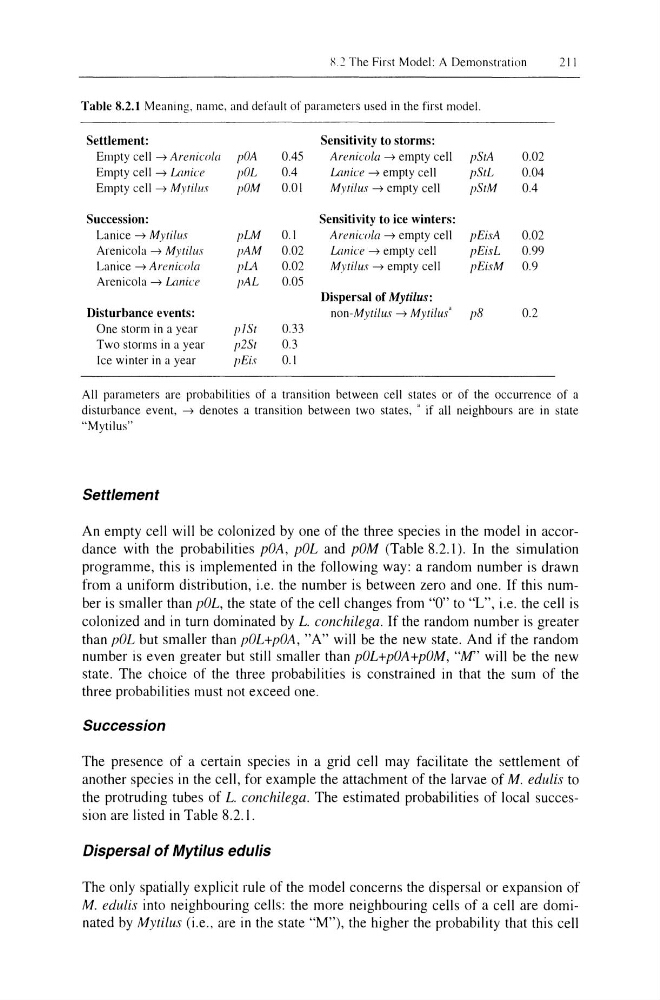
Table 8.2.1 Meaning, name, and derault or parameters used in the first model.
Settlement:
Sensitivity to storms:
Empty cell ---. Arenico/a pOA
0.45
Arenicola ---. empty cell pStA
0.02
Empty cell ---. Laniel'
pOL
0.4
Laniee ---. empty cell
pStL
0.04
Empty cell ---. Mytilus
pOM
0.01
Mytilus ---. empty cell
pStM
0.4
Succession:
Sensitivity to ice winters:
Lanlce ---. Mytilus
pLM
0.1
Arenicola ---. empty cell pEisA
0.02
Arenicola ---. Mytilus
pAM
0.02
Lanice ---. empty cell
pEisL
0.99
Lanice ---. Arcnico/a
pLA
0.02
Mytilus ---. empty cell
pEisM 0.9
Arenicola ---. Laniel'
pAL
0.05
Dispersal of Mytilus:
Disturbance events:
non-Mytilus ---. Mytilus
p8
0.2
One storm in a year
plSt
0.33
Two storms in a year
p2St
0.3
Ice winter in a year
pEis
0.1
All parameters are probabilities of a transition between cell states or of the occurrence of a
disturbance event, ---. denotes a transition between two states, " if all neighbours are in state
"Mytilus"
Settlement
An empty cell will be colonized by one of the three species in the model in accordance with the probabilities pOA, pOL and pOM (Table 8.2.1). In the simulation
programme, this is implemented in the following way: a random number is drawn
from a uniform distribution, i.e. the number is between zero and one. If this number is smaller than pOL, the state of the cell changes from "0" to "L", i.e. the cell is
colonized and in turn dominated by L. conchilega. If the random number is greater
than pOL but smaller than pOL+pOA, "A" will be the new state. And if the random
number is even greater but still smaller than pOL+pOA+pOM, "M' will be the new
state. The choice of the three probabilities is constrained in that the sum of the
three probabilities must not exceed one.
Succession
The presence of a certain species in a grid cell may facilitate the settlement of
another species in the cell, for example the attachment of the larvae of M. edulis to
the protruding tubes of L. conchilega. The estimated probabilities of local succession are listed in Table 8.2.1.
Dispersal of Myti/us edulis
The only spatially explicit rule of the model concerns the dispersal or expansion of
M. edulis into neighbouring cells: the more neighbouring cells of a cell are dominated by Mytilus (i.e., are in the state "M"), the higher the probability that this cell
211
Table 8.2.1 Meaning, name, and derault or parameters used in the first model.
Settlement:
Sensitivity to storms:
Empty cell ---. Arenico/a pOA
0.45
Arenicola ---. empty cell pStA
0.02
Empty cell ---. Laniel'
pOL
0.4
Laniee ---. empty cell
pStL
0.04
Empty cell ---. Mytilus
pOM
0.01
Mytilus ---. empty cell
pStM
0.4
Succession:
Sensitivity to ice winters:
Lanlce ---. Mytilus
pLM
0.1
Arenicola ---. empty cell pEisA
0.02
Arenicola ---. Mytilus
pAM
0.02
Lanice ---. empty cell
pEisL
0.99
Lanice ---. Arcnico/a
pLA
0.02
Mytilus ---. empty cell
pEisM 0.9
Arenicola ---. Laniel'
pAL
0.05
Dispersal of Mytilus:
Disturbance events:
non-Mytilus ---. Mytilus
p8
0.2
One storm in a year
plSt
0.33
Two storms in a year
p2St
0.3
Ice winter in a year
pEis
0.1
All parameters are probabilities of a transition between cell states or of the occurrence of a
disturbance event, ---. denotes a transition between two states, " if all neighbours are in state
"Mytilus"
Settlement
An empty cell will be colonized by one of the three species in the model in accordance with the probabilities pOA, pOL and pOM (Table 8.2.1). In the simulation
programme, this is implemented in the following way: a random number is drawn
from a uniform distribution, i.e. the number is between zero and one. If this number is smaller than pOL, the state of the cell changes from "0" to "L", i.e. the cell is
colonized and in turn dominated by L. conchilega. If the random number is greater
than pOL but smaller than pOL+pOA, "A" will be the new state. And if the random
number is even greater but still smaller than pOL+pOA+pOM, "M' will be the new
state. The choice of the three probabilities is constrained in that the sum of the
three probabilities must not exceed one.
Succession
The presence of a certain species in a grid cell may facilitate the settlement of
another species in the cell, for example the attachment of the larvae of M. edulis to
the protruding tubes of L. conchilega. The estimated probabilities of local succession are listed in Table 8.2.1.
Dispersal of Myti/us edulis
The only spatially explicit rule of the model concerns the dispersal or expansion of
M. edulis into neighbouring cells: the more neighbouring cells of a cell are dominated by Mytilus (i.e., are in the state "M"), the higher the probability that this cell