

184
6 Recolonization oj Tidal Flats Alter Disturbance
Seotoptos armiger
--+-- e'perimenl
--0-- control
Maeoma batthiea
Pygospio e/egans
0 ... .... .... .... .... .... .... .... .... '" '" '"
II)
II)
II)
II)
II)
II) II)
II)
C> C> C> C> C> m m m C>
'" '"
m m m C>
'" '"
m C> m
C.
>. c :; on 0. 13 > u c D m c. >. c :; on Cl 13 >
« '" "
-,
" ' " a
0
' " ' "
CD :::< « ' " "
-,
" '" a
0
:::< -,
« (J)
z 0 -, Ii.
:::< -,
« (J)
z
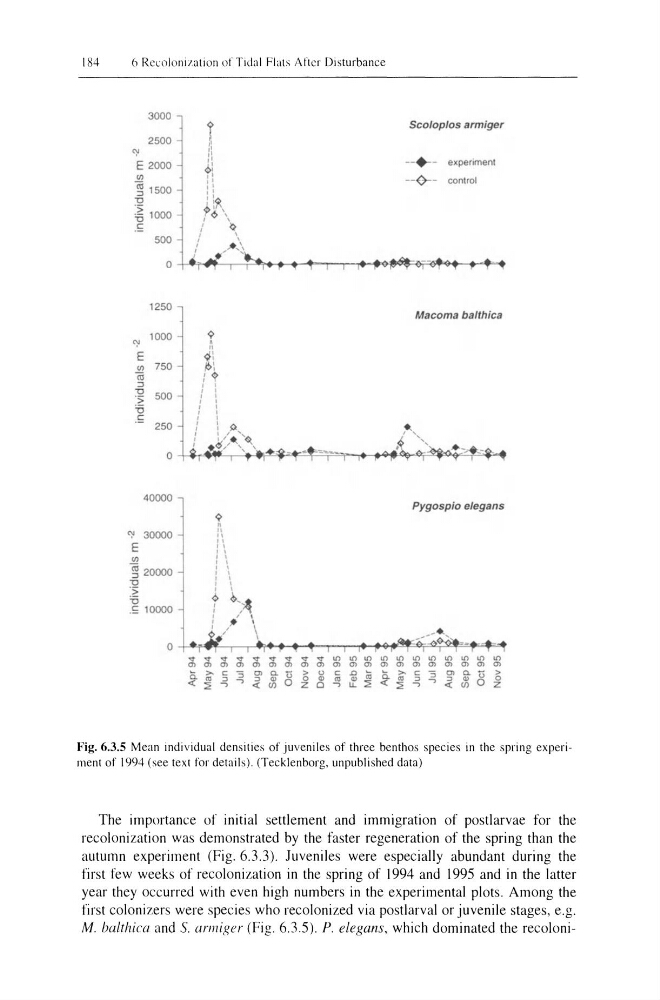
Fig. 6.3.5 Mean individual densities of juveniles of three benthos species in the spring experiment of 1994 (see text for details). (Tecklcnborg, unpublished data)
The importance of initial settlement and immigration of postlarvae for the
recolonization was demonstrated by the faster regeneration of the spring than the
autumn experiment (Fig. 6.3.3). Juveniles were especially abundant during the
first few weeks of recolonization in the spring of 1994 and 1995 and in the latter
year they occurred with even high numbers in the experimental plots. Among the
first colonizers were species who recolonized via postlarval or juvenile stages, e.g.
M. balthica and S. armiger (Fig. 6.3.5). P. elegans, which dominated the recoloni-
6 Recolonization oj Tidal Flats Alter Disturbance
Seotoptos armiger
--+-- e'perimenl
--0-- control
Maeoma batthiea
Pygospio e/egans
0 ... .... .... .... .... .... .... .... .... '" '" '"
II)
II)
II)
II)
II)
II) II)
II)
C> C> C> C> C> m m m C>
'" '"
m m m C>
'" '"
m C> m
C.
>. c :; on 0. 13 > u c D m c. >. c :; on Cl 13 >
« '" "
-,
" ' " a
0
' " ' "
CD :::< « ' " "
-,
" '" a
0
:::< -,
« (J)
z 0 -, Ii.
:::< -,
« (J)
z
Fig. 6.3.5 Mean individual densities of juveniles of three benthos species in the spring experiment of 1994 (see text for details). (Tecklcnborg, unpublished data)
The importance of initial settlement and immigration of postlarvae for the
recolonization was demonstrated by the faster regeneration of the spring than the
autumn experiment (Fig. 6.3.3). Juveniles were especially abundant during the
first few weeks of recolonization in the spring of 1994 and 1995 and in the latter
year they occurred with even high numbers in the experimental plots. Among the
first colonizers were species who recolonized via postlarval or juvenile stages, e.g.
M. balthica and S. armiger (Fig. 6.3.5). P. elegans, which dominated the recoloni-