

5.5 BIotic Interactions in a Lanice-Tidal Flat
157
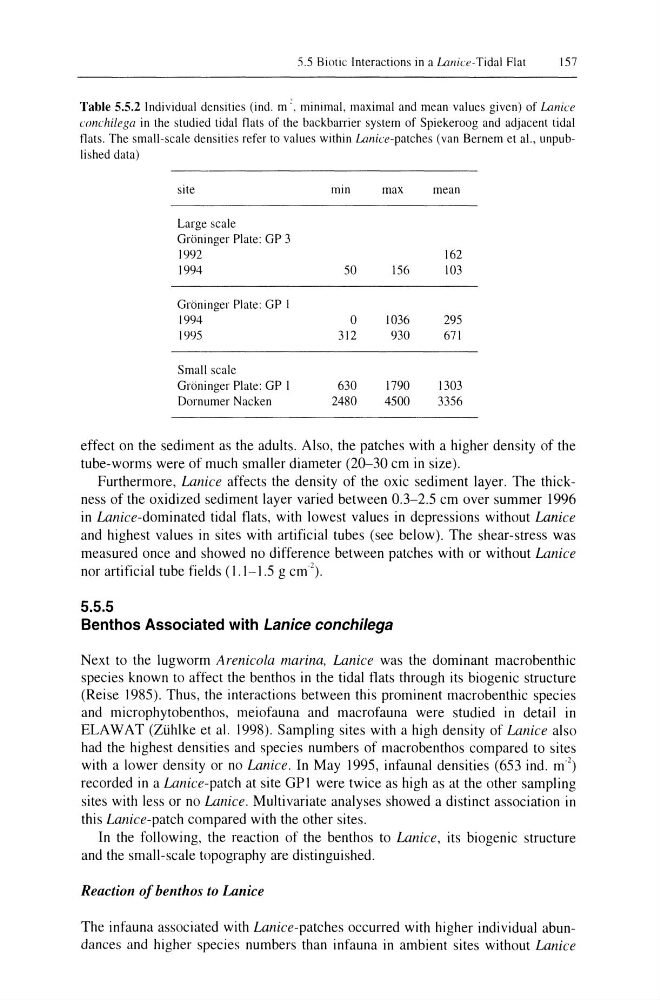
Table 5.5.2 Individual densities (ind. m '. minimal. maximal and mean values given) of Lanice
conchi/ega in the studied tidal flats of the backbarrier system of Spiekeroog and adjacent tidal
flats. The small-scale densities refer to values within Lanice-patches (van Bernem et a!., unpublished data)
site
Large scale
Groninger Plate: GP 3
1992
1994
Groninger Plate: GP I
1994
1995
Small scale
Groninger Plate: GP 1
Dornumer Nackcn
min
50
o
312
630
2480
max
156
1036
930
1790
4500
mean
162
103
295
671
1303
3356
effect on the sediment as the adults. Also, the patches with a higher density of the
tube-worms were of much smaller diameter (20-30 cm in size).
Furthermore, Lanice affects the density of the oxic sediment layer. The thickness of the oxidized sediment layer varied between 0.3-2.5 cm over summer 1996
in Lanice-dominated tidal t1ats, with lowest values in depressions without Lanice
and highest values in sites with artificial tubes (see below). The shear-stress was
measured once and showed no difference between patches with or without Lanice
nor artificial tube fields (1.1-1.5 g cm\
5.5.5
Benthos Associated with Lanice conchilega
Next to the lugworm Arenicola marina, Lanice was the dominant macrobenthic
species known to affect the benthos in the tidal t1ats through its biogenic structure
(Reise 1985). Thus, the interactions between this prominent macrobenthic species
and microphytobenthos, meiofauna and macrofauna were studied in detail in
ELA W AT (Zi.ihlke et al. 1998). Sampling sites with a high density of Lanice also
had the highest densities and species numbers of macrobenthos compared to sites
with a lower density or no Lanice. In May 1995, infaunal densities (653 indo m· 2 )
recorded in a Lanice-patch at site GP I were twice as high as at the other sampling
sites with less or no Lanice. Multivariate analyses showed a distinct association in
this Lanice-patch compared with the other sites.
In the following, the reaction of the benthos to Lanice, its biogenic structure
and the small-scale topography are distinguished.
Reaction of benthos to Lanice
The infauna associated with Lanice-patches occurred with higher individual abundances and higher species numbers than infauna in ambient sites without Lanice
157
Table 5.5.2 Individual densities (ind. m '. minimal. maximal and mean values given) of Lanice
conchi/ega in the studied tidal flats of the backbarrier system of Spiekeroog and adjacent tidal
flats. The small-scale densities refer to values within Lanice-patches (van Bernem et a!., unpublished data)
site
Large scale
Groninger Plate: GP 3
1992
1994
Groninger Plate: GP I
1994
1995
Small scale
Groninger Plate: GP 1
Dornumer Nackcn
min
50
o
312
630
2480
max
156
1036
930
1790
4500
mean
162
103
295
671
1303
3356
effect on the sediment as the adults. Also, the patches with a higher density of the
tube-worms were of much smaller diameter (20-30 cm in size).
Furthermore, Lanice affects the density of the oxic sediment layer. The thickness of the oxidized sediment layer varied between 0.3-2.5 cm over summer 1996
in Lanice-dominated tidal t1ats, with lowest values in depressions without Lanice
and highest values in sites with artificial tubes (see below). The shear-stress was
measured once and showed no difference between patches with or without Lanice
nor artificial tube fields (1.1-1.5 g cm\
5.5.5
Benthos Associated with Lanice conchilega
Next to the lugworm Arenicola marina, Lanice was the dominant macrobenthic
species known to affect the benthos in the tidal t1ats through its biogenic structure
(Reise 1985). Thus, the interactions between this prominent macrobenthic species
and microphytobenthos, meiofauna and macrofauna were studied in detail in
ELA W AT (Zi.ihlke et al. 1998). Sampling sites with a high density of Lanice also
had the highest densities and species numbers of macrobenthos compared to sites
with a lower density or no Lanice. In May 1995, infaunal densities (653 indo m· 2 )
recorded in a Lanice-patch at site GP I were twice as high as at the other sampling
sites with less or no Lanice. Multivariate analyses showed a distinct association in
this Lanice-patch compared with the other sites.
In the following, the reaction of the benthos to Lanice, its biogenic structure
and the small-scale topography are distinguished.
Reaction of benthos to Lanice
The infauna associated with Lanice-patches occurred with higher individual abundances and higher species numbers than infauna in ambient sites without Lanice