

140
5 Spallal and Temporal DlSlnoullorl Pallcrns
5.3.3.2
Temporal and Spatial Variability in the Benthos vs. Water Column
(Secondary Dispersal)
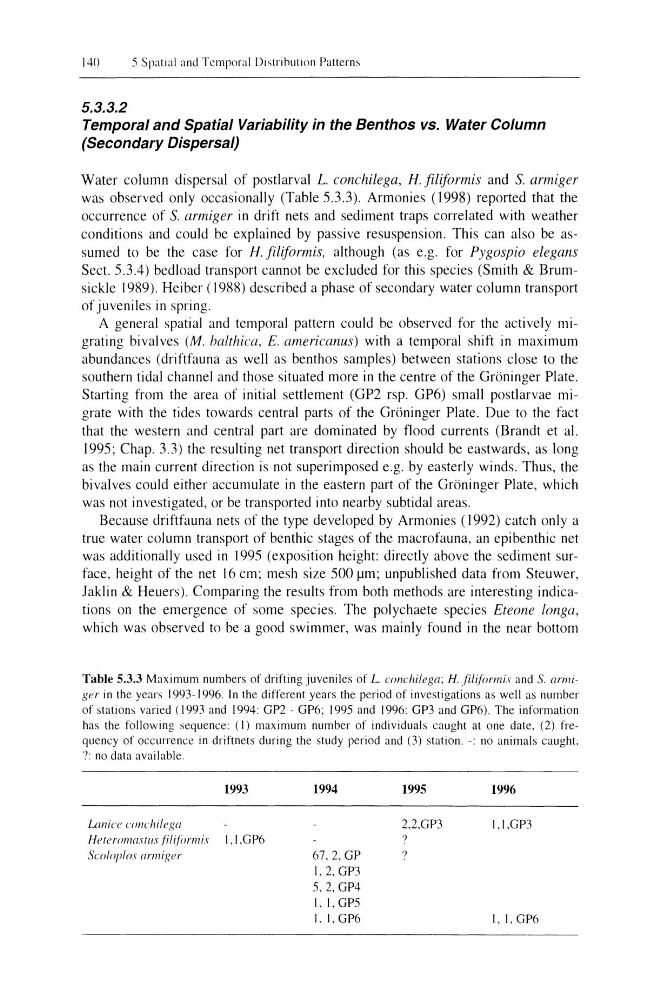
Water column dispersal of postlarval L. conchilega, H. filiformis and S. armiger
was observed only occasionally (Table 5.3.3). Armonies (1998) reported that the
occurrence of S. armiger in drift nets and sediment traps correlated with weather
conditions and could be explained by passive resuspension. This can also be assumed to be the case for H. filiformis, although (as e.g. for Pygospio elegans
Sect. 5.3.4) bedload transport cannot be excluded for this species (Smith & Brumsickle 1989). Heiber (198X) described a phase of secondary water column transport
of juveniles in spring.
A general spatial and temporal pattern could be observed for the actively migrating bivalves (M. balthica, E. americanus) with a temporal shift in maximum
abundances (driftfauna as well as benthos samples) between stations close to the
southern tidal channel and those situated more in the centre of the Grc)ninger Plate.
Starting from the area of initial settlement (GP2 rsp. GP6) small postlarvae migrate with the tides towards central parts of the Groninger Plate. Due to the fact
that the western and central part are dominated by flood currents (Brandt et al.
1995; Chap. 3.3) the resulting net transport direction should be eastwards, as long
as the main current direction is not superimposed e.g. by easterly winds. Thus, the
bivalves could either accumulate in the eastern part of the Groninger Plate, which
was not investigated, or be transported into nearby subtidal areas.
Because driftfauna nets of the type developed by Armonies (1992) catch only a
true water column transport of benthic stages of the macrofauna, an epibenthic net
was additionally used in 1995 (exposition height: directly above the sediment surface, height of the net 16 cm; mesh size 500 11m; unpublished data from Steuwer,
Jaklin & Heuers). Comparing the results from both methods are interesting indications on the emergence of some species. The polychaete species Eteone longa,
which was observed to be a good swimmer, was mainly found in the near bottom
Table 5.3.3 Maximum numbers of drifting juveniles of L. cOl1chilega; H. filiformis and S. armiger in the years 1993-1996. In the different years the period of investigations as well as numoer
of stations varied (1993 and 1994: GP2 - GP6; 1995 and 1996: GP3 and GP6). The information
has the following sequence: (I) maximum number of individuals caught at one date, (2) frequency of occurrence in drift nets during the study period and (3) station. -: no animals caught.
'I: no data available.
1993
Lal1ice cOl1chi/cga
Hcreronwsrus filifilrlnis I, I ,GP6
SCII/nfl/lls armigcr
1994
67,2, GP
I. 2, GP3
5,2, GP4
I, I, GPS
I. I, GP6
1995
1996
2,2,GP3
I, I.GP3
')
I, I, GP6
5 Spallal and Temporal DlSlnoullorl Pallcrns
5.3.3.2
Temporal and Spatial Variability in the Benthos vs. Water Column
(Secondary Dispersal)
Water column dispersal of postlarval L. conchilega, H. filiformis and S. armiger
was observed only occasionally (Table 5.3.3). Armonies (1998) reported that the
occurrence of S. armiger in drift nets and sediment traps correlated with weather
conditions and could be explained by passive resuspension. This can also be assumed to be the case for H. filiformis, although (as e.g. for Pygospio elegans
Sect. 5.3.4) bedload transport cannot be excluded for this species (Smith & Brumsickle 1989). Heiber (198X) described a phase of secondary water column transport
of juveniles in spring.
A general spatial and temporal pattern could be observed for the actively migrating bivalves (M. balthica, E. americanus) with a temporal shift in maximum
abundances (driftfauna as well as benthos samples) between stations close to the
southern tidal channel and those situated more in the centre of the Grc)ninger Plate.
Starting from the area of initial settlement (GP2 rsp. GP6) small postlarvae migrate with the tides towards central parts of the Groninger Plate. Due to the fact
that the western and central part are dominated by flood currents (Brandt et al.
1995; Chap. 3.3) the resulting net transport direction should be eastwards, as long
as the main current direction is not superimposed e.g. by easterly winds. Thus, the
bivalves could either accumulate in the eastern part of the Groninger Plate, which
was not investigated, or be transported into nearby subtidal areas.
Because driftfauna nets of the type developed by Armonies (1992) catch only a
true water column transport of benthic stages of the macrofauna, an epibenthic net
was additionally used in 1995 (exposition height: directly above the sediment surface, height of the net 16 cm; mesh size 500 11m; unpublished data from Steuwer,
Jaklin & Heuers). Comparing the results from both methods are interesting indications on the emergence of some species. The polychaete species Eteone longa,
which was observed to be a good swimmer, was mainly found in the near bottom
Table 5.3.3 Maximum numbers of drifting juveniles of L. cOl1chilega; H. filiformis and S. armiger in the years 1993-1996. In the different years the period of investigations as well as numoer
of stations varied (1993 and 1994: GP2 - GP6; 1995 and 1996: GP3 and GP6). The information
has the following sequence: (I) maximum number of individuals caught at one date, (2) frequency of occurrence in drift nets during the study period and (3) station. -: no animals caught.
'I: no data available.
1993
Lal1ice cOl1chi/cga
Hcreronwsrus filifilrlnis I, I ,GP6
SCII/nfl/lls armigcr
1994
67,2, GP
I. 2, GP3
5,2, GP4
I, I, GPS
I. I, GP6
1995
1996
2,2,GP3
I, I.GP3
')
I, I, GP6