

5.3 Settlement and Dispersal of Macrofauna
137
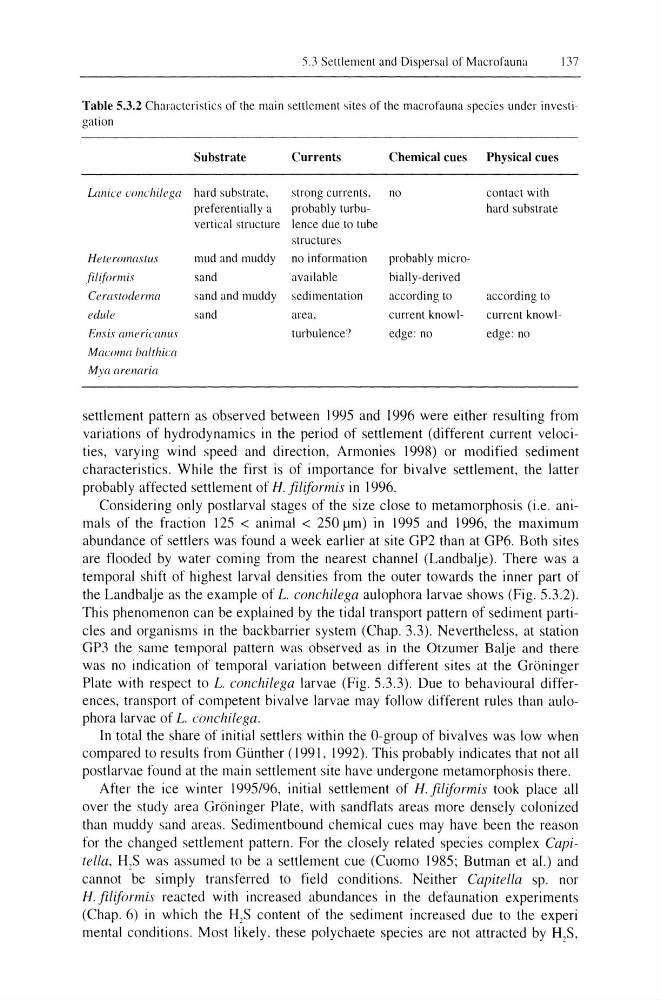
Table 5.3.2 Characteristics of the main settlement sites of the macrofauna species under investigation
Substrate
Currents
Chemical cues
Physical cues
Lnnice col1chilega hard substrate,
strong currents,
no
contact with
hard substrate
Heleromastus
fili{ormis
Cerasloderma
edule
Ensi.\· americanus
Macol11a ba/lhica
Mya arenaria
preferentially a
probably turbuvertical structure Icnce due to tube
structures
mud and muddy no information
sand
available
sand and muddy sedimentation
sand
area,
turbulence?
probably microbially-derived
aecordi ng to
current knowledge: no
according to
current knowledge: no
settlement pattern as observed between 1995 and 1996 were either resulting from
variations of hydrodynamics in the period of settlement (different current velocities, varying wind speed and direction, Armonies 1998) or modified sediment
characteristics. While the first is of importance for bivalve settlement, the latter
probably affected settlement of H. filiformis in 1996.
Considering only postlarval stages of the size close to metamorphosis (i.e. animals of the fraction 125 < animal < 250 11m) in 1995 and 1996, the maximum
abundance of settlers was found a week earlier at site GP2 than at GP6. Both sites
are flooded by water coming from the nearest channel (Landbalje). There was a
temporal shift of highest larval densities from the outer towards the inner part of
the Landbalje as the example of L. conchilega aulophora larvae shows (Fig. 5.3.2).
This phenomenon can be explained by the tidal transport pattern of sediment particles and organisms in the backbarrier system (Chap. 3.3). Nevertheless, at station
GP3 the same temporal pattern was observed as in the Otzumer Balje and there
was no indication of temporal variation between different sites at the Groninger
Plate with respect to L. conchiiega larvae (Fig. 5.3.3). Due to behavioural differences, transport of competent bivalve larvae may follow different rules than aulophora larvae of L. cOf/chilega.
In total the share of initial settlers within the O-group of bivalves was low when
compared to results from Gunther (1991, 1992). This probably indicates that not al\
postlarvae found at the main settlement site have undergone metamorphosis there.
After the ice winter \995/96, initial settlement of H. filiformis took place all
over the study area Groninger Plate, with sandflats areas more densely colonized
than muddy sand areas. Sedimentbound chemical cues may have been the reason
for the changed settlement pattern. For the closely related species complex Capitella, H 2 S was assumed to be a settlement cue (Cuomo 1985; Butman et al.) and
cannot be simply transferred to field conditions. Neither Capitella sp. nor
H. filiformis reacted with increased abundances in the defaunation experiments
(Chap. 6) in which the H,S content of the sediment increased due to the experi
mental conditions. Most likely, these polychaete species are not attracted by H 2 S,
137
Table 5.3.2 Characteristics of the main settlement sites of the macrofauna species under investigation
Substrate
Currents
Chemical cues
Physical cues
Lnnice col1chilega hard substrate,
strong currents,
no
contact with
hard substrate
Heleromastus
fili{ormis
Cerasloderma
edule
Ensi.\· americanus
Macol11a ba/lhica
Mya arenaria
preferentially a
probably turbuvertical structure Icnce due to tube
structures
mud and muddy no information
sand
available
sand and muddy sedimentation
sand
area,
turbulence?
probably microbially-derived
aecordi ng to
current knowledge: no
according to
current knowledge: no
settlement pattern as observed between 1995 and 1996 were either resulting from
variations of hydrodynamics in the period of settlement (different current velocities, varying wind speed and direction, Armonies 1998) or modified sediment
characteristics. While the first is of importance for bivalve settlement, the latter
probably affected settlement of H. filiformis in 1996.
Considering only postlarval stages of the size close to metamorphosis (i.e. animals of the fraction 125 < animal < 250 11m) in 1995 and 1996, the maximum
abundance of settlers was found a week earlier at site GP2 than at GP6. Both sites
are flooded by water coming from the nearest channel (Landbalje). There was a
temporal shift of highest larval densities from the outer towards the inner part of
the Landbalje as the example of L. conchilega aulophora larvae shows (Fig. 5.3.2).
This phenomenon can be explained by the tidal transport pattern of sediment particles and organisms in the backbarrier system (Chap. 3.3). Nevertheless, at station
GP3 the same temporal pattern was observed as in the Otzumer Balje and there
was no indication of temporal variation between different sites at the Groninger
Plate with respect to L. conchiiega larvae (Fig. 5.3.3). Due to behavioural differences, transport of competent bivalve larvae may follow different rules than aulophora larvae of L. cOf/chilega.
In total the share of initial settlers within the O-group of bivalves was low when
compared to results from Gunther (1991, 1992). This probably indicates that not al\
postlarvae found at the main settlement site have undergone metamorphosis there.
After the ice winter \995/96, initial settlement of H. filiformis took place all
over the study area Groninger Plate, with sandflats areas more densely colonized
than muddy sand areas. Sedimentbound chemical cues may have been the reason
for the changed settlement pattern. For the closely related species complex Capitella, H 2 S was assumed to be a settlement cue (Cuomo 1985; Butman et al.) and
cannot be simply transferred to field conditions. Neither Capitella sp. nor
H. filiformis reacted with increased abundances in the defaunation experiments
(Chap. 6) in which the H,S content of the sediment increased due to the experi
mental conditions. Most likely, these polychaete species are not attracted by H 2 S,