

5.2 Biol!cllchemical Processes and Interactions
123
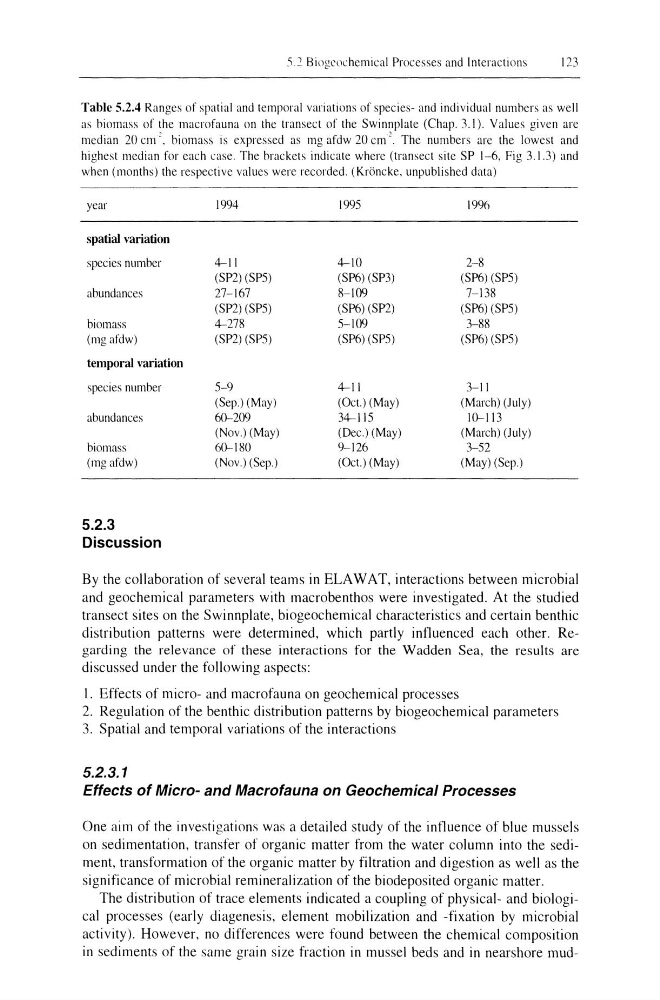
Table 5.2.4 Ranges of spatial and tcmporal variations of species- and individual numbers as well
as biomass of the macrofauna on the transect of the Swinnplate (Chap. 3.1). Values l!iven are
median 20 cm'. biomass is cxpressed as mg afdw 20 cm '. The numbers are the lowest and
highest median for each case. The brackets indicate where (transect site SP 1-6, Fig 3.1.3) and
when (months) the respective values were recorded. (Kroncke, unpublished data)
year
spatial variation
species number
abundances
biomass
(mg afdw)
temporal variation
species number
abundances
biomass
(mg afdw)
5.2.3
Discussion
1994
4--11
(SP2) (SP5)
27-167
(SP2) (SP5)
4--278
(SP2) (SPS)
5-9
(Scp.) (May)
60-209
(Nov.) (May)
60-180
(Nov.) (Sep.)
1995
1996
4--10
2-8
(SP6) (SP3)
(SP6) (SP5)
8-109
7-138
(SP6) (SP2)
(SP6) (SP5)
5-109
3-88
(SP6) (SP5)
(SP6) (SPS)
4--11
3-11
(Ocl.) (May)
(March) (July)
34--115
10-113
(Dec.) (May)
(March) (July)
9-126
3-S2
(Oct.) (May)
(May) (Scp.)
By the collaboration of several teams in ELA WAT, interactions between microbial
and geochemical parameters with macrobenthos were investigated. At the studied
transect sites on the Swinnplate, biogeochemical characteristics and certain benthic
distribution patterns were determined, which partly influenced each other. Regarding the relevance of these interactions for the Wadden Sea, the results are
discussed under the following aspects:
I. Effects of micro- and macrofauna on geochemical processes
2. Regulation of the benthic distribution patterns by biogeochemical parameters
3. Spatial and temporal variations of the interactions
5.2.3.1
Effects of Micro- and Macrofauna on Geochemical Processes
One aim of the investigations was a detailed study of the influence of blue mussels
on sedimentation, transfer of organic matter from the water column into the sediment, transformation of the organic matter by filtration and digestion as well as the
significance of microbial remineralization of the biodeposited organic matter.
The distribution of trace elements indicated a coupling of physical- and biological processes (early diagenesis, element mobilization and -fixation by microbial
activity). However, no differences were found between the chemical composition
in sediments of the same grain size fraction in mussel beds and in nearshore mud-
123
Table 5.2.4 Ranges of spatial and tcmporal variations of species- and individual numbers as well
as biomass of the macrofauna on the transect of the Swinnplate (Chap. 3.1). Values l!iven are
median 20 cm'. biomass is cxpressed as mg afdw 20 cm '. The numbers are the lowest and
highest median for each case. The brackets indicate where (transect site SP 1-6, Fig 3.1.3) and
when (months) the respective values were recorded. (Kroncke, unpublished data)
year
spatial variation
species number
abundances
biomass
(mg afdw)
temporal variation
species number
abundances
biomass
(mg afdw)
5.2.3
Discussion
1994
4--11
(SP2) (SP5)
27-167
(SP2) (SP5)
4--278
(SP2) (SPS)
5-9
(Scp.) (May)
60-209
(Nov.) (May)
60-180
(Nov.) (Sep.)
1995
1996
4--10
2-8
(SP6) (SP3)
(SP6) (SP5)
8-109
7-138
(SP6) (SP2)
(SP6) (SP5)
5-109
3-88
(SP6) (SP5)
(SP6) (SPS)
4--11
3-11
(Ocl.) (May)
(March) (July)
34--115
10-113
(Dec.) (May)
(March) (July)
9-126
3-S2
(Oct.) (May)
(May) (Scp.)
By the collaboration of several teams in ELA WAT, interactions between microbial
and geochemical parameters with macrobenthos were investigated. At the studied
transect sites on the Swinnplate, biogeochemical characteristics and certain benthic
distribution patterns were determined, which partly influenced each other. Regarding the relevance of these interactions for the Wadden Sea, the results are
discussed under the following aspects:
I. Effects of micro- and macrofauna on geochemical processes
2. Regulation of the benthic distribution patterns by biogeochemical parameters
3. Spatial and temporal variations of the interactions
5.2.3.1
Effects of Micro- and Macrofauna on Geochemical Processes
One aim of the investigations was a detailed study of the influence of blue mussels
on sedimentation, transfer of organic matter from the water column into the sediment, transformation of the organic matter by filtration and digestion as well as the
significance of microbial remineralization of the biodeposited organic matter.
The distribution of trace elements indicated a coupling of physical- and biological processes (early diagenesis, element mobilization and -fixation by microbial
activity). However, no differences were found between the chemical composition
in sediments of the same grain size fraction in mussel beds and in nearshore mud-