

5.2 BIOgeochemical Processes and Interactions
119
Input 01 btodepoSlls. rrud and organic maleri.1
anaerobe sedlmenl
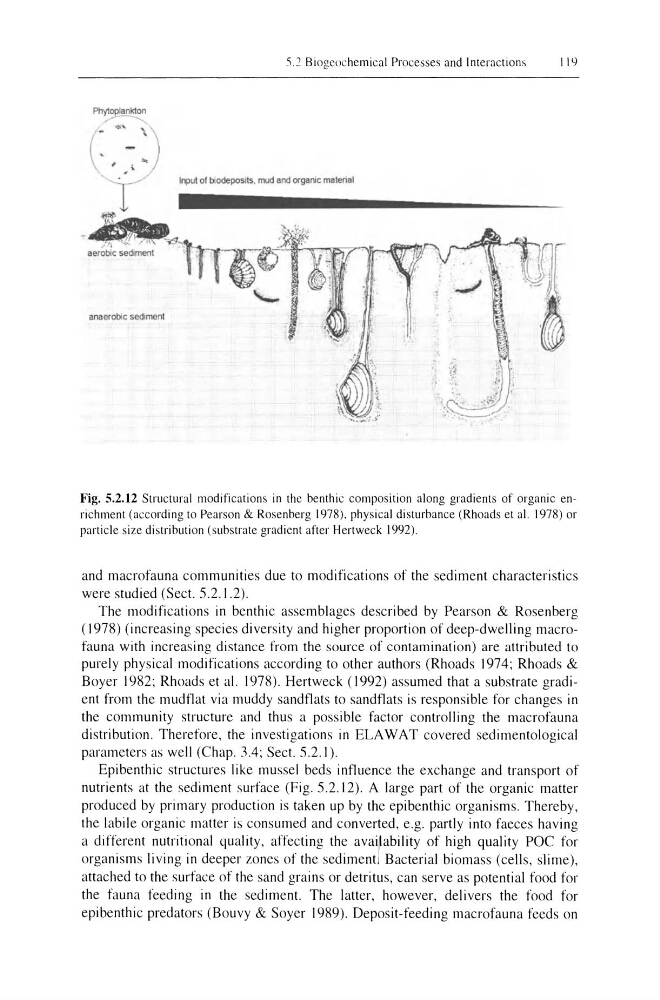
Fig. 5.2.12 Structural modifications in the benthic composition along gradients of organic enrichment (according to Pearson & Rosenberg 1978), physical disturbance (Rhoads et aL 1978) or
particle size distribution (substrate gradient after Hertweck 1992).
and macrofauna communities due to modifications of the sediment characteristics
were studied (Sect. 5.2.1.2).
The modifications in benthic assemblages described by Pearson & Rosenberg
(1978) (increasing species diversity and higher proportion of deep-dwelling macrofauna with increasing distance from the source of contamination) are attributed to
purely physical modifications according to other authors (Rhoads 1974; Rhoads &
Boyer 1982; Rhoads et al. 1978). Hertweck (1992) assumed that a substrate gradient from the mudflat via muddy sandt1ats to sandflats is responsible for changes in
the community structure and thus a possible factor controlling the macrofauna
distribution. Therefore, the investigations in ELA WAT covered sedimentological
parameters as well (Chap. 3.4; Sect. 5.2.1).
Epibenthic structures like mussel beds int1uence the exchange and transport of
nutrients at the sediment surface (Fig. 5.2.12). A large part of the organic matter
produced by primary production is taken up by the epibenthic organisms. Thereby,
the labile organic matter is consumed and converted, e.g. partly into faeces having
a different nutritional quality, affecting the availability of high quality POC for
organisms living in deeper zones of the sediment! Bacterial biomass (cells, slime),
attached to the surface of the sand grains or detritus, can serve as potential food for
the fauna feeding in the sediment. The latter, however, delivers the food for
epibenthic predators (Bouvy & Soyer 1989). Deposit-feeding macrofauna feeds on
119
Input 01 btodepoSlls. rrud and organic maleri.1
anaerobe sedlmenl
Fig. 5.2.12 Structural modifications in the benthic composition along gradients of organic enrichment (according to Pearson & Rosenberg 1978), physical disturbance (Rhoads et aL 1978) or
particle size distribution (substrate gradient after Hertweck 1992).
and macrofauna communities due to modifications of the sediment characteristics
were studied (Sect. 5.2.1.2).
The modifications in benthic assemblages described by Pearson & Rosenberg
(1978) (increasing species diversity and higher proportion of deep-dwelling macrofauna with increasing distance from the source of contamination) are attributed to
purely physical modifications according to other authors (Rhoads 1974; Rhoads &
Boyer 1982; Rhoads et al. 1978). Hertweck (1992) assumed that a substrate gradient from the mudflat via muddy sandt1ats to sandflats is responsible for changes in
the community structure and thus a possible factor controlling the macrofauna
distribution. Therefore, the investigations in ELA WAT covered sedimentological
parameters as well (Chap. 3.4; Sect. 5.2.1).
Epibenthic structures like mussel beds int1uence the exchange and transport of
nutrients at the sediment surface (Fig. 5.2.12). A large part of the organic matter
produced by primary production is taken up by the epibenthic organisms. Thereby,
the labile organic matter is consumed and converted, e.g. partly into faeces having
a different nutritional quality, affecting the availability of high quality POC for
organisms living in deeper zones of the sediment! Bacterial biomass (cells, slime),
attached to the surface of the sand grains or detritus, can serve as potential food for
the fauna feeding in the sediment. The latter, however, delivers the food for
epibenthic predators (Bouvy & Soyer 1989). Deposit-feeding macrofauna feeds on