

~.2 Blo!2cochcmical Proccsscs and Interactions
117
DOC [mg 1- 1 ]
o 50 1 00 1 50 200
o
10
6 '--'
..c 20
~
30
40
o
10
20
30
40
sum HS [mM 1- 1 ]
o
5
10
15
Oct 95
Mar 96
May 96
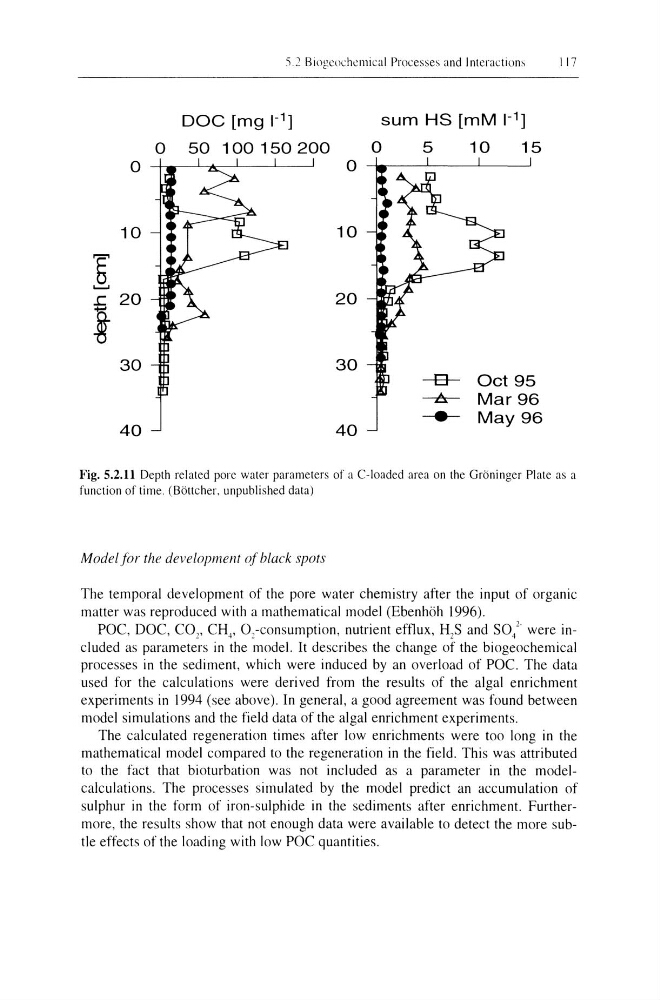
Fig. 5.2.11 Depth related pore water parameters of a C-Ioaded area on the Groninger Plate as a
function of time. (Bottcher. unpuhlished data)
Model for the development oj' black spots
The temporal development of the pore water chemistry after the input of organic
matter was reproduced with a mathematical model (Ebenhoh 1996).
POC, DOC, CO!' CH., O!-consumption, nutrient efflux, H 2 S and SO/· were included as parameters in the model. It describes the change of the biogeochemical
processes in the sediment, which were induced by an overload of POc. The data
used for the calculations were derived from the results of the algal enrichment
experiments in 1994 (see above). In general, a good agreement was found between
model simulations and the field data of the algal enrichment experiments.
The calculated regeneration times after low enrichments were too long in the
mathematical model compared to the regeneration in the field. This was attributed
to the fact that bioturbation was not included as a parameter in the modelcalculations. The processes simulated by the model predict an accumulation of
sulphur in the form of iron-sulphide in the sediments after enrichment. Furthermore, the results show that not enough data were available to detect the more subtle effects of the loading with low POC quantities.
117
DOC [mg 1- 1 ]
o 50 1 00 1 50 200
o
10
6 '--'
..c 20
~
30
40
o
10
20
30
40
sum HS [mM 1- 1 ]
o
5
10
15
Oct 95
Mar 96
May 96
Fig. 5.2.11 Depth related pore water parameters of a C-Ioaded area on the Groninger Plate as a
function of time. (Bottcher. unpuhlished data)
Model for the development oj' black spots
The temporal development of the pore water chemistry after the input of organic
matter was reproduced with a mathematical model (Ebenhoh 1996).
POC, DOC, CO!' CH., O!-consumption, nutrient efflux, H 2 S and SO/· were included as parameters in the model. It describes the change of the biogeochemical
processes in the sediment, which were induced by an overload of POc. The data
used for the calculations were derived from the results of the algal enrichment
experiments in 1994 (see above). In general, a good agreement was found between
model simulations and the field data of the algal enrichment experiments.
The calculated regeneration times after low enrichments were too long in the
mathematical model compared to the regeneration in the field. This was attributed
to the fact that bioturbation was not included as a parameter in the modelcalculations. The processes simulated by the model predict an accumulation of
sulphur in the form of iron-sulphide in the sediments after enrichment. Furthermore, the results show that not enough data were available to detect the more subtle effects of the loading with low POC quantities.