

100
5 Spatial and Temporal Distrihutlon Patterns
Sediment sorting
As discussed in chapter 3.4, the continuous reallocation of the surface sediments
by wave action and tides produces a horizontal zonation of sediment types in the
backbarrier tidal tlats (sediment sorting). Deviating from this situation, a deposition of fine-grained material took place in mussel beds, where no fine-grained
material would deposit by hydrodynamic factors only without the settlement and
activity of the mussels (Chap. 3.6.1).
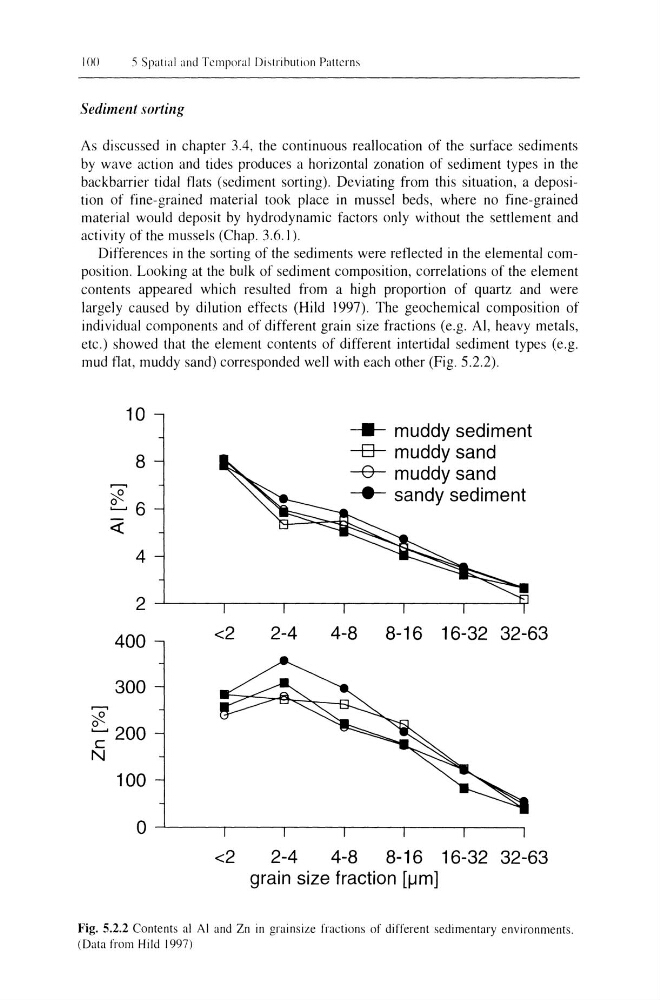
Differences in the sorting of the sediments were reflected in the elemental composition. Looking at the bulk of sediment composition, correlations of the element
contents appeared which resulted from a high proportion of quartz and were
largely caused by dilution effects CHild 1997). The geochemical composition of
individual components and of different grain size fractions (e.g. AI, heavy metals,
etc.) showed that the element contents of different intertidal sediment types (e.g.
mud flat, muddy sand) corresponded well with each other (Fig. 5.2.2).
10
8
4
2
400
300
~
' :J2.
~200
c
N
100
o
<2
<2
2-4
2-4
___ muddy sediment
-B- muddy sand
-e- muddy sand
----- sandy sediment
4-8
8-16 16-32 32-63
4-8
8-16 16-32 32-63
grain size fraction [~m]
Fig. 5.2.2 Contents al AI and Zn in grainsizc fractions of different sedimentary environments.
(Data frol11 Hild 1997)
5 Spatial and Temporal Distrihutlon Patterns
Sediment sorting
As discussed in chapter 3.4, the continuous reallocation of the surface sediments
by wave action and tides produces a horizontal zonation of sediment types in the
backbarrier tidal tlats (sediment sorting). Deviating from this situation, a deposition of fine-grained material took place in mussel beds, where no fine-grained
material would deposit by hydrodynamic factors only without the settlement and
activity of the mussels (Chap. 3.6.1).
Differences in the sorting of the sediments were reflected in the elemental composition. Looking at the bulk of sediment composition, correlations of the element
contents appeared which resulted from a high proportion of quartz and were
largely caused by dilution effects CHild 1997). The geochemical composition of
individual components and of different grain size fractions (e.g. AI, heavy metals,
etc.) showed that the element contents of different intertidal sediment types (e.g.
mud flat, muddy sand) corresponded well with each other (Fig. 5.2.2).
10
8
4
2
400
300
~
' :J2.
~200
c
N
100
o
<2
<2
2-4
2-4
___ muddy sediment
-B- muddy sand
-e- muddy sand
----- sandy sediment
4-8
8-16 16-32 32-63
4-8
8-16 16-32 32-63
grain size fraction [~m]
Fig. 5.2.2 Contents al AI and Zn in grainsizc fractions of different sedimentary environments.
(Data frol11 Hild 1997)