

5.2 Biogeochemical Processes and Interactions
97
Air
_ - - - - - - - - - - _
----~-----. .. -----,.--'"
Water
- - - - - - - - -
Sediment
Biodeposits
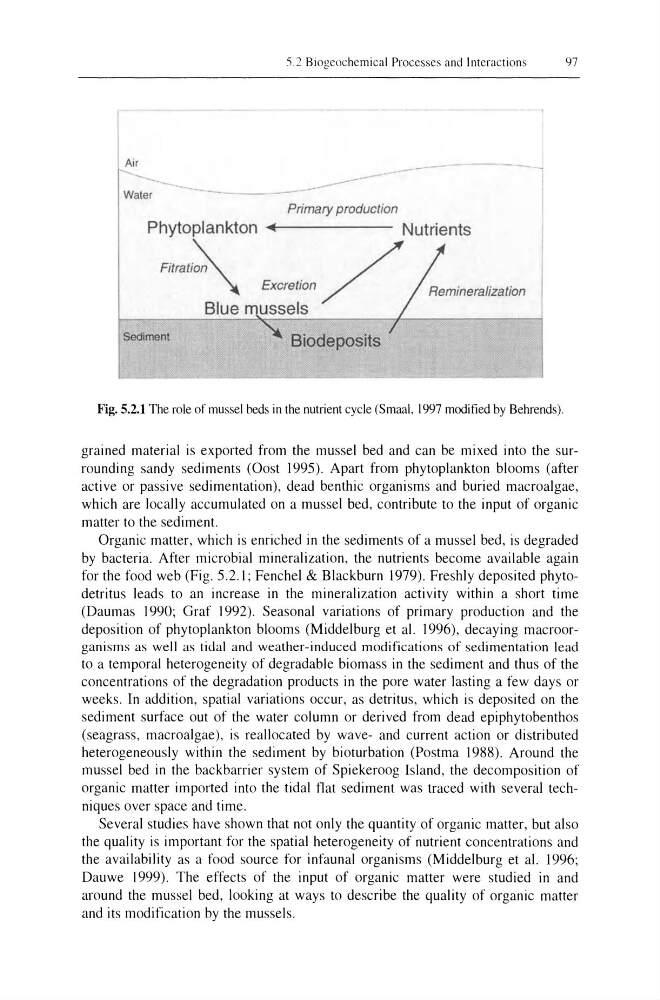
Fig. 5.2.1 The role of mussel beds in the nutrient cycle (Smaal. 1997 modified by Behrends).
grained material is exported from the mussel bed and can be mixed into the surrounding sandy sediments (Oost 1995). Apart from phytoplankton blooms (after
active or passive sedimentation), dead benthic organisms and buried macroalgae,
which are locally accumulated on a mussel bed, contribute to the input of organic
matter to the sediment.
Organic matter, which is enriched in the sediments of a mussel bed, is degraded
by bacteria. After microbial mineralization, the nutrients become available again
for the food web (Fig. 5.2.1; Fenchel & Blackburn 1979). Freshly deposited phytodetritus leads to an increase in the mineralization activity within a short time
(Daumas 1990; Graf 1992). Seasonal variations of primary production and the
deposition of phytoplankton blooms (Middelburg et a!. 1996), decaying macroorganisms as well as tidal and weather-induced modifications of sedimentation lead
to a temporal heterogeneity of degradable biomass in the sediment and thus of the
concentrations of the degradation products in the pore water lasting a few days or
weeks. In addition, spatial variations occur, as detritus, which is deposited on the
sediment surface out of the water column or derived from dead epiphytobenthos
(seagrass, macroalgae), is reallocated by wave- and current action or distributed
heterogeneously within the sediment by bioturbation (Postma 1988). Around the
mussel bed in the backbarrier system of Spiekeroog Island, the decomposition of
organic matter imported into the tidal t1at sediment was traced with several techniques over space and time.
Several studies have shown that not only the quantity of organic matter, but also
the quality is important for the spatial heterogeneity of nutrient concentrations and
the availability as a food source for infaunal organisms (Middelburg et a!. 1996;
Dauwe 1999). The effects of the input of organic matter were studied in and
around the mussel bed, looking at ways to describe the quality of organic matter
and its modification by the mussels.
97
Air
_ - - - - - - - - - - _
----~-----. .. -----,.--'"
Water
- - - - - - - - -
Sediment
Biodeposits
Fig. 5.2.1 The role of mussel beds in the nutrient cycle (Smaal. 1997 modified by Behrends).
grained material is exported from the mussel bed and can be mixed into the surrounding sandy sediments (Oost 1995). Apart from phytoplankton blooms (after
active or passive sedimentation), dead benthic organisms and buried macroalgae,
which are locally accumulated on a mussel bed, contribute to the input of organic
matter to the sediment.
Organic matter, which is enriched in the sediments of a mussel bed, is degraded
by bacteria. After microbial mineralization, the nutrients become available again
for the food web (Fig. 5.2.1; Fenchel & Blackburn 1979). Freshly deposited phytodetritus leads to an increase in the mineralization activity within a short time
(Daumas 1990; Graf 1992). Seasonal variations of primary production and the
deposition of phytoplankton blooms (Middelburg et a!. 1996), decaying macroorganisms as well as tidal and weather-induced modifications of sedimentation lead
to a temporal heterogeneity of degradable biomass in the sediment and thus of the
concentrations of the degradation products in the pore water lasting a few days or
weeks. In addition, spatial variations occur, as detritus, which is deposited on the
sediment surface out of the water column or derived from dead epiphytobenthos
(seagrass, macroalgae), is reallocated by wave- and current action or distributed
heterogeneously within the sediment by bioturbation (Postma 1988). Around the
mussel bed in the backbarrier system of Spiekeroog Island, the decomposition of
organic matter imported into the tidal t1at sediment was traced with several techniques over space and time.
Several studies have shown that not only the quantity of organic matter, but also
the quality is important for the spatial heterogeneity of nutrient concentrations and
the availability as a food source for infaunal organisms (Middelburg et a!. 1996;
Dauwe 1999). The effects of the input of organic matter were studied in and
around the mussel bed, looking at ways to describe the quality of organic matter
and its modification by the mussels.