

56
trenches excavated at lowland. Because the
marine species of diatoms were collected only
from sand layers, indicating that these layers
were originated from marine event sediments,
brought by tsunamis from the ocean (Dawson
et al. 1996 ). Major earthquakes like the Pacifi c
coast of Tohoku earthquake in 2011 have occurred
in 500-year cycles along the Pacifi c coast of
northern part of Japan. The tsunami caused a
lot of damage to the Tohoku region including
marine life.
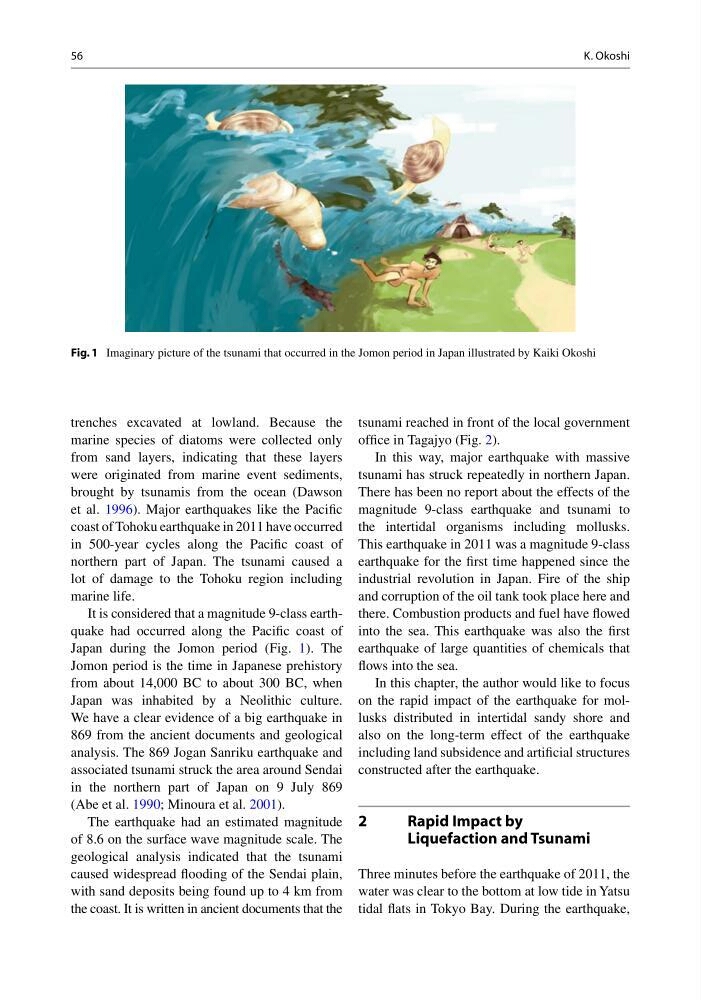
It is considered that a magnitude 9-class earthquake had occurred along the Pacifi c coast of
Japan during the Jomon period (Fig. 1 ). The
Jomon period is the time in Japanese prehistory
from about 14,000 BC to about 300 BC, when
Japan was inhabited by a Neolithic culture.
We have a clear evidence of a big earthquake in
869 from the ancient documents and geological
analysis. The 869 Jogan Sanriku earthquake and
associated tsunami struck the area around Sendai
in the northern part of Japan on 9 July 869
(Abe et al. 1990 ; Minoura et al. 2001 ).
The earthquake had an estimated magnitude
of 8.6 on the surface wave magnitude scale. The
geological analysis indicated that the tsunami
caused widespread fl ooding of the Sendai plain,
with sand deposits being found up to 4 km from
the coast. It is written in ancient documents that the
tsunami reached in front of the local government
offi ce in Tagajyo (Fig. 2 ).
In this way, major earthquake with massive
tsunami has struck repeatedly in northern Japan.
There has been no report about the effects of the
magnitude 9-class earthquake and tsunami to
the intertidal organisms including mollusks.
This earthquake in 2011 was a magnitude 9-class
earthquake for the fi rst time happened since the
industrial revolution in Japan. Fire of the ship
and corruption of the oil tank took place here and
there. Combustion products and fuel have fl owed
into the sea. This earthquake was also the fi rst
earthquake of large quantities of chemicals that
fl ows into the sea.
In this chapter, the author would like to focus
on the rapid impact of the earthquake for mollusks distributed in intertidal sandy shore and
also on the long-term effect of the earthquake
including land subsidence and artifi cial structures
constructed after the earthquake.
2
Rapid Impact by
Liquefaction and Tsunami
Three minutes before the earthquake of 2011, the
water was clear to the bottom at low tide in Yatsu
tidal fl ats in Tokyo Bay. During the earthquake,
Fig. 1 Imaginary picture of the tsunami that occurred in the Jomon period in Japan illustrated by Kaiki Okoshi
K. Okoshi
trenches excavated at lowland. Because the
marine species of diatoms were collected only
from sand layers, indicating that these layers
were originated from marine event sediments,
brought by tsunamis from the ocean (Dawson
et al. 1996 ). Major earthquakes like the Pacifi c
coast of Tohoku earthquake in 2011 have occurred
in 500-year cycles along the Pacifi c coast of
northern part of Japan. The tsunami caused a
lot of damage to the Tohoku region including
marine life.
It is considered that a magnitude 9-class earthquake had occurred along the Pacifi c coast of
Japan during the Jomon period (Fig. 1 ). The
Jomon period is the time in Japanese prehistory
from about 14,000 BC to about 300 BC, when
Japan was inhabited by a Neolithic culture.
We have a clear evidence of a big earthquake in
869 from the ancient documents and geological
analysis. The 869 Jogan Sanriku earthquake and
associated tsunami struck the area around Sendai
in the northern part of Japan on 9 July 869
(Abe et al. 1990 ; Minoura et al. 2001 ).
The earthquake had an estimated magnitude
of 8.6 on the surface wave magnitude scale. The
geological analysis indicated that the tsunami
caused widespread fl ooding of the Sendai plain,
with sand deposits being found up to 4 km from
the coast. It is written in ancient documents that the
tsunami reached in front of the local government
offi ce in Tagajyo (Fig. 2 ).
In this way, major earthquake with massive
tsunami has struck repeatedly in northern Japan.
There has been no report about the effects of the
magnitude 9-class earthquake and tsunami to
the intertidal organisms including mollusks.
This earthquake in 2011 was a magnitude 9-class
earthquake for the fi rst time happened since the
industrial revolution in Japan. Fire of the ship
and corruption of the oil tank took place here and
there. Combustion products and fuel have fl owed
into the sea. This earthquake was also the fi rst
earthquake of large quantities of chemicals that
fl ows into the sea.
In this chapter, the author would like to focus
on the rapid impact of the earthquake for mollusks distributed in intertidal sandy shore and
also on the long-term effect of the earthquake
including land subsidence and artifi cial structures
constructed after the earthquake.
2
Rapid Impact by
Liquefaction and Tsunami
Three minutes before the earthquake of 2011, the
water was clear to the bottom at low tide in Yatsu
tidal fl ats in Tokyo Bay. During the earthquake,
Fig. 1 Imaginary picture of the tsunami that occurred in the Jomon period in Japan illustrated by Kaiki Okoshi
K. Okoshi