

44
Park due to the attractive landform of the bays and
now part of the Sanriku Recovery National Park.
The majority of the aquaculture operating on the
Sanriku Coast comprises of seaweeds, oysters,
ascidians and scallops, which do not require artifi -
cial feed input. Shells and ascidians are fi lter feeders that depend on particulate organic matter
(POM) in the seawater (Dame 1993 ; Petersen
2007 ). POM is supplied from rivers and the ocean
(Wada et al. 1987 ; Kawamiya et al. 1996 ). Oceanderived POM consists of phytoplankton, zooplankton and other particulate materials. In the
Sanriku ria bays, the seaweed and seagrass beds
produce POM not only from their own biomass
but also from epiphytic organisms (e.g. Oshima
et al. 1999 ). The seaweed beds are distributed
mainly in the mouth and middle of the bays, and the
seagrass beds are distributed mainly at the head of
the bays, because the seaweed grows on rock beds,
and most of the seagrass grows on sand beds.
Seagrass and seaweed beds play an ecologically important role as substrates for fl ora and
fauna, including epiphytic and benthic organisms, as well as their key role in fi sheries ( Fortes
1996 ; Coles et al. 1993 ). Seagrass beds contribute to the marine environment by stabilising bottom sediments and maintaining coastal water
quality and clarity (Ward et al. 1984 ; Jeudy de
Grissac and Boudouresque 1985 ; Komatsu and
Yamano 2000 ; Komatsu et al. 2004 ). Seaweed
and seagrass beds contribute to forming marine
environments by infl uencing the spatial and temporal distributions of water fl ow (Komatsu and
Murakami 1994 ), water temperature (Komatsu
et al. 1982 , 1985 , 1994 ), downward illumination
via shading by their canopies (Komatsu 1989 ;
Komatsu et al. 1990 ), pH distribution (Komatsu
and Kawai 1986 ) and dissolved oxygen content
by their respiration and assimilation (Komatsu
1989 ; Komatsu et al. 1990 ). Many commercially
important species spawn in seagrass and seaweed
beds (e.g. molluscs, sea urchins, balaos, cuttlefi sh), and larvae and juveniles use the beds as
nursery grounds (Arasaki and Arasaki 1978 ).
Thus, seagrass and seaweed beds support biodiversity and are important habitats for marine
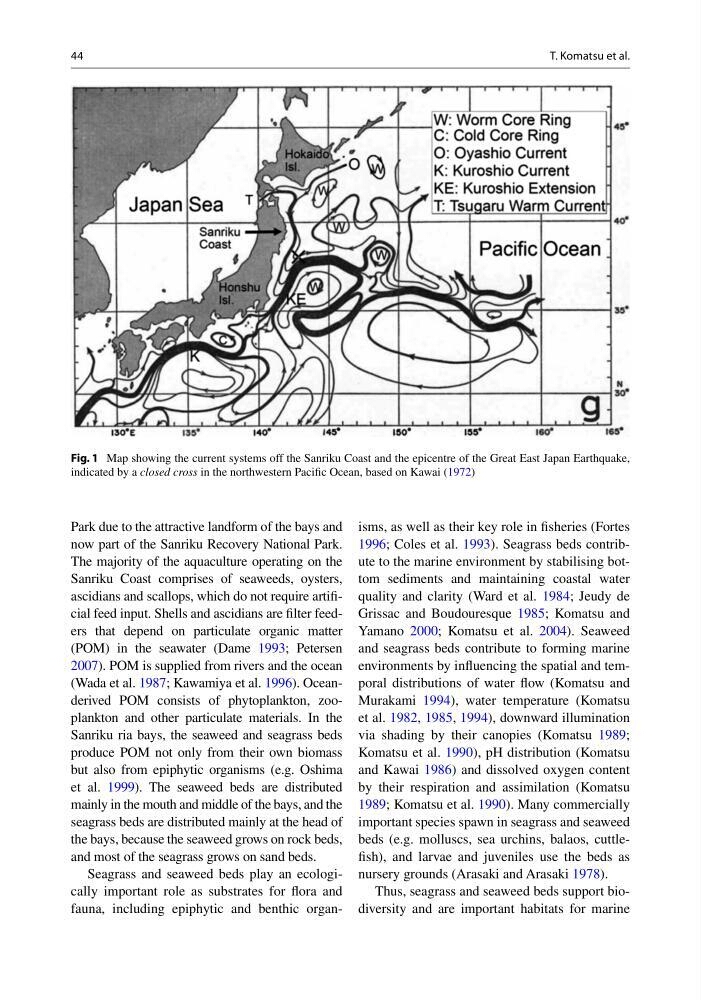
Fig. 1 Map showing the current systems off the Sanriku Coast and the epicentre of the Great East Japan Earthquake,
indicated by a closed cross in the northwestern Pacifi c Ocean, based on Kawai ( 1972 )
T. Komatsu et al.
Park due to the attractive landform of the bays and
now part of the Sanriku Recovery National Park.
The majority of the aquaculture operating on the
Sanriku Coast comprises of seaweeds, oysters,
ascidians and scallops, which do not require artifi -
cial feed input. Shells and ascidians are fi lter feeders that depend on particulate organic matter
(POM) in the seawater (Dame 1993 ; Petersen
2007 ). POM is supplied from rivers and the ocean
(Wada et al. 1987 ; Kawamiya et al. 1996 ). Oceanderived POM consists of phytoplankton, zooplankton and other particulate materials. In the
Sanriku ria bays, the seaweed and seagrass beds
produce POM not only from their own biomass
but also from epiphytic organisms (e.g. Oshima
et al. 1999 ). The seaweed beds are distributed
mainly in the mouth and middle of the bays, and the
seagrass beds are distributed mainly at the head of
the bays, because the seaweed grows on rock beds,
and most of the seagrass grows on sand beds.
Seagrass and seaweed beds play an ecologically important role as substrates for fl ora and
fauna, including epiphytic and benthic organisms, as well as their key role in fi sheries ( Fortes
1996 ; Coles et al. 1993 ). Seagrass beds contribute to the marine environment by stabilising bottom sediments and maintaining coastal water
quality and clarity (Ward et al. 1984 ; Jeudy de
Grissac and Boudouresque 1985 ; Komatsu and
Yamano 2000 ; Komatsu et al. 2004 ). Seaweed
and seagrass beds contribute to forming marine
environments by infl uencing the spatial and temporal distributions of water fl ow (Komatsu and
Murakami 1994 ), water temperature (Komatsu
et al. 1982 , 1985 , 1994 ), downward illumination
via shading by their canopies (Komatsu 1989 ;
Komatsu et al. 1990 ), pH distribution (Komatsu
and Kawai 1986 ) and dissolved oxygen content
by their respiration and assimilation (Komatsu
1989 ; Komatsu et al. 1990 ). Many commercially
important species spawn in seagrass and seaweed
beds (e.g. molluscs, sea urchins, balaos, cuttlefi sh), and larvae and juveniles use the beds as
nursery grounds (Arasaki and Arasaki 1978 ).
Thus, seagrass and seaweed beds support biodiversity and are important habitats for marine
Fig. 1 Map showing the current systems off the Sanriku Coast and the epicentre of the Great East Japan Earthquake,
indicated by a closed cross in the northwestern Pacifi c Ocean, based on Kawai ( 1972 )
T. Komatsu et al.