

29
because the major accessory pigment of diatoms
is Fuco and that of dinofl agellates is Perid
(Jeffrey and Vesk 1997 ). We concluded that the
spring bloom was caused by diatoms and that
the autumn bloom was due to dinofl agellates.
The autumn bloom in Kesennuma Bay was
thought to be mainly phytoplankton except diatoms (Itoh et al. 2006 ). These results agree with
those of a previous report.
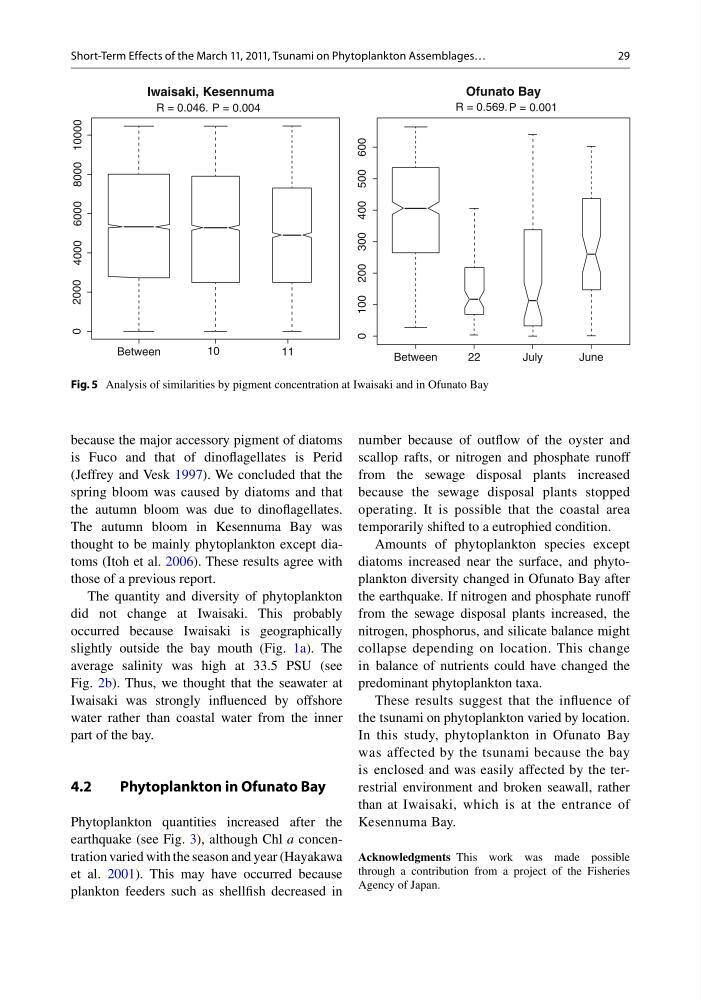
The quantity and diversity of phytoplankton
did not change at Iwaisaki. This probably
occurred because Iwaisaki is geographically
slightly outside the bay mouth (Fig. 1a ). The
average salinity was high at 33.5 PSU (see
Fig. 2b ). Thus, we thought that the seawater at
Iwaisaki was strongly infl uenced by offshore
water rather than coastal water from the inner
part of the bay.
4.2
Phytoplankton in Ofunato Bay
Phytoplankton quantities increased after the
earthquake (see Fig. 3 ), although Chl a concentration varied with the season and year (Hayakawa
et al. 2001 ). This may have occurred because
plankton feeders such as shellfi sh decreased in
number because of outfl ow of the oyster and
scallop rafts, or nitrogen and phosphate runoff
from the sewage disposal plants increased
because the sewage disposal plants stopped
operating. It is possible that the coastal area
temporarily shifted to a eutrophied condition.
Amounts of phytoplankton species except
diatoms increased near the surface, and phytoplankton diversity changed in Ofunato Bay after
the earthquake. If nitrogen and phosphate runoff
from the sewage disposal plants increased, the
nitrogen, phosphorus, and silicate balance might
collapse depending on location. This change
in balance of nutrients could have changed the
predominant phytoplankton taxa.
These results suggest that the infl uence of
the tsunami on phytoplankton varied by location.
In this study, phytoplankton in Ofunato Bay
was affected by the tsunami because the bay
is enclosed and was easily affected by the terrestrial environment and broken seawall, rather
than at Iwaisaki, which is at the entrance of
Kesennuma Bay.
Acknowledgments This work was made possible
through a contribution from a project of the Fisheries
Agency of Japan.
Iwaisaki, Kesennuma
P = 0.004
R = 0.046.
10000
8000
6000
4000
2000
0
Between
10
11
Between
22
July
June
Ofunato Bay
R = 0.569. P = 0.001
600
500
400
300
200
100
0
Fig. 5 Analysis of similarities by pigment concentration at Iwaisaki and in Ofunato Bay
Short-Term Effects of the March 11, 2011, Tsunami on Phytoplankton Assemblages…
because the major accessory pigment of diatoms
is Fuco and that of dinofl agellates is Perid
(Jeffrey and Vesk 1997 ). We concluded that the
spring bloom was caused by diatoms and that
the autumn bloom was due to dinofl agellates.
The autumn bloom in Kesennuma Bay was
thought to be mainly phytoplankton except diatoms (Itoh et al. 2006 ). These results agree with
those of a previous report.
The quantity and diversity of phytoplankton
did not change at Iwaisaki. This probably
occurred because Iwaisaki is geographically
slightly outside the bay mouth (Fig. 1a ). The
average salinity was high at 33.5 PSU (see
Fig. 2b ). Thus, we thought that the seawater at
Iwaisaki was strongly infl uenced by offshore
water rather than coastal water from the inner
part of the bay.
4.2
Phytoplankton in Ofunato Bay
Phytoplankton quantities increased after the
earthquake (see Fig. 3 ), although Chl a concentration varied with the season and year (Hayakawa
et al. 2001 ). This may have occurred because
plankton feeders such as shellfi sh decreased in
number because of outfl ow of the oyster and
scallop rafts, or nitrogen and phosphate runoff
from the sewage disposal plants increased
because the sewage disposal plants stopped
operating. It is possible that the coastal area
temporarily shifted to a eutrophied condition.
Amounts of phytoplankton species except
diatoms increased near the surface, and phytoplankton diversity changed in Ofunato Bay after
the earthquake. If nitrogen and phosphate runoff
from the sewage disposal plants increased, the
nitrogen, phosphorus, and silicate balance might
collapse depending on location. This change
in balance of nutrients could have changed the
predominant phytoplankton taxa.
These results suggest that the infl uence of
the tsunami on phytoplankton varied by location.
In this study, phytoplankton in Ofunato Bay
was affected by the tsunami because the bay
is enclosed and was easily affected by the terrestrial environment and broken seawall, rather
than at Iwaisaki, which is at the entrance of
Kesennuma Bay.
Acknowledgments This work was made possible
through a contribution from a project of the Fisheries
Agency of Japan.
Iwaisaki, Kesennuma
P = 0.004
R = 0.046.
10000
8000
6000
4000
2000
0
Between
10
11
Between
22
July
June
Ofunato Bay
R = 0.569. P = 0.001
600
500
400
300
200
100
0
Fig. 5 Analysis of similarities by pigment concentration at Iwaisaki and in Ofunato Bay
Short-Term Effects of the March 11, 2011, Tsunami on Phytoplankton Assemblages…