

21
in kelp beds. In contrast, the main habitat of adult
abalone is kelp beds, where the current velocity
of the tsunami might have been partially attenuated by the presence of the algal canopy as
observed in the previous tsunami event generated
by the Sumatra-Andaman earthquake in 2004
(Whanpetch et al. 2010 ).
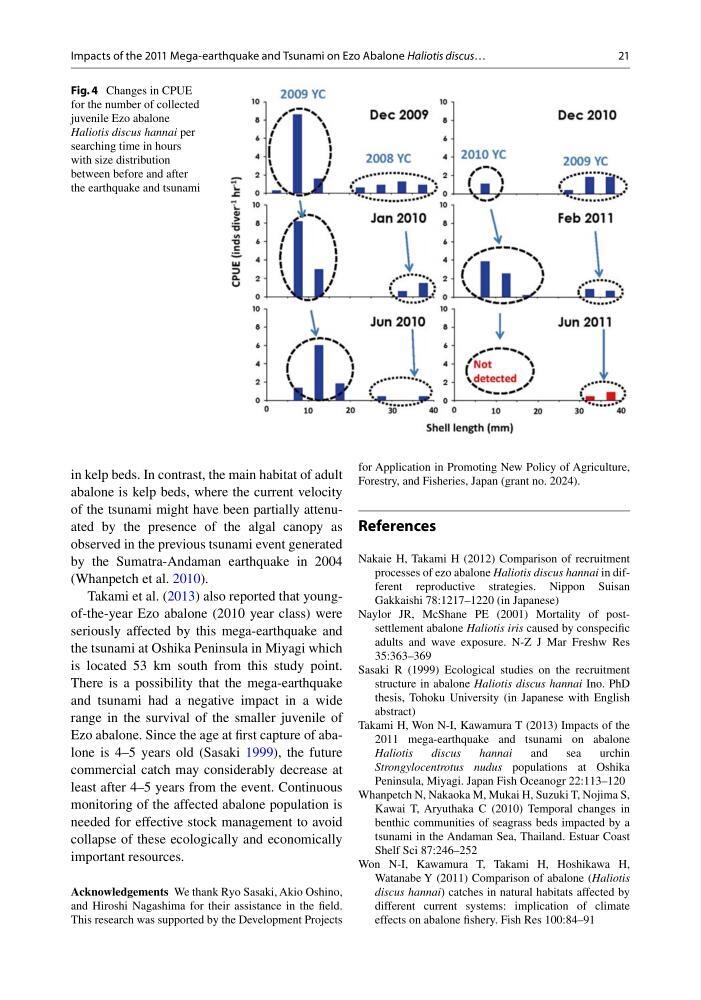
Takami et al. ( 2013 ) also reported that youngof- the-year Ezo abalone (2010 year class) were
seriously affected by this mega-earthquake and
the tsunami at Oshika Peninsula in Miyagi which
is located 53 km south from this study point.
There is a possibility that the mega-earthquake
and tsunami had a negative impact in a wide
range in the survival of the smaller juvenile of
Ezo abalone. Since the age at fi rst capture of abalone is 4–5 years old (Sasaki 1999 ), the future
commercial catch may considerably decrease at
least after 4–5 years from the event. Continuous
monitoring of the affected abalone population is
needed for effective stock management to avoid
collapse of these ecologically and economically
important resources.
Acknowledgements We thank Ryo Sasaki, Akio Oshino,
and Hiroshi Nagashima for their assistance in the fi eld.
This research was supported by the Development Projects
for Application in Promoting New Policy of Agriculture,
Forestry, and Fisheries, Japan (grant no. 2024).
References
Nakaie H, Takami H (2012) Comparison of recruitment
processes of ezo abalone Haliotis discus hannai in different reproductive strategies. Nippon Suisan
Gakkaishi 78:1217–1220 (in Japanese)
Naylor JR, McShane PE (2001) Mortality of postsettlement abalone Haliotis iris caused by conspecifi c
adults and wave exposure. N-Z J Mar Freshw Res
35:363–369
Sasaki R (1999) Ecological studies on the recruitment
structure in abalone Haliotis discus hannai Ino. PhD
thesis, Tohoku University (in Japanese with English
abstract)
Takami H, Won N-I, Kawamura T (2013) Impacts of the
2011 mega-earthquake and tsunami on abalone
Haliotis
discus
hannai
and
sea
urchin
Strongylocentrotus nudus populations at Oshika
Peninsula, Miyagi. Japan Fish Oceanogr 22:113–120
Whanpetch N, Nakaoka M, Mukai H, Suzuki T, Nojima S,
Kawai T, Aryuthaka C (2010) Temporal changes in
benthic communities of seagrass beds impacted by a
tsunami in the Andaman Sea, Thailand. Estuar Coast
Shelf Sci 87:246–252
Won N-I, Kawamura T, Takami H, Hoshikawa H,
Watanabe Y (2011) Comparison of abalone ( Haliotis
discus hannai ) catches in natural habitats affected by
different current systems: implication of climate
effects on abalone fi shery. Fish Res 100:84–91
Fig. 4 Changes in CPUE
for the number of collected
juvenile Ezo abalone
Haliotis discus hannai per
searching time in hours
with size distribution
between before and after
the earthquake and tsunami
Impacts of the 2011 Mega-earthquake and Tsunami on Ezo Abalone Haliotis discus…
in kelp beds. In contrast, the main habitat of adult
abalone is kelp beds, where the current velocity
of the tsunami might have been partially attenuated by the presence of the algal canopy as
observed in the previous tsunami event generated
by the Sumatra-Andaman earthquake in 2004
(Whanpetch et al. 2010 ).
Takami et al. ( 2013 ) also reported that youngof- the-year Ezo abalone (2010 year class) were
seriously affected by this mega-earthquake and
the tsunami at Oshika Peninsula in Miyagi which
is located 53 km south from this study point.
There is a possibility that the mega-earthquake
and tsunami had a negative impact in a wide
range in the survival of the smaller juvenile of
Ezo abalone. Since the age at fi rst capture of abalone is 4–5 years old (Sasaki 1999 ), the future
commercial catch may considerably decrease at
least after 4–5 years from the event. Continuous
monitoring of the affected abalone population is
needed for effective stock management to avoid
collapse of these ecologically and economically
important resources.
Acknowledgements We thank Ryo Sasaki, Akio Oshino,
and Hiroshi Nagashima for their assistance in the fi eld.
This research was supported by the Development Projects
for Application in Promoting New Policy of Agriculture,
Forestry, and Fisheries, Japan (grant no. 2024).
References
Nakaie H, Takami H (2012) Comparison of recruitment
processes of ezo abalone Haliotis discus hannai in different reproductive strategies. Nippon Suisan
Gakkaishi 78:1217–1220 (in Japanese)
Naylor JR, McShane PE (2001) Mortality of postsettlement abalone Haliotis iris caused by conspecifi c
adults and wave exposure. N-Z J Mar Freshw Res
35:363–369
Sasaki R (1999) Ecological studies on the recruitment
structure in abalone Haliotis discus hannai Ino. PhD
thesis, Tohoku University (in Japanese with English
abstract)
Takami H, Won N-I, Kawamura T (2013) Impacts of the
2011 mega-earthquake and tsunami on abalone
Haliotis
discus
hannai
and
sea
urchin
Strongylocentrotus nudus populations at Oshika
Peninsula, Miyagi. Japan Fish Oceanogr 22:113–120
Whanpetch N, Nakaoka M, Mukai H, Suzuki T, Nojima S,
Kawai T, Aryuthaka C (2010) Temporal changes in
benthic communities of seagrass beds impacted by a
tsunami in the Andaman Sea, Thailand. Estuar Coast
Shelf Sci 87:246–252
Won N-I, Kawamura T, Takami H, Hoshikawa H,
Watanabe Y (2011) Comparison of abalone ( Haliotis
discus hannai ) catches in natural habitats affected by
different current systems: implication of climate
effects on abalone fi shery. Fish Res 100:84–91
Fig. 4 Changes in CPUE
for the number of collected
juvenile Ezo abalone
Haliotis discus hannai per
searching time in hours
with size distribution
between before and after
the earthquake and tsunami
Impacts of the 2011 Mega-earthquake and Tsunami on Ezo Abalone Haliotis discus…