

370
the use of trawls and anchors by boats; the regression of sea grass meadows, where they usually
live; or their capture by scuba divers who commercialize the shells for ornamentation have
increased the pressure on their damaged populations (Vicente 1991 ; Vicente and Moreteau
1991 ). Thus, it is necessary to develop new strategies which contribute to reinforce damaged
populations which are under high risk of disappearance and to restore ecosystems degraded
largely by human activities. Therefore, the proposal of this work intends to constrain the
methodology to obtain juvenile specimens of
P. nobilis in laboratory conditions in order to
supply harmed environment with new cohorts
increasing their population density and consequently favoring the conservation of natural
environments. It could suppose the solution to
ensure the durability of this emblematic species
in the Mediterranean Sea (Garcia-March 2005 ).
In this work the fi rst data on the hatchery of
P. nobilis are shown. We have carried out numerous essays to develop the best hatchery protocol
for this endangered bivalve. In order to obtain
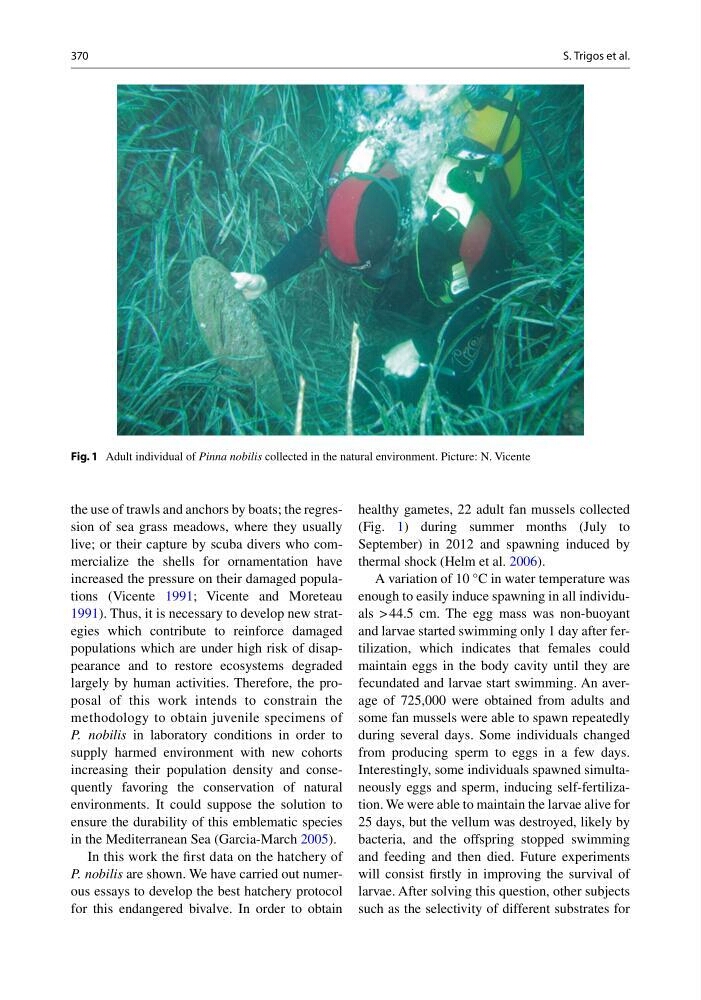
healthy gametes, 22 adult fan mussels collected
(Fig. 1 ) during summer months (July to
September) in 2012 and spawning induced by
thermal shock (Helm et al. 2006 ).
A variation of 10 °C in water temperature was
enough to easily induce spawning in all individuals > 44.5 cm. The egg mass was non-buoyant
and larvae started swimming only 1 day after fertilization, which indicates that females could
maintain eggs in the body cavity until they are
fecundated and larvae start swimming. An average of 725,000 were obtained from adults and
some fan mussels were able to spawn repeatedly
during several days. Some individuals changed
from producing sperm to eggs in a few days.
Interestingly, some individuals spawned simultaneously eggs and sperm, inducing self-fertilization. We were able to maintain the larvae alive for
25 days, but the vellum was destroyed, likely by
bacteria, and the offspring stopped swimming
and feeding and then died. Future experiments
will consist fi rstly in improving the survival of
larvae. After solving this question, other subjects
such as the selectivity of different substrates for
Fig. 1 Adult individual of Pinna nobilis collected in the natural environment. Picture: N. Vicente
S. Trigos et al.
the use of trawls and anchors by boats; the regression of sea grass meadows, where they usually
live; or their capture by scuba divers who commercialize the shells for ornamentation have
increased the pressure on their damaged populations (Vicente 1991 ; Vicente and Moreteau
1991 ). Thus, it is necessary to develop new strategies which contribute to reinforce damaged
populations which are under high risk of disappearance and to restore ecosystems degraded
largely by human activities. Therefore, the proposal of this work intends to constrain the
methodology to obtain juvenile specimens of
P. nobilis in laboratory conditions in order to
supply harmed environment with new cohorts
increasing their population density and consequently favoring the conservation of natural
environments. It could suppose the solution to
ensure the durability of this emblematic species
in the Mediterranean Sea (Garcia-March 2005 ).
In this work the fi rst data on the hatchery of
P. nobilis are shown. We have carried out numerous essays to develop the best hatchery protocol
for this endangered bivalve. In order to obtain
healthy gametes, 22 adult fan mussels collected
(Fig. 1 ) during summer months (July to
September) in 2012 and spawning induced by
thermal shock (Helm et al. 2006 ).
A variation of 10 °C in water temperature was
enough to easily induce spawning in all individuals > 44.5 cm. The egg mass was non-buoyant
and larvae started swimming only 1 day after fertilization, which indicates that females could
maintain eggs in the body cavity until they are
fecundated and larvae start swimming. An average of 725,000 were obtained from adults and
some fan mussels were able to spawn repeatedly
during several days. Some individuals changed
from producing sperm to eggs in a few days.
Interestingly, some individuals spawned simultaneously eggs and sperm, inducing self-fertilization. We were able to maintain the larvae alive for
25 days, but the vellum was destroyed, likely by
bacteria, and the offspring stopped swimming
and feeding and then died. Future experiments
will consist fi rstly in improving the survival of
larvae. After solving this question, other subjects
such as the selectivity of different substrates for
Fig. 1 Adult individual of Pinna nobilis collected in the natural environment. Picture: N. Vicente
S. Trigos et al.