

330
2.2
Adoption on the Cabinet Level
Two months after the formulation of the “Marine
Biodiversity Conservation Strategy” in 2011, the
Headquarters for Ocean Policy, which is comprised of cabinet members, adopted the defi nition
of MPAs and the areas that meet this defi nition,
along with the policy to establish MPAs. The area
covered by the known existing MPAs is about
8.3 % of Japan’s territorial waters and EEZ,
excluding the overlaps between different types of
MPAs.
In 2012, the cabinet endorsed “National
Biodiversity Strategy of Japan 2012–2020,”
which was revised to refl ect the “Aichi
Biodiversity Targets.” It set a national target to
appropriately conserve and manage at least 10 %
of coastal areas and ocean areas by 2020.
At the same time, not only the area covered by
MPAs but also the level of management is important, and the enhancement of management, such
as reviewing the location and the type of MPAs in
accordance with the changes in natural and social
environment, should be pursued as necessary.
2.3
Management of MPAs
The above mentioned MPAs are managed by
different agencies or entities – i.e., the Ministry of the
Environment, the Agency for Cultural Affairs, the
Fisheries Agency, the prefectural governments,
the fi shery cooperatives, etc.
The level of management also differs from
one type of MPA to another, according to the
purpose of the MPA. The MPAs autonomously
managed by local fi shers are patrolled almost
everyday, whereas the national parks are managed by rangers who do not visit the site as often
as they wish. In what is called “Sato-umi,” the
fi shers may try to make their fi shing ground
richer by maintaining seaweed/sea grass beds or
coral reefs or by installing artifi cial reefs, etc.
As many of the MPAs managed by the
Ministry of the Environment are overlapping
with other MPAs, the Ministry manages their
MPAs collaboratively with local governments,
local fi shers, scientists, NGOs, etc.
3
Criticism and the Possible
Way Forward
There is a controversy as to whether some MPAs
can really be regarded as MPAs. The effectiveness of regulations applied on these MPAs is
questioned. As stated in the “National Biodiversity
Strategy of Japan 2012–2020,” it is important to
consider standards and methods for evaluating
the effects of marine protected areas from
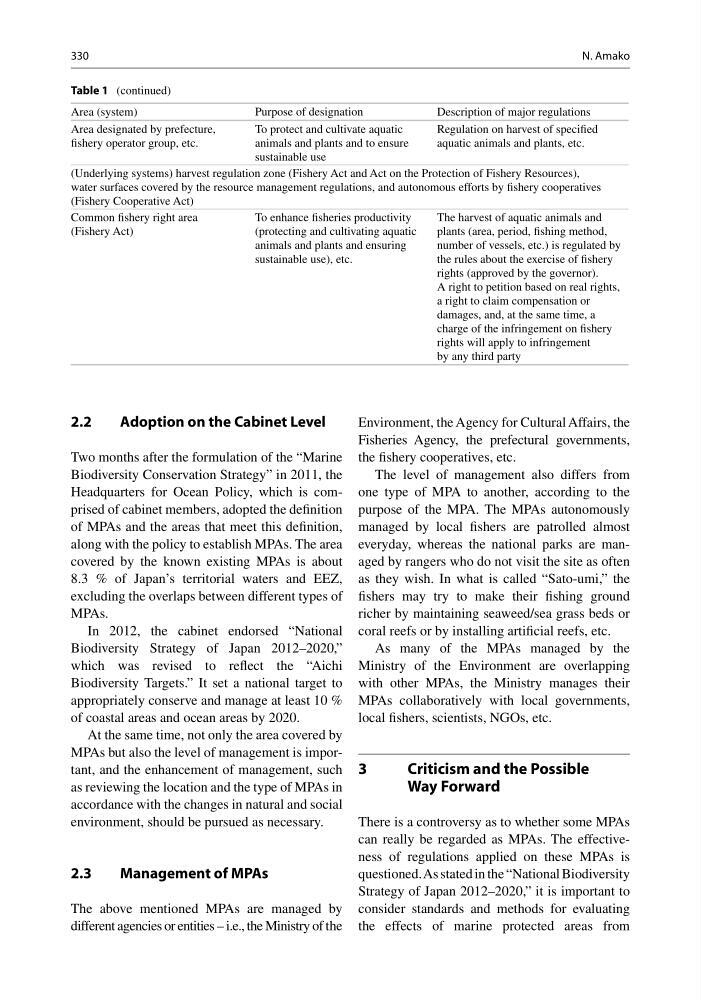
Table 1 (continued)
Area (system)
Purpose of designation
Description of major regulations
Area designated by prefecture,
fi shery operator group, etc.
To protect and cultivate aquatic
animals and plants and to ensure
sustainable use
Regulation on harvest of specifi ed
aquatic animals and plants, etc.
(Underlying systems) harvest regulation zone (Fishery Act and Act on the Protection of Fishery Resources),
water surfaces covered by the resource management regulations, and autonomous efforts by fi shery cooperatives
(Fishery Cooperative Act)
Common fi shery right area
(Fishery Act)
To enhance fi sheries productivity
(protecting and cultivating aquatic
animals and plants and ensuring
sustainable use), etc.
The harvest of aquatic animals and
plants (area, period, fi shing method,
number of vessels, etc.) is regulated by
the rules about the exercise of fi shery
rights (approved by the governor).
A right to petition based on real rights,
a right to claim compensation or
damages, and, at the same time, a
charge of the infringement on fi shery
rights will apply to infringement
by any third party
N. Amako
2.2
Adoption on the Cabinet Level
Two months after the formulation of the “Marine
Biodiversity Conservation Strategy” in 2011, the
Headquarters for Ocean Policy, which is comprised of cabinet members, adopted the defi nition
of MPAs and the areas that meet this defi nition,
along with the policy to establish MPAs. The area
covered by the known existing MPAs is about
8.3 % of Japan’s territorial waters and EEZ,
excluding the overlaps between different types of
MPAs.
In 2012, the cabinet endorsed “National
Biodiversity Strategy of Japan 2012–2020,”
which was revised to refl ect the “Aichi
Biodiversity Targets.” It set a national target to
appropriately conserve and manage at least 10 %
of coastal areas and ocean areas by 2020.
At the same time, not only the area covered by
MPAs but also the level of management is important, and the enhancement of management, such
as reviewing the location and the type of MPAs in
accordance with the changes in natural and social
environment, should be pursued as necessary.
2.3
Management of MPAs
The above mentioned MPAs are managed by
different agencies or entities – i.e., the Ministry of the
Environment, the Agency for Cultural Affairs, the
Fisheries Agency, the prefectural governments,
the fi shery cooperatives, etc.
The level of management also differs from
one type of MPA to another, according to the
purpose of the MPA. The MPAs autonomously
managed by local fi shers are patrolled almost
everyday, whereas the national parks are managed by rangers who do not visit the site as often
as they wish. In what is called “Sato-umi,” the
fi shers may try to make their fi shing ground
richer by maintaining seaweed/sea grass beds or
coral reefs or by installing artifi cial reefs, etc.
As many of the MPAs managed by the
Ministry of the Environment are overlapping
with other MPAs, the Ministry manages their
MPAs collaboratively with local governments,
local fi shers, scientists, NGOs, etc.
3
Criticism and the Possible
Way Forward
There is a controversy as to whether some MPAs
can really be regarded as MPAs. The effectiveness of regulations applied on these MPAs is
questioned. As stated in the “National Biodiversity
Strategy of Japan 2012–2020,” it is important to
consider standards and methods for evaluating
the effects of marine protected areas from
Table 1 (continued)
Area (system)
Purpose of designation
Description of major regulations
Area designated by prefecture,
fi shery operator group, etc.
To protect and cultivate aquatic
animals and plants and to ensure
sustainable use
Regulation on harvest of specifi ed
aquatic animals and plants, etc.
(Underlying systems) harvest regulation zone (Fishery Act and Act on the Protection of Fishery Resources),
water surfaces covered by the resource management regulations, and autonomous efforts by fi shery cooperatives
(Fishery Cooperative Act)
Common fi shery right area
(Fishery Act)
To enhance fi sheries productivity
(protecting and cultivating aquatic
animals and plants and ensuring
sustainable use), etc.
The harvest of aquatic animals and
plants (area, period, fi shing method,
number of vessels, etc.) is regulated by
the rules about the exercise of fi shery
rights (approved by the governor).
A right to petition based on real rights,
a right to claim compensation or
damages, and, at the same time, a
charge of the infringement on fi shery
rights will apply to infringement
by any third party
N. Amako