

321
study, in each boat was estimated based on the crew’s
work postures recorded on video images. The Ovako
working posture analysing system (OWAS) method,
one of the simplest and best-known methods, was
used in this study (Karhu et al. 1977 ). In the OWAS
method, a work posture is determined categorizing
posture based on three portions of the body (upper
body, upper limbs, and lower limbs) and the weight
of objects handled. When a work posture is identifi ed
precisely, the physical burden is ranked in one of four
action categories (AC); these serve as an index of the
degree of demand for improvement. That is, the number associated with the AC refl ects the harmfulness
of the work posture on the subject’s body (AC1 being
the best posture and AC4 being the most harmful).
When a harmful posture occurs with high frequency,
preference should be given to improve the work.
3
Results
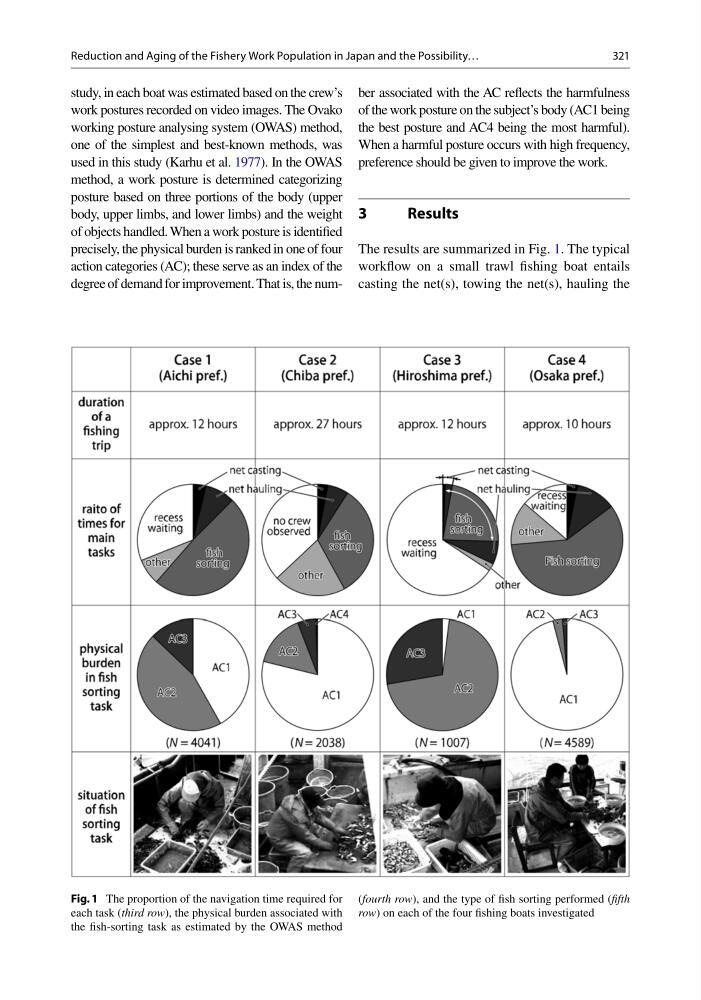
The results are summarized in Fig. 1 . The typical
workfl ow on a small trawl fi shing boat entails
casting the net(s), towing the net(s), hauling the
Fig. 1 The proportion of the navigation time required for
each task ( third row ), the physical burden associated with
the fi sh-sorting task as estimated by the OWAS method
( fourth row ), and the type of fi sh sorting performed ( fi fth
row ) on each of the four fi shing boats investigated
Reduction and Aging of the Fishery Work Population in Japan and the Possibility…
study, in each boat was estimated based on the crew’s
work postures recorded on video images. The Ovako
working posture analysing system (OWAS) method,
one of the simplest and best-known methods, was
used in this study (Karhu et al. 1977 ). In the OWAS
method, a work posture is determined categorizing
posture based on three portions of the body (upper
body, upper limbs, and lower limbs) and the weight
of objects handled. When a work posture is identifi ed
precisely, the physical burden is ranked in one of four
action categories (AC); these serve as an index of the
degree of demand for improvement. That is, the number associated with the AC refl ects the harmfulness
of the work posture on the subject’s body (AC1 being
the best posture and AC4 being the most harmful).
When a harmful posture occurs with high frequency,
preference should be given to improve the work.
3
Results
The results are summarized in Fig. 1 . The typical
workfl ow on a small trawl fi shing boat entails
casting the net(s), towing the net(s), hauling the
Fig. 1 The proportion of the navigation time required for
each task ( third row ), the physical burden associated with
the fi sh-sorting task as estimated by the OWAS method
( fourth row ), and the type of fi sh sorting performed ( fi fth
row ) on each of the four fi shing boats investigated
Reduction and Aging of the Fishery Work Population in Japan and the Possibility…