

312
juvenile nets were used, and the data collected
were integrated into the geographical information system (GIS) and visualized by two- or
three-dimensional images (Tanoue et al. 2007 ).
As a result, it was found that Hachiri-ga-se is an
area where the shallow parts are as shallow as
18 m and where large-scale rapids about 90 m
high spread for over 8 miles (Hamano et al. 2011 )
(Fig. 2 ). It was also shown that behind Hachiriga-se where a branch of the Tsushima Warm
Current fl ows, whirlpools of the back fl ows are
formed, which provide an environment where
larvae and juveniles having only a low swimming
ability are liable to stay (Hamano and Shinagawa
2010 ). In addition, the shallow water depth zones
around the ridges are rich in zooplankton and
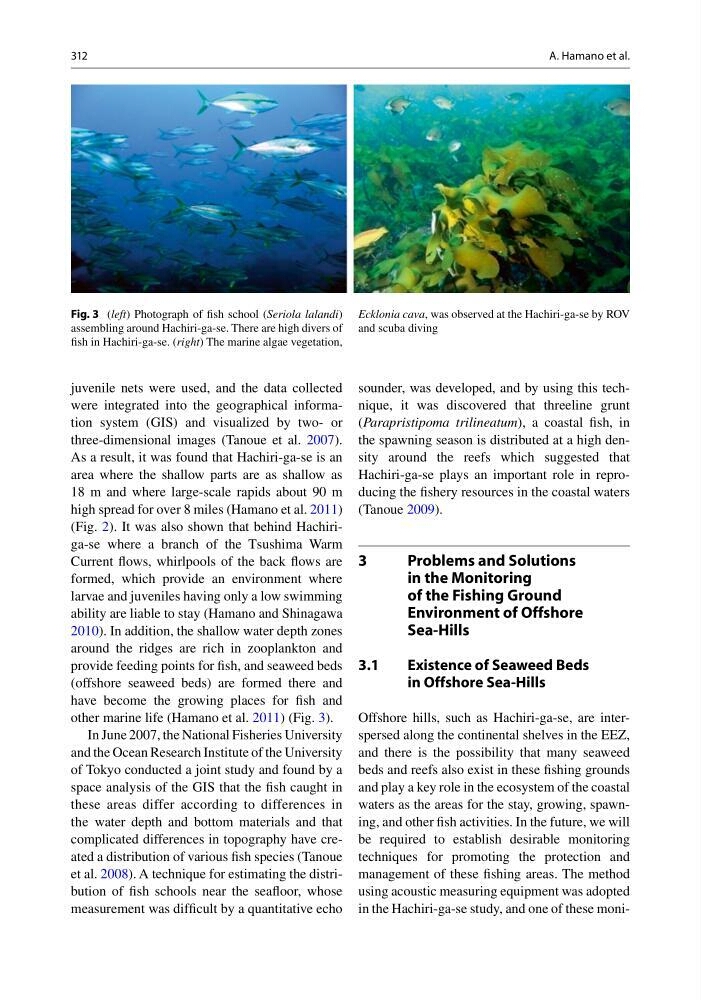
provide feeding points for fi sh, and seaweed beds
(offshore seaweed beds) are formed there and
have become the growing places for fi sh and
other marine life (Hamano et al. 2011 ) (Fig. 3 ).
In June 2007, the National Fisheries University
and the Ocean Research Institute of the University
of Tokyo conducted a joint study and found by a
space analysis of the GIS that the fi sh caught in
these areas differ according to differences in
the water depth and bottom materials and that
complicated differences in topography have created a distribution of various fi sh species (Tanoue
et al. 2008 ). A technique for estimating the distribution of fi sh schools near the seafl oor, whose
measurement was diffi cult by a quantitative echo
sounder, was developed, and by using this technique, it was discovered that threeline grunt
( Parapristipoma trilineatum ), a coastal fi sh, in
the spawning season is distributed at a high density around the reefs which suggested that
Hachiri-ga-se plays an important role in reproducing the fi shery resources in the coastal waters
(Tanoue 2009 ).
3
Problems and Solutions
in the Monitoring
of the Fishing Ground
Environment of Offshore
Sea-Hills
3.1
Existence of Seaweed Beds
in Offshore Sea-Hills
Offshore hills, such as Hachiri-ga-se, are interspersed along the continental shelves in the EEZ,
and there is the possibility that many seaweed
beds and reefs also exist in these fi shing grounds
and play a key role in the ecosystem of the coastal
waters as the areas for the stay, growing, spawning, and other fi sh activities. In the future, we will
be required to establish desirable monitoring
techniques for promoting the protection and
management of these fi shing areas. The method
using acoustic measuring equipment was adopted
in the Hachiri-ga-se study, and one of these moniFig. 3 ( left ) Photograph of fi sh school ( Seriola lalandi )
assembling around Hachiri-ga-se. There are high divers of
fi sh in Hachiri-ga-se. ( right ) The marine algae vegetation,
Ecklonia cava , was observed at the Hachiri-ga-se by ROV
and scuba diving
A. Hamano et al.
juvenile nets were used, and the data collected
were integrated into the geographical information system (GIS) and visualized by two- or
three-dimensional images (Tanoue et al. 2007 ).
As a result, it was found that Hachiri-ga-se is an
area where the shallow parts are as shallow as
18 m and where large-scale rapids about 90 m
high spread for over 8 miles (Hamano et al. 2011 )
(Fig. 2 ). It was also shown that behind Hachiriga-se where a branch of the Tsushima Warm
Current fl ows, whirlpools of the back fl ows are
formed, which provide an environment where
larvae and juveniles having only a low swimming
ability are liable to stay (Hamano and Shinagawa
2010 ). In addition, the shallow water depth zones
around the ridges are rich in zooplankton and
provide feeding points for fi sh, and seaweed beds
(offshore seaweed beds) are formed there and
have become the growing places for fi sh and
other marine life (Hamano et al. 2011 ) (Fig. 3 ).
In June 2007, the National Fisheries University
and the Ocean Research Institute of the University
of Tokyo conducted a joint study and found by a
space analysis of the GIS that the fi sh caught in
these areas differ according to differences in
the water depth and bottom materials and that
complicated differences in topography have created a distribution of various fi sh species (Tanoue
et al. 2008 ). A technique for estimating the distribution of fi sh schools near the seafl oor, whose
measurement was diffi cult by a quantitative echo
sounder, was developed, and by using this technique, it was discovered that threeline grunt
( Parapristipoma trilineatum ), a coastal fi sh, in
the spawning season is distributed at a high density around the reefs which suggested that
Hachiri-ga-se plays an important role in reproducing the fi shery resources in the coastal waters
(Tanoue 2009 ).
3
Problems and Solutions
in the Monitoring
of the Fishing Ground
Environment of Offshore
Sea-Hills
3.1
Existence of Seaweed Beds
in Offshore Sea-Hills
Offshore hills, such as Hachiri-ga-se, are interspersed along the continental shelves in the EEZ,
and there is the possibility that many seaweed
beds and reefs also exist in these fi shing grounds
and play a key role in the ecosystem of the coastal
waters as the areas for the stay, growing, spawning, and other fi sh activities. In the future, we will
be required to establish desirable monitoring
techniques for promoting the protection and
management of these fi shing areas. The method
using acoustic measuring equipment was adopted
in the Hachiri-ga-se study, and one of these moniFig. 3 ( left ) Photograph of fi sh school ( Seriola lalandi )
assembling around Hachiri-ga-se. There are high divers of
fi sh in Hachiri-ga-se. ( right ) The marine algae vegetation,
Ecklonia cava , was observed at the Hachiri-ga-se by ROV
and scuba diving
A. Hamano et al.