

232
4
Conclusion
Different methods have been developed to
assess losses and gains related to biodiversity
offsets. Despite the use of common factors
(distinctiveness, condition, surface occupied by
the species/habitat impacted, risk associated
with the restoration technique used, time
discount rate) to size ecological mitigation
projects, very few software have emerged.
The use of consistent and robust methods has
been widespread through this type of user- friendly
devices combining accessibility and transparency.
The main interest of HEA method is to try to
provide a rational and reproducible process,
based on simple and accessible data even for a
“nonexpert” public. The use of an “integrator” or
systemic proxy allows, with little fi nancial means
or techniques, to obtain (prior to the project)
knowledge about the impact expected, and therefore what could be the compensatory mitigation
surfaces and project to implement for a “fair”
compensation: no more but also no less (Strange
et al. 2002 ; Zafonte and Hampton 2007 ). The
goal is obviously to choose the best alternative
project, with less impact to the environment.
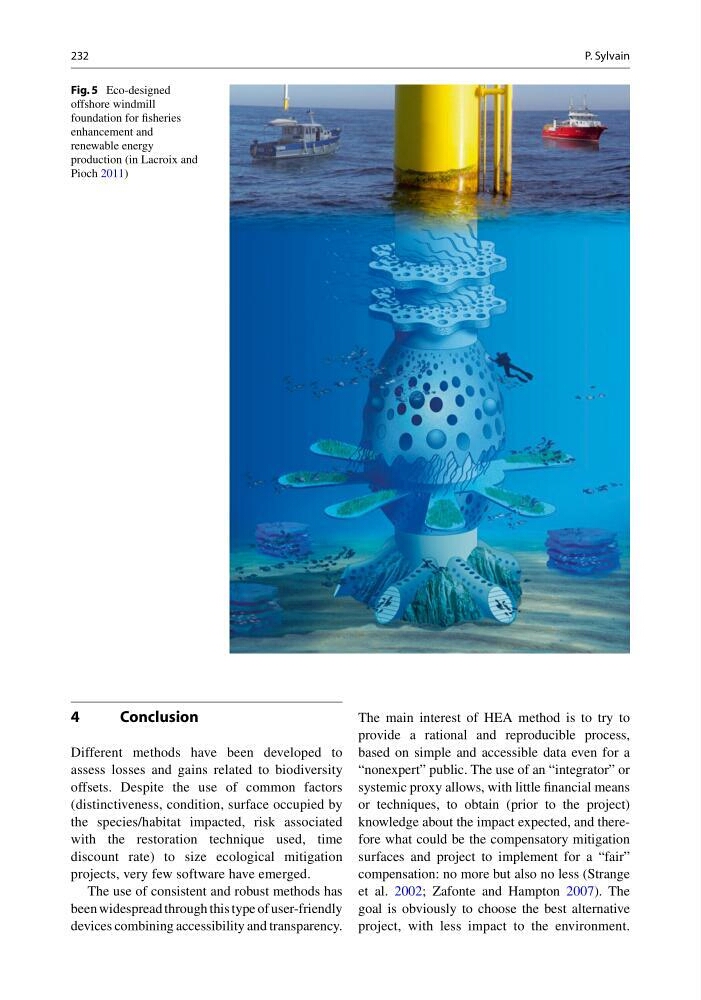
Fig. 5 Eco-designed
offshore windmill
foundation for fi sheries
enhancement and
renewable energy
production (in Lacroix and
Pioch 2011 )
P. Sylvain
4
Conclusion
Different methods have been developed to
assess losses and gains related to biodiversity
offsets. Despite the use of common factors
(distinctiveness, condition, surface occupied by
the species/habitat impacted, risk associated
with the restoration technique used, time
discount rate) to size ecological mitigation
projects, very few software have emerged.
The use of consistent and robust methods has
been widespread through this type of user- friendly
devices combining accessibility and transparency.
The main interest of HEA method is to try to
provide a rational and reproducible process,
based on simple and accessible data even for a
“nonexpert” public. The use of an “integrator” or
systemic proxy allows, with little fi nancial means
or techniques, to obtain (prior to the project)
knowledge about the impact expected, and therefore what could be the compensatory mitigation
surfaces and project to implement for a “fair”
compensation: no more but also no less (Strange
et al. 2002 ; Zafonte and Hampton 2007 ). The
goal is obviously to choose the best alternative
project, with less impact to the environment.
Fig. 5 Eco-designed
offshore windmill
foundation for fi sheries
enhancement and
renewable energy
production (in Lacroix and
Pioch 2011 )
P. Sylvain